About this artwork
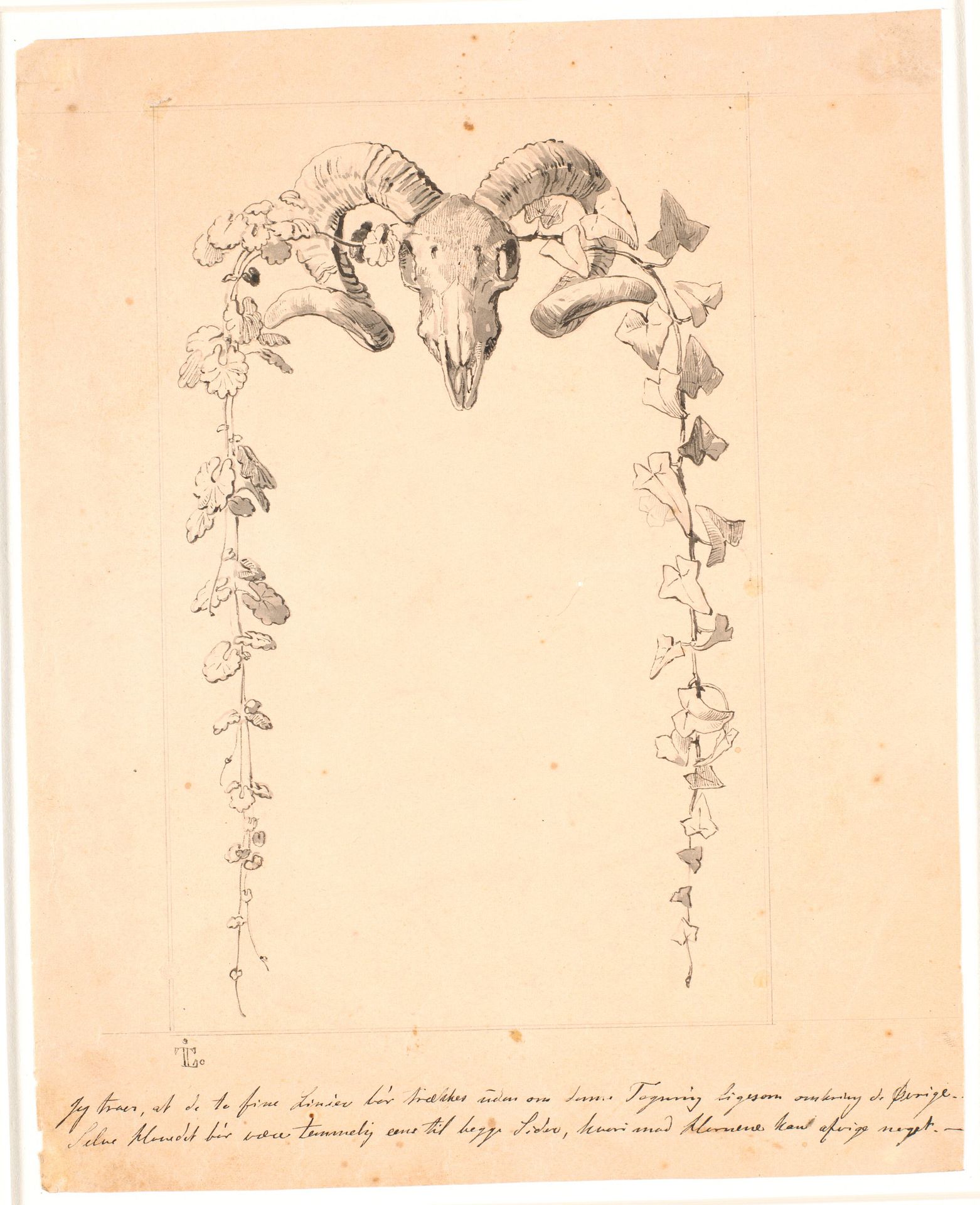
Editor: So, this is "Titelvignet til Kaalunds 'Fabler for Børn,'" created in 1843 by Johan Thomas Lundbye. It's an ink drawing on paper, and the image is dominated by what appears to be a ram skull surrounded by vines. There’s something very delicate, yet macabre, about it. What do you see in this piece? Curator: Immediately, I am struck by the artist's engagement with materials and their symbolic weight. Lundbye uses ink, a readily available and relatively inexpensive medium, to depict a ram's skull—a symbol often associated with vanitas and the ephemeral nature of life. Why choose this combination of accessible materials to represent something so historically charged and loaded? Editor: I hadn’t thought about it that way. I suppose I saw the skull more as just a visual motif, without considering the impact of ink and paper themselves. Curator: Consider how the mass production of paper and ink in the 19th century impacted the accessibility of art and the dissemination of ideas. Could Lundbye be making a comment about the democratization of knowledge, even in the face of mortality? Or perhaps on Romanticism's commercial appeal through the darkly sublime imagery of death, which in turn commodifies even melancholy. The deliberate selection of common materials encourages us to look at the means of production behind this image. Editor: That’s fascinating. The choice of medium becomes less about artistic expression in the traditional sense, and more about communicating with the social fabric of the time. Curator: Precisely. By using ubiquitous materials, Lundbye challenges the separation between "high art" and everyday experience. Editor: It’s almost like the skull itself is secondary to the statement made by the ink and paper. I’ll definitely think more about the social context of materials moving forward.
Titelvignet til Kaalunds "Fabler for Børn". Se kommentar fra arkkatalog.
1843


Artwork details
- Medium
- drawing, paper, ink
- Dimensions
- 242 mm (height) x 194 mm (width) (bladmaal)
- Location
- SMK - Statens Museum for Kunst
Tags
Comments
Share your thoughts
About this artwork
Editor: So, this is "Titelvignet til Kaalunds 'Fabler for Børn,'" created in 1843 by Johan Thomas Lundbye. It's an ink drawing on paper, and the image is dominated by what appears to be a ram skull surrounded by vines. There’s something very delicate, yet macabre, about it. What do you see in this piece? Curator: Immediately, I am struck by the artist's engagement with materials and their symbolic weight. Lundbye uses ink, a readily available and relatively inexpensive medium, to depict a ram's skull—a symbol often associated with vanitas and the ephemeral nature of life. Why choose this combination of accessible materials to represent something so historically charged and loaded? Editor: I hadn’t thought about it that way. I suppose I saw the skull more as just a visual motif, without considering the impact of ink and paper themselves. Curator: Consider how the mass production of paper and ink in the 19th century impacted the accessibility of art and the dissemination of ideas. Could Lundbye be making a comment about the democratization of knowledge, even in the face of mortality? Or perhaps on Romanticism's commercial appeal through the darkly sublime imagery of death, which in turn commodifies even melancholy. The deliberate selection of common materials encourages us to look at the means of production behind this image. Editor: That’s fascinating. The choice of medium becomes less about artistic expression in the traditional sense, and more about communicating with the social fabric of the time. Curator: Precisely. By using ubiquitous materials, Lundbye challenges the separation between "high art" and everyday experience. Editor: It’s almost like the skull itself is secondary to the statement made by the ink and paper. I’ll definitely think more about the social context of materials moving forward.
Comments
Share your thoughts