About this artwork
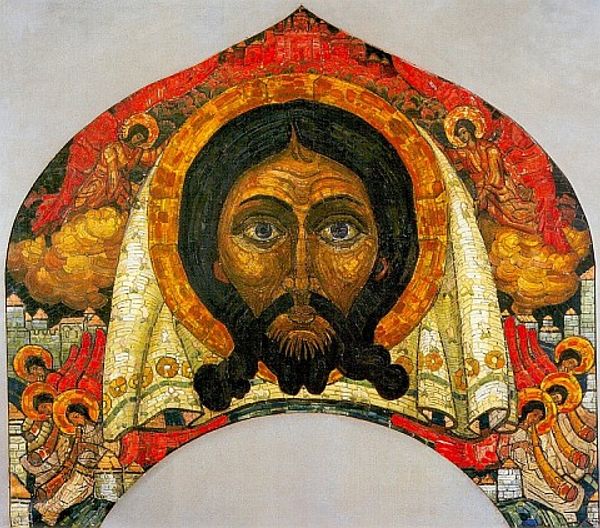
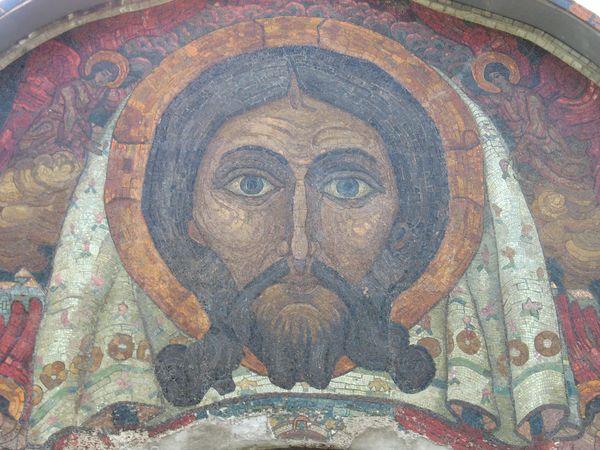
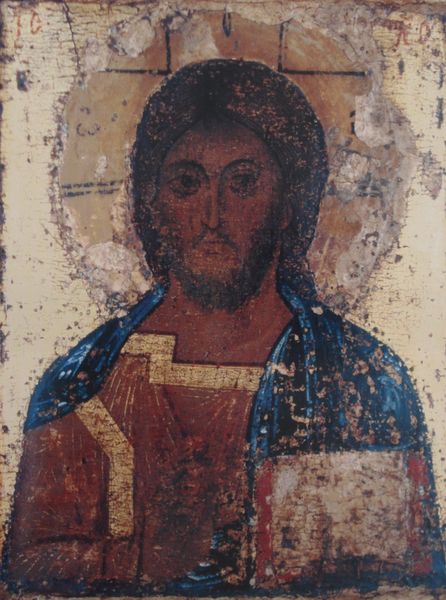
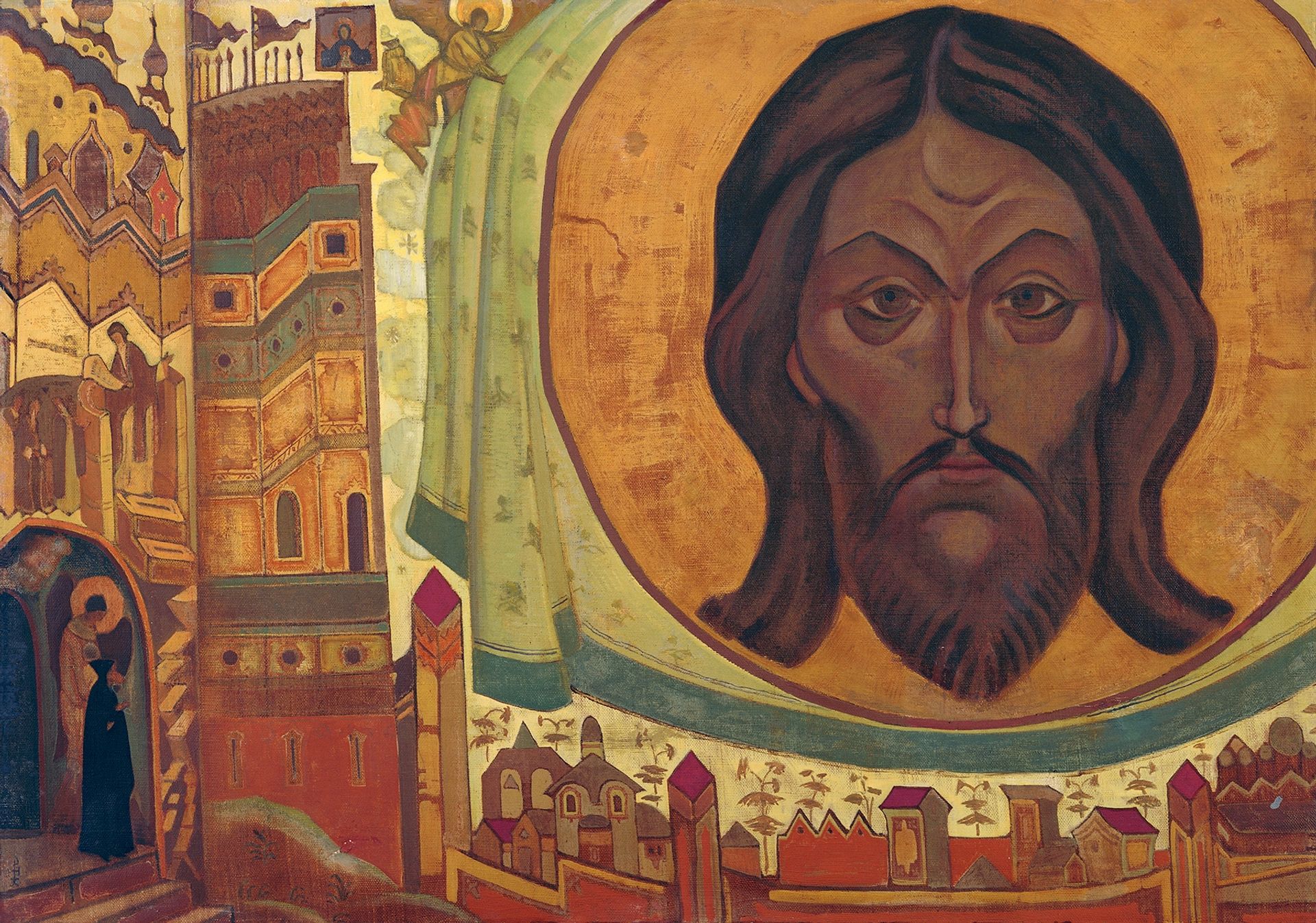
Editor: Here we have Nicholas Roerich’s "And we see," created in 1922. It's currently housed at the Roerich Museum in Moscow. What immediately strikes me is how the religious iconography is presented in such a modern, almost abstracted style. What's your interpretation of this work? Curator: It’s a powerful piece. When I look at "And we see," I see a bridge, really, between historical oppression and the promise of spiritual liberation. Roerich, with his deep interest in Eastern philosophy and theosophy, is situating this traditional image of Christ within a context of social change and a call for peace. The somewhat flattened, almost iconographic representation of Christ, juxtaposed with the stylized cityscapes, brings forward questions about whose voices are heard in times of societal upheaval and who dictates the narrative. What is Christ “seeing,” and more importantly, who *are* "we"? Editor: I hadn't considered the perspective like that before. The question "who are we" changes my entire view. The gaze seems so intent and critical. It makes me feel unsettled. Curator: Exactly! The gaze challenges us to consider our own complicity within larger power structures. Roerich’s placement of Christ feels almost confrontational. Are we living up to the ideals espoused? Are we truly working towards a more just world, or are we passively complicit in systems of oppression? The symbol, rooted in devotion, prompts critical self-reflection about social justice. Does that shift your understanding? Editor: It does. It moves it from a historical religious painting into a present day call to action. I see it less as a religious scene, and more as a statement. Curator: Precisely! And seeing it as a statement—a demand even—opens up space for critical dialogues. Editor: Thank you for your analysis, this has provided an eye-opening view. Curator: My pleasure! It is exciting to uncover these dimensions together.

Artwork details
- Dimensions
- 71 x 101.5 cm
- Location
- Roerich Museum, Moscow, Russia
- Copyright
- Public domain
Tags
Comments
Share your thoughts
About this artwork
Editor: Here we have Nicholas Roerich’s "And we see," created in 1922. It's currently housed at the Roerich Museum in Moscow. What immediately strikes me is how the religious iconography is presented in such a modern, almost abstracted style. What's your interpretation of this work? Curator: It’s a powerful piece. When I look at "And we see," I see a bridge, really, between historical oppression and the promise of spiritual liberation. Roerich, with his deep interest in Eastern philosophy and theosophy, is situating this traditional image of Christ within a context of social change and a call for peace. The somewhat flattened, almost iconographic representation of Christ, juxtaposed with the stylized cityscapes, brings forward questions about whose voices are heard in times of societal upheaval and who dictates the narrative. What is Christ “seeing,” and more importantly, who *are* "we"? Editor: I hadn't considered the perspective like that before. The question "who are we" changes my entire view. The gaze seems so intent and critical. It makes me feel unsettled. Curator: Exactly! The gaze challenges us to consider our own complicity within larger power structures. Roerich’s placement of Christ feels almost confrontational. Are we living up to the ideals espoused? Are we truly working towards a more just world, or are we passively complicit in systems of oppression? The symbol, rooted in devotion, prompts critical self-reflection about social justice. Does that shift your understanding? Editor: It does. It moves it from a historical religious painting into a present day call to action. I see it less as a religious scene, and more as a statement. Curator: Precisely! And seeing it as a statement—a demand even—opens up space for critical dialogues. Editor: Thank you for your analysis, this has provided an eye-opening view. Curator: My pleasure! It is exciting to uncover these dimensions together.
Comments
Share your thoughts