About this artwork
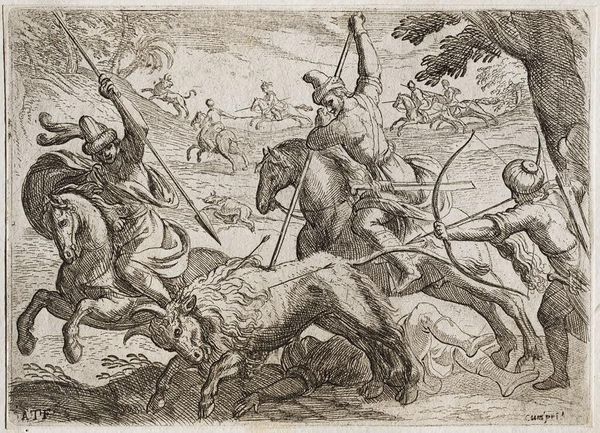
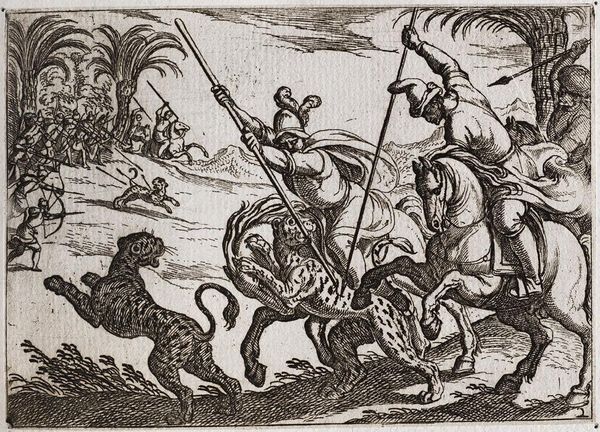
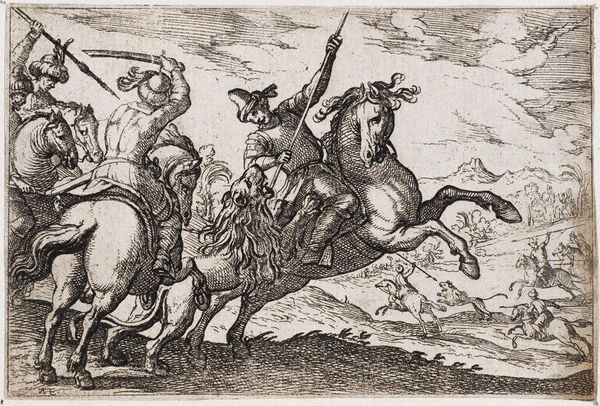
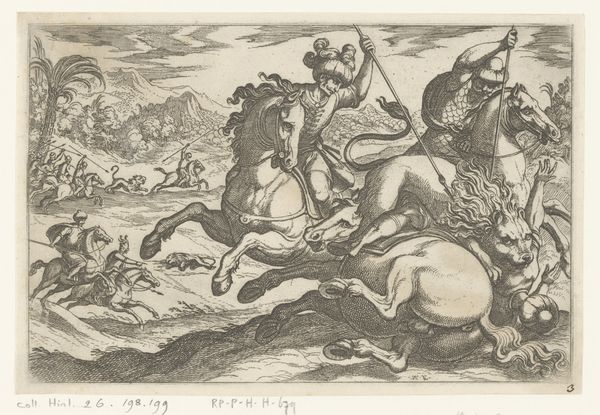
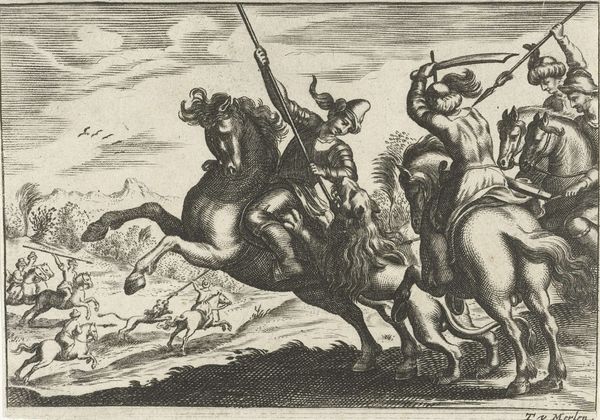
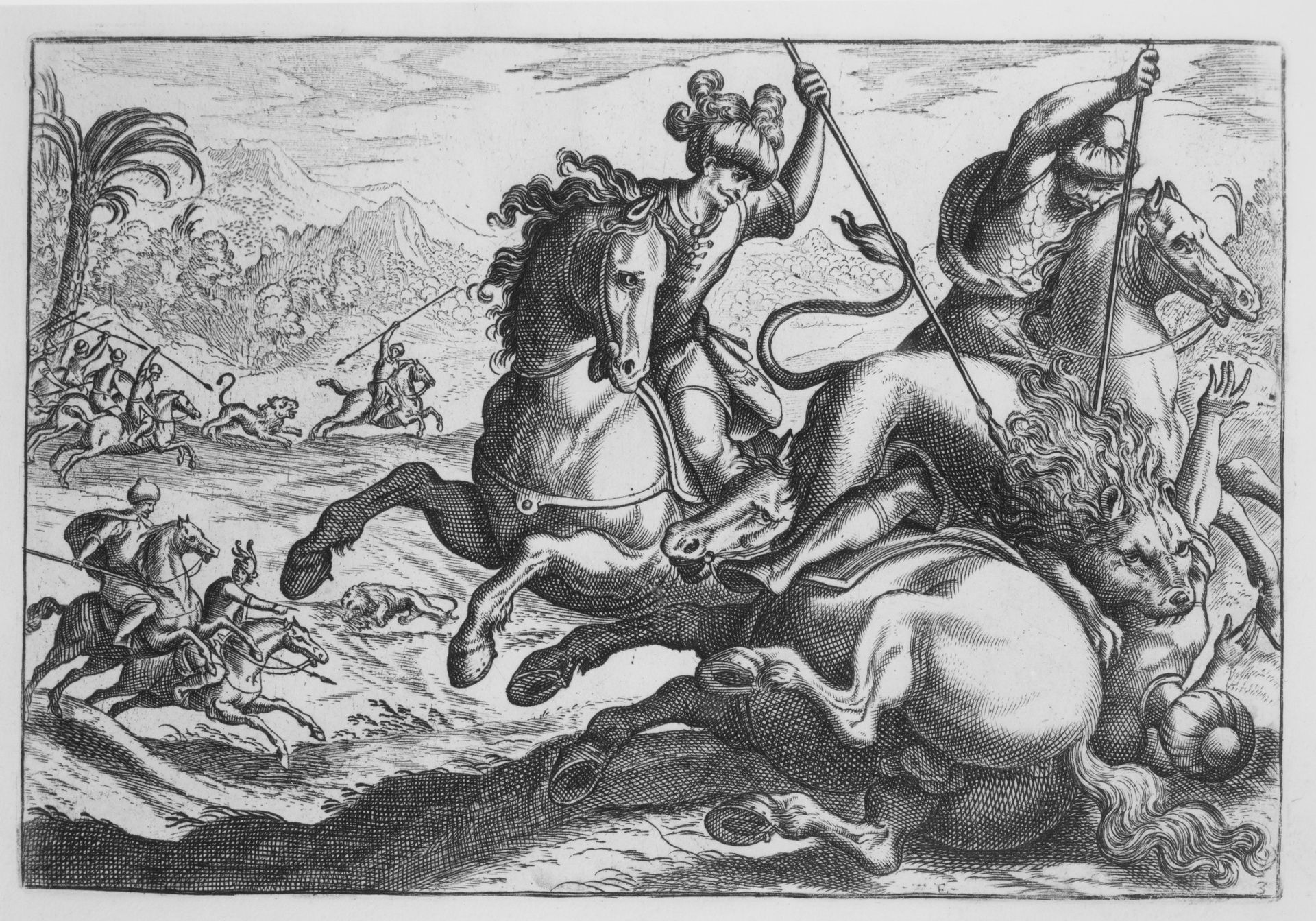
Curator: This etching, titled 'Lion Hunt, from 'Hunting Scenes IV'," was created by Antonio Tempesta sometime between 1595 and 1630. It is a rather dramatic piece. Editor: It’s brutal, immediately striking with its stark contrast and dynamic composition. You can almost hear the horses screaming! Curator: The landscape sets a distant stage for this hunting scene, wouldn’t you agree? We have mounted figures, some with spears at the ready, piercing lions; the overall effect conveys action and violence. I wonder about the audience for whom Tempesta created this print, and how its imagery may have resonated politically. Editor: Notice the horses’ contorted bodies, their muscles flexed to the maximum in this moment. Even in a static image, one gets the sensation of rapid movement, intensified by Tempesta’s use of densely packed lines to build form. The image is busy, every inch is etched. Curator: That density certainly lends the work a certain drama, a certain visual weight that speaks to its subject matter. One might explore its origins as a print and how multiple copies circulated within 17th-century social circles. Was its primary function decorative or did it serve some additional propaganda for the nobility of that period? Editor: There’s definitely a Baroque flair in that theatrical intensity. Tempesta’s technical mastery is evident; how he’s transformed a rather base act—hunting—into something epic. Even the distant landscape plays its part, filled with turmoil, with churning details and varied textures. The foreground feels chaotic while the distant scenes feature a sort of patterned rhythm. Curator: Looking at the labor involved in producing such an intricately detailed print allows me to contemplate art in early modern Europe as a form of specialized, often collaborative craft production within workshops. The economic exchanges, material supplies—it presents a perspective beyond just artistic expression. Editor: Precisely. And within this controlled chaos, the central lion’s eye glints back, as if saying that all violence has meaning in the order of creation. Curator: Thinking about how prints, as reproducible media, were consumed and traded encourages me to appreciate Tempesta's position as a visual chronicler for a specific era. Editor: In this regard, "Lion Hunt" allows us to explore historical conceptions of nature, of humankind's place in the world, or even, the dynamics of human conflict.
Lion Hunt, from 'Hunting Scenes IV' 1595 - 1630


Artwork details
- Medium
- drawing, print, etching, engraving
- Dimensions
- Sheet: 7 9/16 × 10 7/8 in. (19.2 × 27.7 cm) Plate: 5 3/16 × 7 13/16 in. (13.2 × 19.8 cm)
- Location
- Metropolitan Museum of Art, New York, NY
- Copyright
- Public Domain
Tags
drawing
baroque
etching
landscape
figuration
horse
men
history-painting
engraving
Comments
No comments
About this artwork
Curator: This etching, titled 'Lion Hunt, from 'Hunting Scenes IV'," was created by Antonio Tempesta sometime between 1595 and 1630. It is a rather dramatic piece. Editor: It’s brutal, immediately striking with its stark contrast and dynamic composition. You can almost hear the horses screaming! Curator: The landscape sets a distant stage for this hunting scene, wouldn’t you agree? We have mounted figures, some with spears at the ready, piercing lions; the overall effect conveys action and violence. I wonder about the audience for whom Tempesta created this print, and how its imagery may have resonated politically. Editor: Notice the horses’ contorted bodies, their muscles flexed to the maximum in this moment. Even in a static image, one gets the sensation of rapid movement, intensified by Tempesta’s use of densely packed lines to build form. The image is busy, every inch is etched. Curator: That density certainly lends the work a certain drama, a certain visual weight that speaks to its subject matter. One might explore its origins as a print and how multiple copies circulated within 17th-century social circles. Was its primary function decorative or did it serve some additional propaganda for the nobility of that period? Editor: There’s definitely a Baroque flair in that theatrical intensity. Tempesta’s technical mastery is evident; how he’s transformed a rather base act—hunting—into something epic. Even the distant landscape plays its part, filled with turmoil, with churning details and varied textures. The foreground feels chaotic while the distant scenes feature a sort of patterned rhythm. Curator: Looking at the labor involved in producing such an intricately detailed print allows me to contemplate art in early modern Europe as a form of specialized, often collaborative craft production within workshops. The economic exchanges, material supplies—it presents a perspective beyond just artistic expression. Editor: Precisely. And within this controlled chaos, the central lion’s eye glints back, as if saying that all violence has meaning in the order of creation. Curator: Thinking about how prints, as reproducible media, were consumed and traded encourages me to appreciate Tempesta's position as a visual chronicler for a specific era. Editor: In this regard, "Lion Hunt" allows us to explore historical conceptions of nature, of humankind's place in the world, or even, the dynamics of human conflict.
Comments
No comments