About this artwork
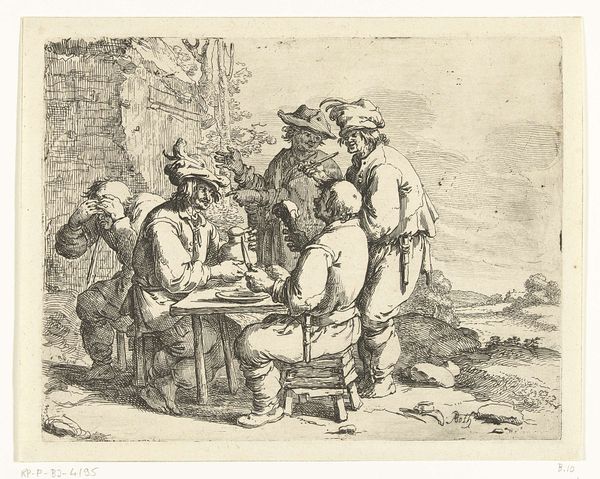
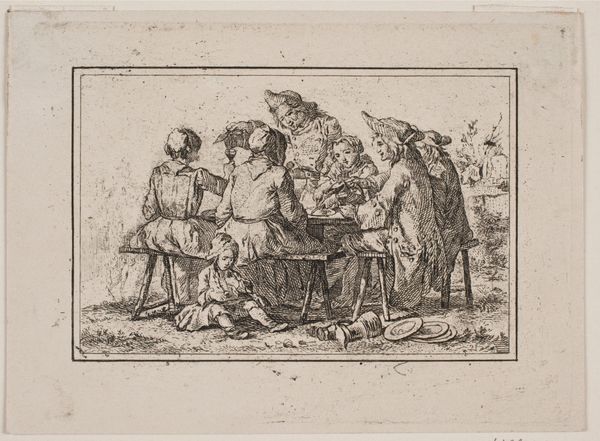
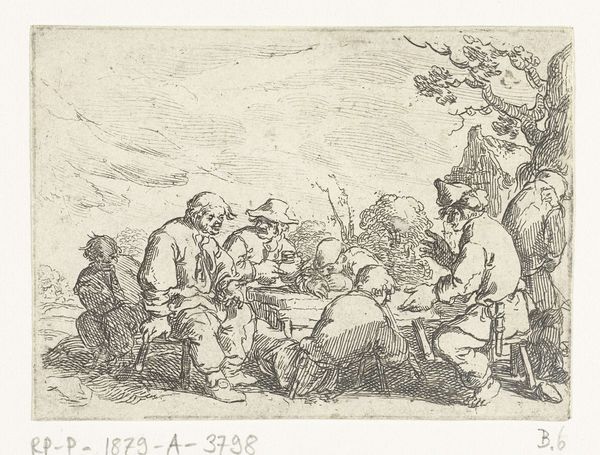
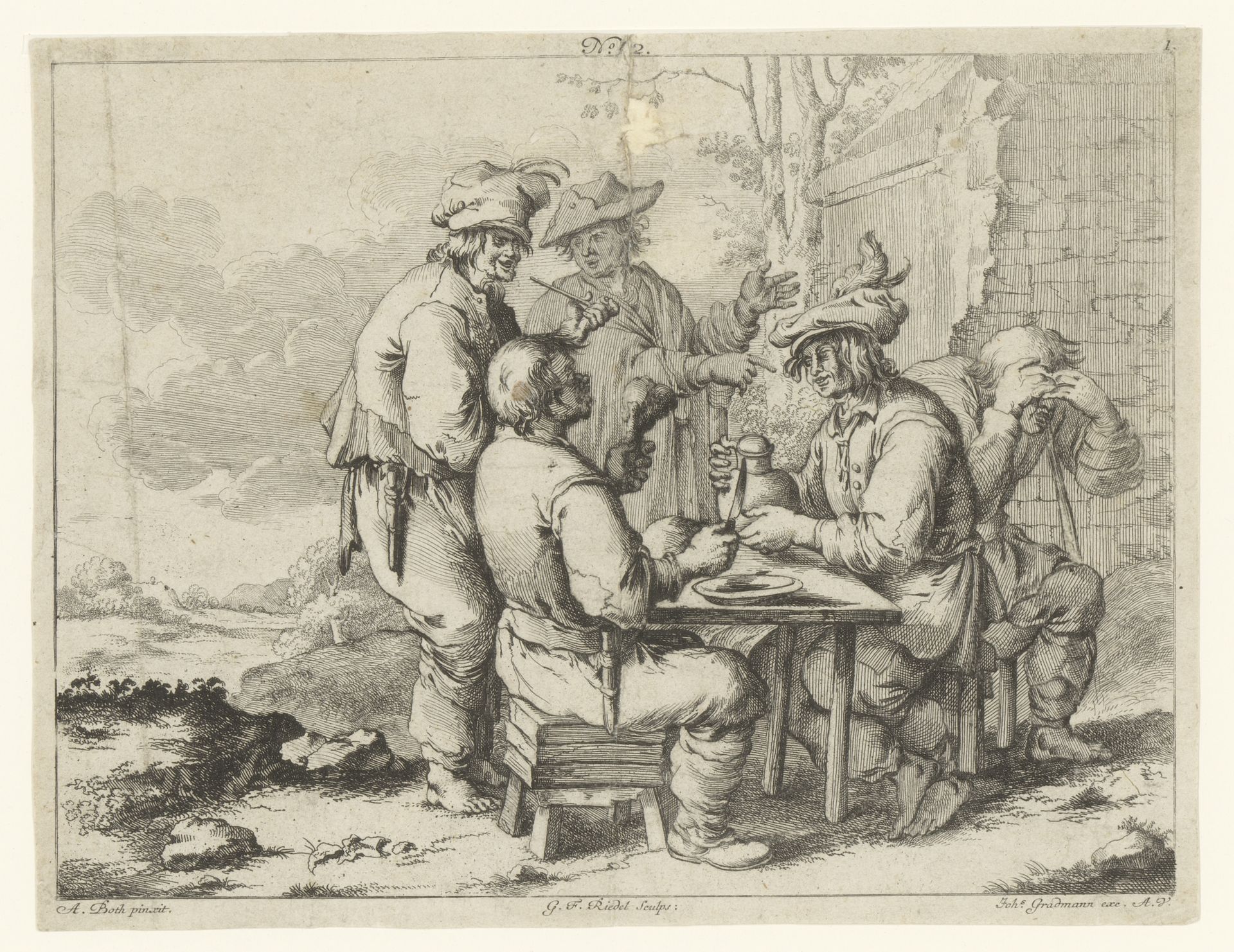
This is Gottlieb Friedrich Riedel's etching titled "Five Peasants at a Table Outdoors." Although undated, it presents us with a fascinating interplay of form and social commentary. The composition is immediately striking. Riedel uses line and form to direct our gaze. The figures are grouped tightly around the table, creating a sense of intimacy but also constraint, which contrasts with the open landscape in the background. Note how the artist uses hatching and cross-hatching to create depth and texture, particularly in the peasants' clothing. The scene suggests a moment of leisure, yet the men's gestures and expressions hint at something more complex. This element is typical of the artist's period, where seemingly simple genre scenes often carried deeper social or moral messages. By using a precise linear structure, Riedel creates a complex tableau that invites viewers to unpack its multiple layers of meaning. The print is not just an aesthetic experience but also an intellectual puzzle that encourages interpretation and debate.
Vijf boeren aan tafel in de buitenlucht c. 1734 - 1784

Gottlieb Friedrich Riedel
1724 - 1784Location
RijksmuseumArtwork details
- Medium
- print, etching
- Dimensions
- height 177 mm, width 231 mm
- Location
- Rijksmuseum
- Copyright
- Rijks Museum: Open Domain
Tags
ink drawing
baroque
etching
group-portraits
genre-painting
Comments
No comments
About this artwork
This is Gottlieb Friedrich Riedel's etching titled "Five Peasants at a Table Outdoors." Although undated, it presents us with a fascinating interplay of form and social commentary. The composition is immediately striking. Riedel uses line and form to direct our gaze. The figures are grouped tightly around the table, creating a sense of intimacy but also constraint, which contrasts with the open landscape in the background. Note how the artist uses hatching and cross-hatching to create depth and texture, particularly in the peasants' clothing. The scene suggests a moment of leisure, yet the men's gestures and expressions hint at something more complex. This element is typical of the artist's period, where seemingly simple genre scenes often carried deeper social or moral messages. By using a precise linear structure, Riedel creates a complex tableau that invites viewers to unpack its multiple layers of meaning. The print is not just an aesthetic experience but also an intellectual puzzle that encourages interpretation and debate.
Comments
No comments