painting, oil-paint
#
portrait
#
painting
#
oil-paint
#
oil painting
#
group-portraits
#
naive art
#
genre-painting
#
realism
Copyright: Norman Rockwell,Fair Use
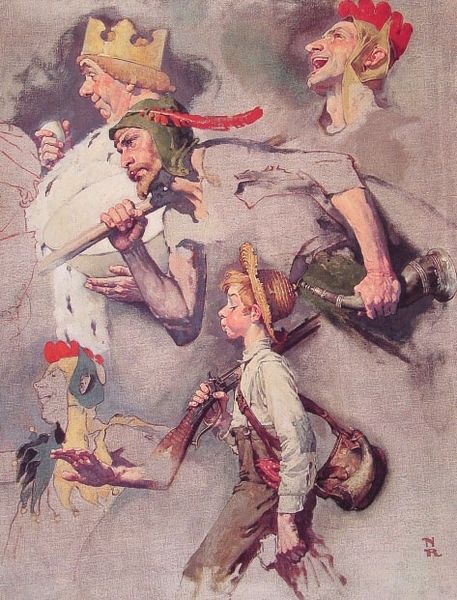
Curator: We are looking at Norman Rockwell's "A Family Tree," an oil painting completed in 1959. It depicts, quite literally, a family genealogy. Editor: Immediately, the image strikes me as…quirky, almost humorous. The arrangement of heads floating amidst branches is a bit unsettling but also fascinating. The light sepia tones give it an aged, almost antiquated feel. Curator: Rockwell painted this at a pivotal point in American history, following post-war boom. The fascination with ancestry was gaining ground in popularity, particularly among middle-class families. The work appeared on the cover of "Family Circle" magazine, demonstrating Rockwell's continued contribution to mass media. Editor: But who’s family is this supposed to be? Or is this perhaps meant as a representation of the broader American lineage, rooted in colonialism and immigration? Look at the inclusion of Indigenous people represented amidst all these various European portraits and consider this through a lens of power dynamics. How are historical narratives constructed through imagery like this? Curator: Rockwell’s paintings often embody this sense of idealized American life. His commissions frequently represented national events. In “A Family Tree” there are specific moments visualized: immigration ships, colonial battle scenes, images that depict generations unfolding from its ancestral base up through to a modern redhead! The tree is used here to present continuity between then and now. Editor: It’s definitely an interesting juxtaposition. I find myself dwelling on the way the ancestral figures appear almost theatrical in their historical garb; particularly in light of Rockwell's overall project as an illustrator catering to widespread sentiments during the era. One could question how this nostalgia either affirms or undermines the social order and mythologies surrounding American progress. What narrative is perpetuated through visualizing specific types of figures? Curator: In essence, “A Family Tree” allows us to unpack the broader social narratives surrounding ancestry. It challenges viewers to reflect critically about the values we inherit, perpetuate, and sometimes need to rethink. Editor: Exactly, it provides a potent space to contemplate themes like identity, legacy, and the intricate socio-political influences shaping our perception of history and ourselves.
Comments
No comments
Be the first to comment and join the conversation on the ultimate creative platform.
 Collect
 React
React Comment
More like this