About this artwork
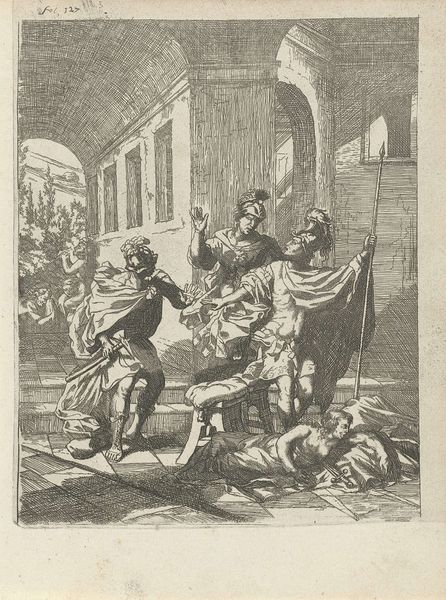
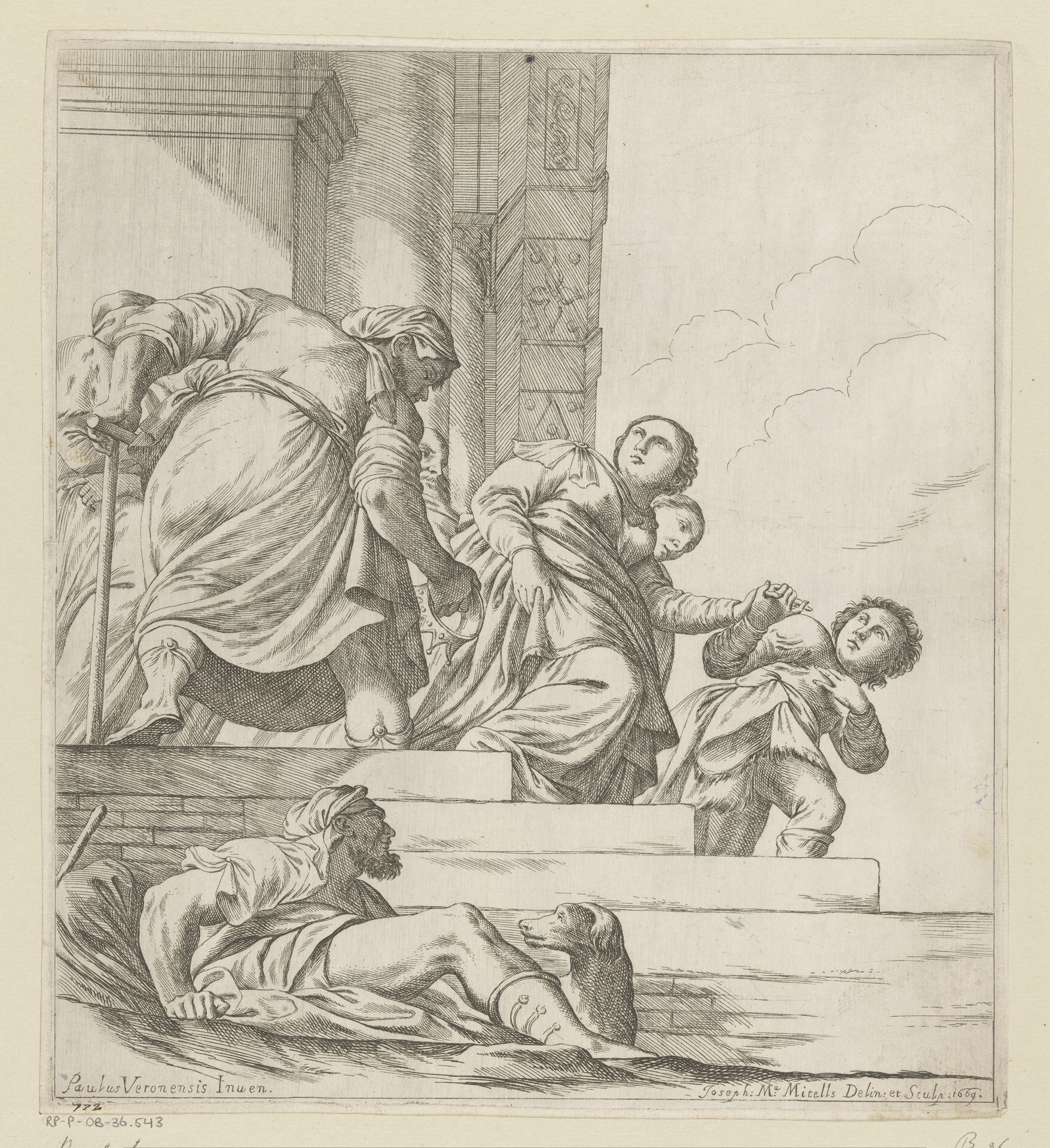
Editor: This is "Koningin Vashti wordt verbannen," or "Queen Vashti Being Banished," an engraving by Giuseppe Maria Mitelli, from 1669. The composition is striking, how Vashti is literally descending, cast out of the architectural space. What's your take on this piece? Curator: Mitelli's print gives us an opportunity to consider the representation of female power, and its forceful removal, in 17th-century art. Think of the story of Vashti, who refused to be displayed as a spectacle to the King's banquet guests. How might this act of defiance be seen as a proto-feminist stance? Editor: That's a really interesting point. So, you're saying Vashti’s refusal is more than just disobedience? Curator: Precisely. It's about agency and the right to self-determination. And, if we bring in a contemporary lens, we can analyze the visual language Mitelli employs. Notice how the bodies of the male figures seem so solid, in contrast with the frenzied gestures of the group surrounding Vashti, whose faces appear to plead with an averted gaze toward the heavens, not the authoritative figure? How does that contribute to a narrative about power dynamics and the suppression of female voice? Editor: It’s almost like the banishment is staged, an intentional spectacle meant to reinforce the King's power. Curator: Absolutely! And, by examining this work through the frameworks of gender, power, and representation, we start to unearth layers of meaning relevant to current social dialogues. What are your thoughts now? Editor: It’s fascinating to see how historical artworks can speak to contemporary issues. I’ll definitely be looking at art with these questions of gender and power in mind.

Artwork details
- Medium
- print, engraving
- Dimensions
- height 333 mm, width 297 mm
- Location
- Rijksmuseum
- Copyright
- Rijks Museum: Open Domain
Tags
portrait
light pencil work
narrative-art
baroque
pen sketch
pencil sketch
figuration
personal sketchbook
sketchwork
pen-ink sketch
line
sketchbook drawing
pencil work
history-painting
storyboard and sketchbook work
sketchbook art
engraving
Comments
No comments
About this artwork
Editor: This is "Koningin Vashti wordt verbannen," or "Queen Vashti Being Banished," an engraving by Giuseppe Maria Mitelli, from 1669. The composition is striking, how Vashti is literally descending, cast out of the architectural space. What's your take on this piece? Curator: Mitelli's print gives us an opportunity to consider the representation of female power, and its forceful removal, in 17th-century art. Think of the story of Vashti, who refused to be displayed as a spectacle to the King's banquet guests. How might this act of defiance be seen as a proto-feminist stance? Editor: That's a really interesting point. So, you're saying Vashti’s refusal is more than just disobedience? Curator: Precisely. It's about agency and the right to self-determination. And, if we bring in a contemporary lens, we can analyze the visual language Mitelli employs. Notice how the bodies of the male figures seem so solid, in contrast with the frenzied gestures of the group surrounding Vashti, whose faces appear to plead with an averted gaze toward the heavens, not the authoritative figure? How does that contribute to a narrative about power dynamics and the suppression of female voice? Editor: It’s almost like the banishment is staged, an intentional spectacle meant to reinforce the King's power. Curator: Absolutely! And, by examining this work through the frameworks of gender, power, and representation, we start to unearth layers of meaning relevant to current social dialogues. What are your thoughts now? Editor: It’s fascinating to see how historical artworks can speak to contemporary issues. I’ll definitely be looking at art with these questions of gender and power in mind.
Comments
No comments