before 1893
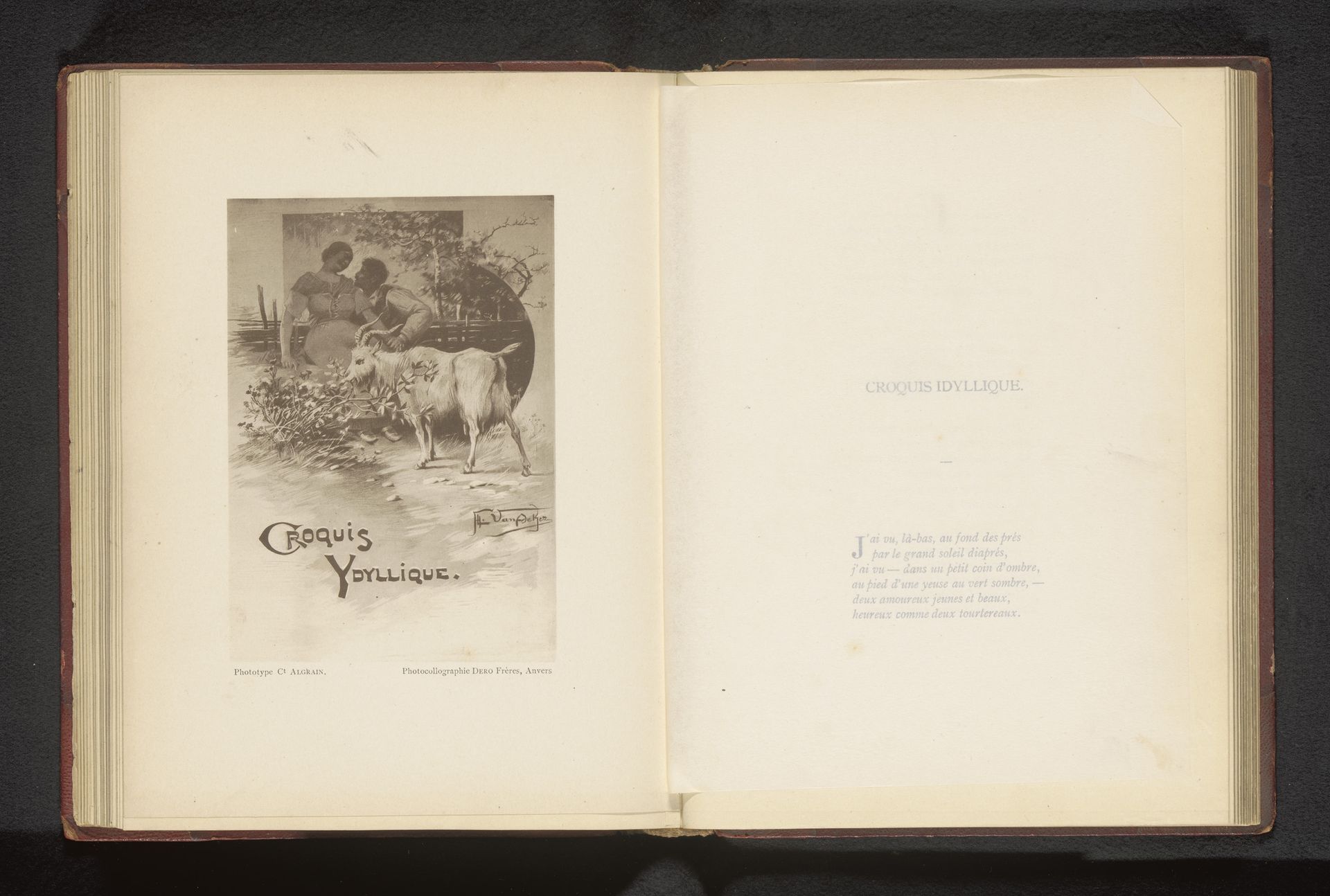
Reproductie van een ontwerp van een montage van twee mensen, een geit en bomen achter een hek door Flori van Acker

Listen to curator's interpretation
Curatorial notes
Editor: This is a reproduction of a montage design, made before 1893 by Flori van Acker, it includes two figures, a goat, and some trees behind a fence, and looks to be a photograph. The monochromatic tones create a subdued pastoral feeling, yet the figures are ambiguous. How might we interpret the composition of these diverse elements, considering van Acker's approach to form and structure? Curator: Observe how the arrangement leans on established formal elements: the curved framing device contains the primary scene, creating an oval window through which the eye enters. The figures and goat are carefully arranged to create a balanced, yet dynamic tableau. Notice the fence, trees, and figures establish a series of horizontal lines that suggest depth, contrasting with the upright goat. Are the two figures arranged symmetrically, as mirror images, or do they exhibit a gradient, and does this contribute to meaning? Editor: They are definitely asymmetrical! One is seated; the other leans over. What does the absence of symmetry communicate, do you think? Curator: Perhaps asymmetry signals a transition. If we understand it as a moment of shifting within a controlled environment, like that offered by landscape traditions, does the inclusion of a goat alter the balance between those human actors and nature? It's not merely a snapshot; it's carefully constructed. We must evaluate how such manipulations signify artistic intention. How would you contrast the texture within the oval scene, in the foliage and on the animal, against the pure whiteness of the space around the montage? Editor: It does set off the picture and draw you in, it's very neat. This has shown me a more deliberate and conscious choice-making with even an imagined rural tableau, especially if one looks for compositional and material meaning. Curator: Indeed. Understanding these structures grants us access to the rich dialogues Van Acker established within this reproduction.