About this artwork
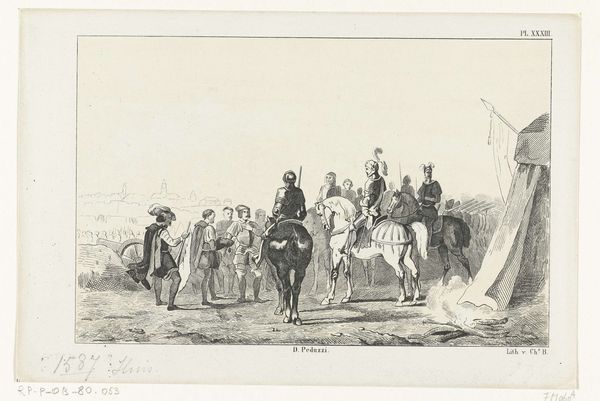
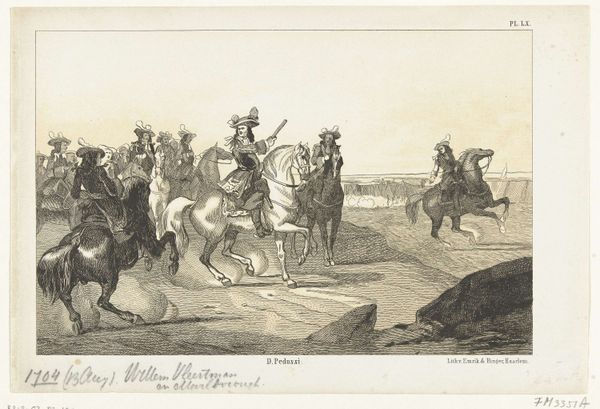
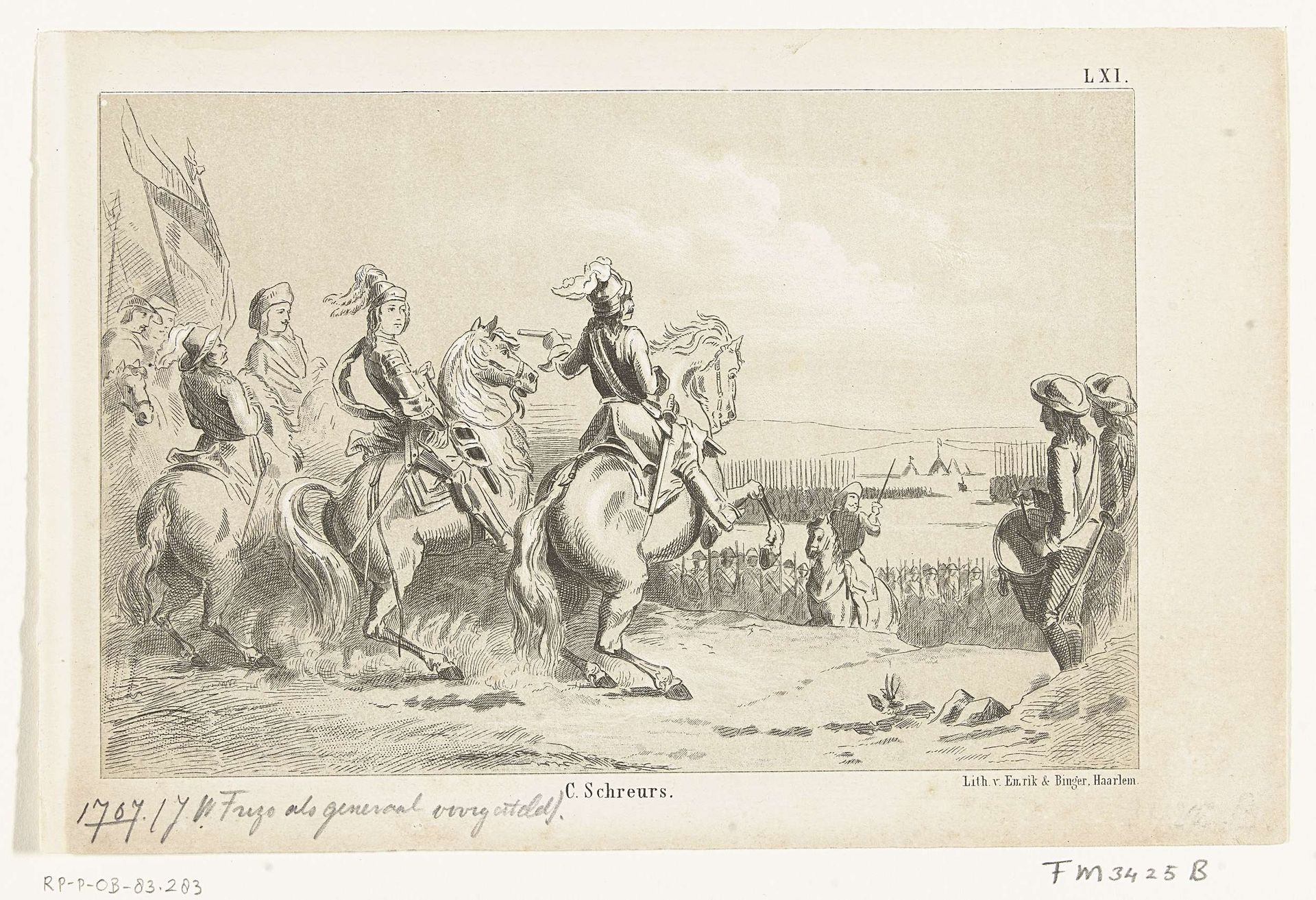
Curator: Looking at this engraving, "Johan Willem Friso als generaal voorgesteld" created between 1853 and 1861, what's your immediate reaction? Editor: The composition feels rather theatrical, almost staged. It certainly gives off a formal vibe. Curator: I agree. Considering its later creation, we can reflect on how 19th-century printmakers interpreted and disseminated history, shaping public perception of past leaders. It shows us not just the event, but its afterlife in cultural memory. Editor: Absolutely. The very act of choosing this subject, this moment, and reproducing it en masse – the medium itself lends itself to the propagation of a specific narrative. The choice of engraving implies something readily reproducible and therefore widely accessible to many, shaping public imagination of that era. Curator: Indeed. If we examine the materiality and technique more closely, the lines, while precise, seem almost mass-produced. This suggests the prioritization of dissemination and affordability. Think about the division of labor: the artist, the engraver, the publisher all contributing to a single end product consumed by a wide audience. Editor: Precisely. Look at the rendering of Johan Willem Friso himself, placed centrally, raised on horseback, brandishing what looks like a firearm, yet the detail fades the further you move into the backdrop with ranks and ranks of repeating soldiery, which reduces their material presence and hence impact. Curator: The architecture and use of perspective in this engraving certainly tell us a lot about how power and authority were communicated and consumed through visual culture. It invites us to consider what exactly it meant to portray Friso in such a grand, assertive way. Editor: And this tells us about the intended audiences and socio-political uses, highlighting the intersection of historical events and how printed imagery cemented the myth-making that drove much nation building. Curator: That's well put. By scrutinizing the material and socio-historical circumstances of this print’s production, we uncover layers of meaning and interpretation beyond just the image itself. Editor: Absolutely. It serves as a reminder of how art operates not in a vacuum, but within intricate networks of creation, distribution, and political sway. It tells of Johan Willem Friso, but perhaps says even more about ourselves.

Artwork details
- Medium
- drawing, print, engraving
- Dimensions
- height 161 mm, width 246 mm
- Copyright
- Rijks Museum: Open Domain
Tags
portrait
drawing
narrative-art
pencil sketch
genre-painting
history-painting
engraving
Comments
No comments
About this artwork
Curator: Looking at this engraving, "Johan Willem Friso als generaal voorgesteld" created between 1853 and 1861, what's your immediate reaction? Editor: The composition feels rather theatrical, almost staged. It certainly gives off a formal vibe. Curator: I agree. Considering its later creation, we can reflect on how 19th-century printmakers interpreted and disseminated history, shaping public perception of past leaders. It shows us not just the event, but its afterlife in cultural memory. Editor: Absolutely. The very act of choosing this subject, this moment, and reproducing it en masse – the medium itself lends itself to the propagation of a specific narrative. The choice of engraving implies something readily reproducible and therefore widely accessible to many, shaping public imagination of that era. Curator: Indeed. If we examine the materiality and technique more closely, the lines, while precise, seem almost mass-produced. This suggests the prioritization of dissemination and affordability. Think about the division of labor: the artist, the engraver, the publisher all contributing to a single end product consumed by a wide audience. Editor: Precisely. Look at the rendering of Johan Willem Friso himself, placed centrally, raised on horseback, brandishing what looks like a firearm, yet the detail fades the further you move into the backdrop with ranks and ranks of repeating soldiery, which reduces their material presence and hence impact. Curator: The architecture and use of perspective in this engraving certainly tell us a lot about how power and authority were communicated and consumed through visual culture. It invites us to consider what exactly it meant to portray Friso in such a grand, assertive way. Editor: And this tells us about the intended audiences and socio-political uses, highlighting the intersection of historical events and how printed imagery cemented the myth-making that drove much nation building. Curator: That's well put. By scrutinizing the material and socio-historical circumstances of this print’s production, we uncover layers of meaning and interpretation beyond just the image itself. Editor: Absolutely. It serves as a reminder of how art operates not in a vacuum, but within intricate networks of creation, distribution, and political sway. It tells of Johan Willem Friso, but perhaps says even more about ourselves.
Comments
No comments