About this artwork
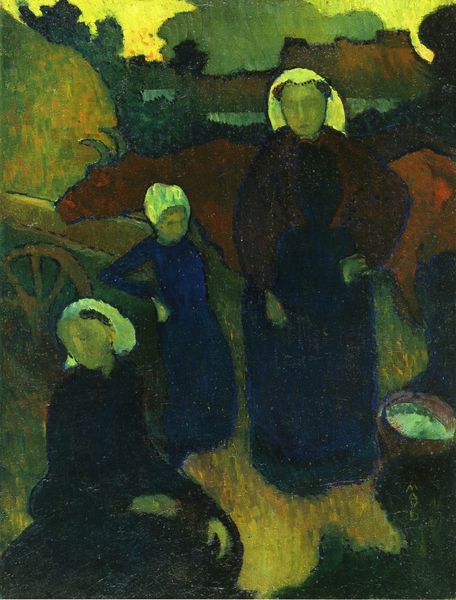
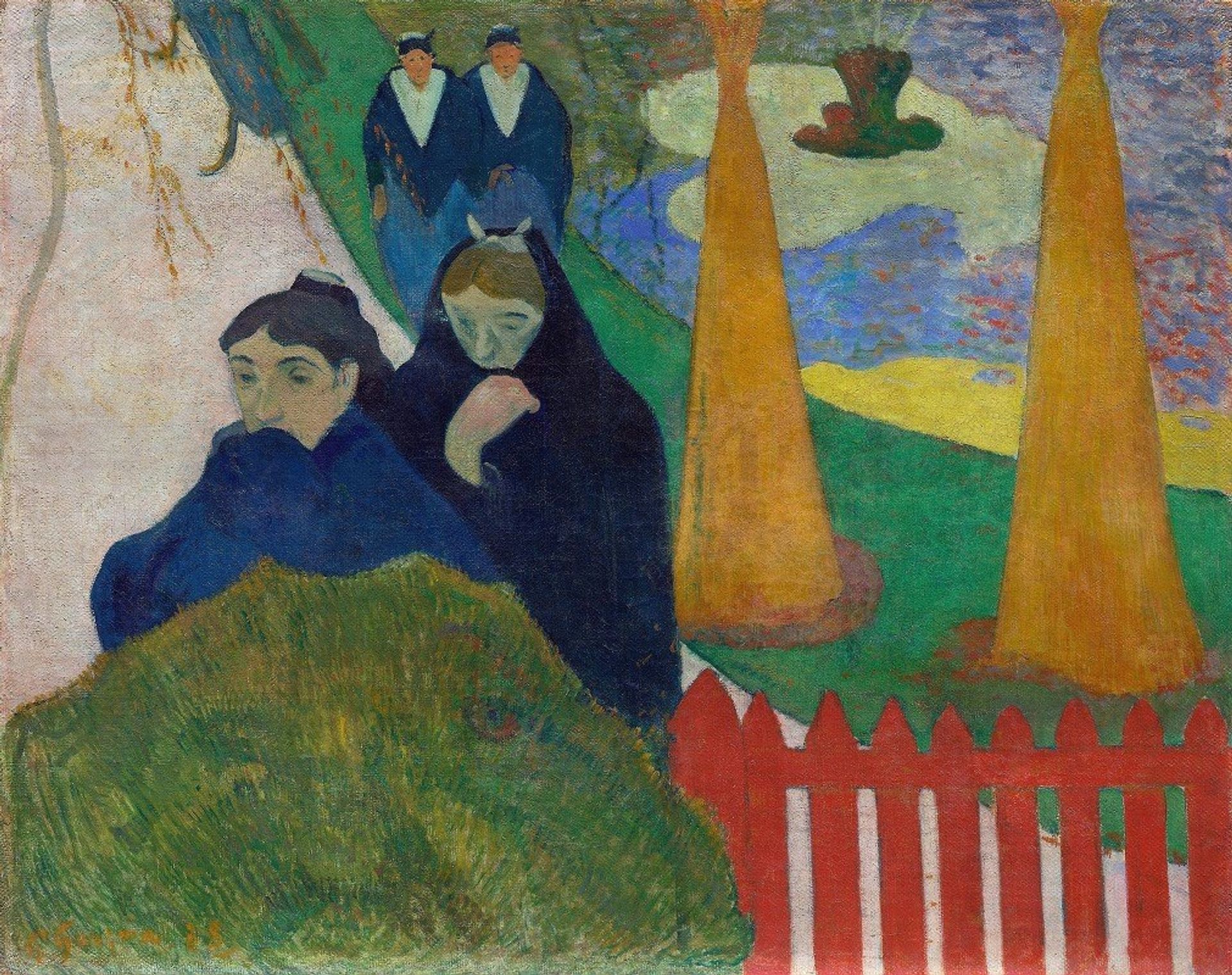
Curator: Today, we’re looking at Paul Gauguin’s "Arlésiennes", painted in 1888. Editor: Wow, that fence hits you immediately! A vibrant red barrier against what feels like muted sorrow. It's got this folk art simplicity mixed with a deeply psychological undertone. Curator: Precisely! It’s fascinating how Gauguin captured the women of Arles. See how he renders them, seemingly bound by tradition in their dark clothing, set against a somewhat unnatural landscape. Editor: Yes, everything is carefully coded! Their clothing represents more than just daily attire, it's almost a uniform expressing grief and a very somber way of life. Even those towering golden, cone-shaped trees – what do they mean? Curator: Some interpretations suggest they might be an assertion of almost pagan imagery amid his very troubled sojourn. I mean, he was feeling stifled by what he thought was provincial life while in Arles. Editor: It makes perfect sense. Everything seems very still, almost staged. They are like figures in a tableau of a fading world, observed as though in an open-air theatre. It definitely captures that feeling of a moment frozen in time. I suppose one reason the viewer’s gaze is fixed on them is that we see these two imposing forms but their interior lives remain inscrutable and mysterious. Curator: Which I think is typical of Gauguin. There’s a deliberateness, right? The choice of color, form... there's almost always something simmering beneath the surface that seems deeply personal for Gauguin himself. Editor: It's almost voyeuristic isn’t it? We see, but we’re kept at a distance. The red fence seals us out. Curator: The beauty of a work like this, perhaps, lies in this ambiguous feeling. Gauguin invites speculation but offers no firm conclusion. Editor: Well, thinking about it, this painting becomes a really evocative portal. Those women remain there on that plane forever fixed and in eternal quiet contemplation.

Artwork details
- Medium
- painting, plein-air, oil-paint
- Copyright
- Public Domain: Artvee
Tags
figurative
water colours
painting
impressionism
plein-air
oil-paint
landscape
figuration
orientalism
genre-painting
post-impressionism
Comments
No comments
About this artwork
Curator: Today, we’re looking at Paul Gauguin’s "Arlésiennes", painted in 1888. Editor: Wow, that fence hits you immediately! A vibrant red barrier against what feels like muted sorrow. It's got this folk art simplicity mixed with a deeply psychological undertone. Curator: Precisely! It’s fascinating how Gauguin captured the women of Arles. See how he renders them, seemingly bound by tradition in their dark clothing, set against a somewhat unnatural landscape. Editor: Yes, everything is carefully coded! Their clothing represents more than just daily attire, it's almost a uniform expressing grief and a very somber way of life. Even those towering golden, cone-shaped trees – what do they mean? Curator: Some interpretations suggest they might be an assertion of almost pagan imagery amid his very troubled sojourn. I mean, he was feeling stifled by what he thought was provincial life while in Arles. Editor: It makes perfect sense. Everything seems very still, almost staged. They are like figures in a tableau of a fading world, observed as though in an open-air theatre. It definitely captures that feeling of a moment frozen in time. I suppose one reason the viewer’s gaze is fixed on them is that we see these two imposing forms but their interior lives remain inscrutable and mysterious. Curator: Which I think is typical of Gauguin. There’s a deliberateness, right? The choice of color, form... there's almost always something simmering beneath the surface that seems deeply personal for Gauguin himself. Editor: It's almost voyeuristic isn’t it? We see, but we’re kept at a distance. The red fence seals us out. Curator: The beauty of a work like this, perhaps, lies in this ambiguous feeling. Gauguin invites speculation but offers no firm conclusion. Editor: Well, thinking about it, this painting becomes a really evocative portal. Those women remain there on that plane forever fixed and in eternal quiet contemplation.
Comments
No comments