About this artwork
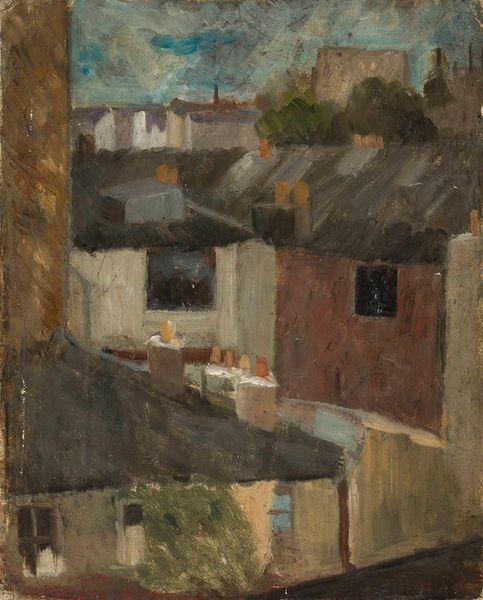
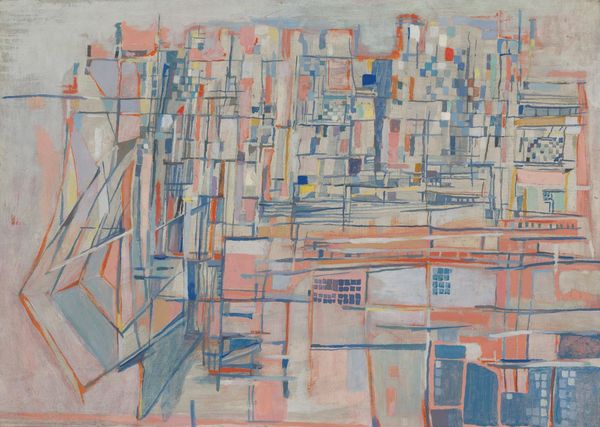
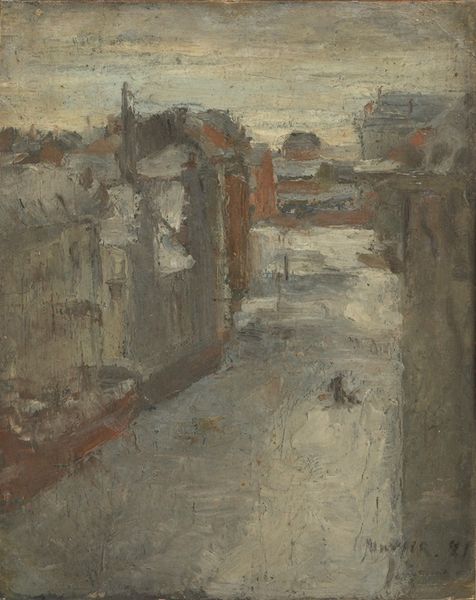
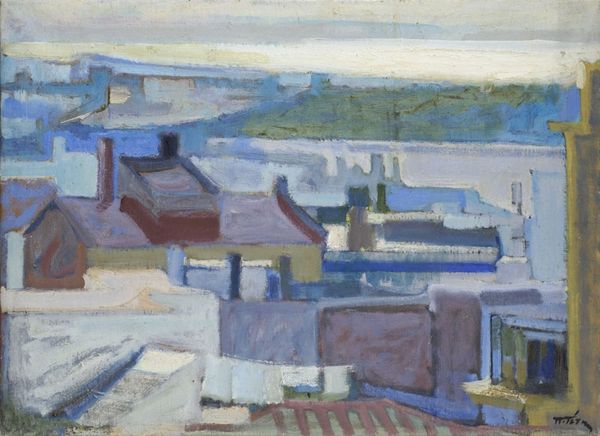
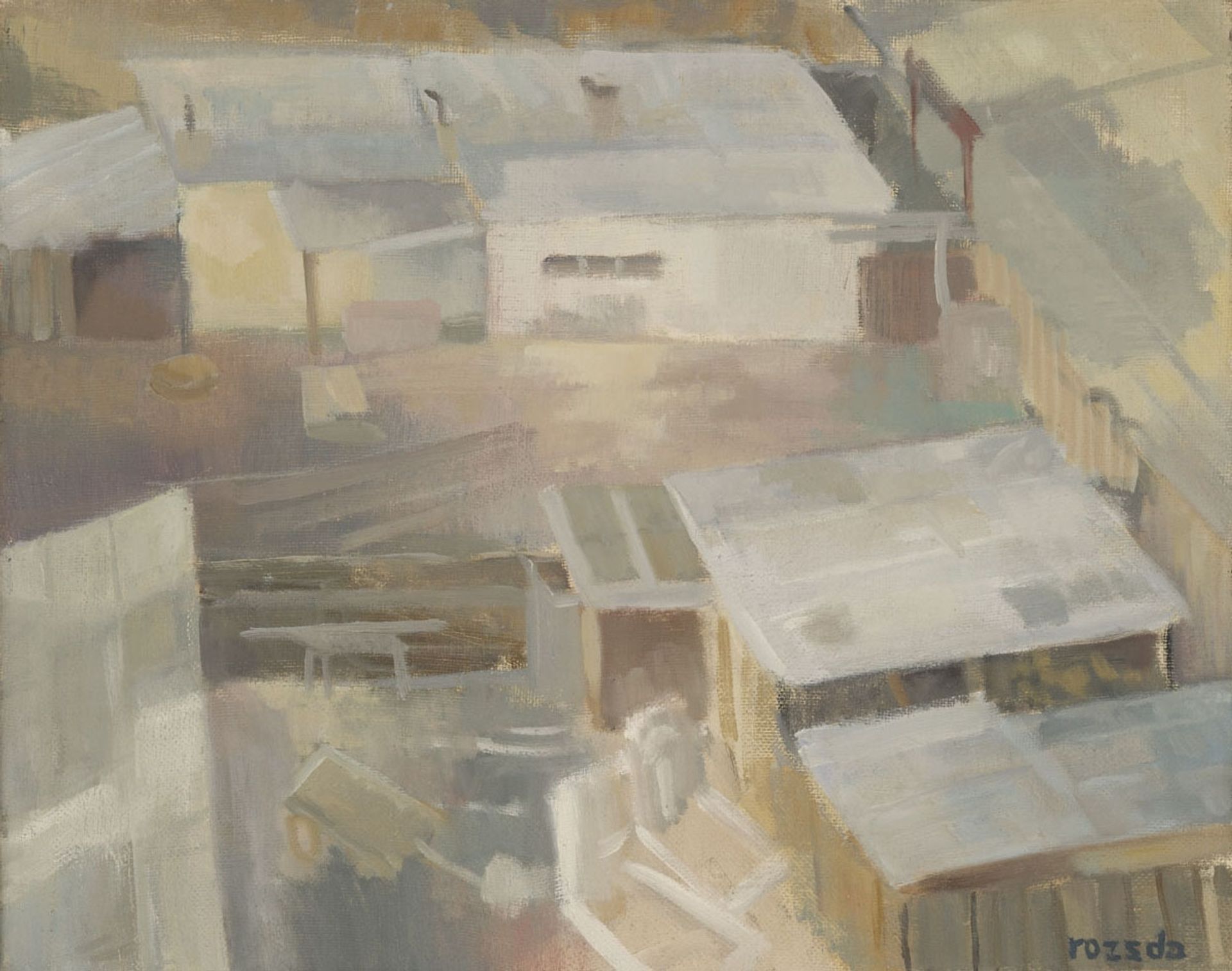
Editor: Here we have Endre Rozsda’s "The Paul Street Boys," painted in 1934. It looks like an oil painting, depicting rooftops, almost from a bird’s eye view. There’s a kind of dreamlike quality, with muted colors, that feels a bit melancholic. How do you interpret this work? Curator: Rozsda captures not just buildings, but a shared space etched in memory. It’s not just a landscape; it evokes the collective experience of a generation. The rooftops, from above, hint at a remove, a gaze perhaps of someone reflecting on the past from a position of safety, or even loss. What do the building blocks signify to you? Editor: I guess the muted colors, like faded photographs, do give the impression of memory and longing. The roofs look metallic and aged. Could the rooftops be a symbol of community? Curator: Absolutely. Think of rooftops throughout art history, whether in Van Gogh’s expressive village scenes or Chagall's floating figures above their hometown. Rozsda provides a powerful sense of location and rootedness within a certain timeframe, giving shape to collective memories tied to specific locales, perhaps tinged with idealism of youth, set against industrialization’s cold architecture. Editor: It’s amazing how much depth is hidden in what seems like a simple painting. Curator: The magic of images lies in their layered meanings and ability to encapsulate collective narratives across time. Editor: I see that now, thanks. This piece carries so much more weight and intention than I initially noticed. Curator: Indeed. Now you can spot similar threads in other works too. Enjoy your art journey!
The Paul Street Boys 1934


Artwork details
- Medium
- oil-paint
- Dimensions
- 40 x 50 cm
- Location
- Budapest Museum of Fine Arts, Budapest, Hungary
- Copyright
- Endre Rozsda,Fair Use
Tags
oil-paint
landscape
oil painting
modernism
realism
Comments
No comments
About this artwork
Editor: Here we have Endre Rozsda’s "The Paul Street Boys," painted in 1934. It looks like an oil painting, depicting rooftops, almost from a bird’s eye view. There’s a kind of dreamlike quality, with muted colors, that feels a bit melancholic. How do you interpret this work? Curator: Rozsda captures not just buildings, but a shared space etched in memory. It’s not just a landscape; it evokes the collective experience of a generation. The rooftops, from above, hint at a remove, a gaze perhaps of someone reflecting on the past from a position of safety, or even loss. What do the building blocks signify to you? Editor: I guess the muted colors, like faded photographs, do give the impression of memory and longing. The roofs look metallic and aged. Could the rooftops be a symbol of community? Curator: Absolutely. Think of rooftops throughout art history, whether in Van Gogh’s expressive village scenes or Chagall's floating figures above their hometown. Rozsda provides a powerful sense of location and rootedness within a certain timeframe, giving shape to collective memories tied to specific locales, perhaps tinged with idealism of youth, set against industrialization’s cold architecture. Editor: It’s amazing how much depth is hidden in what seems like a simple painting. Curator: The magic of images lies in their layered meanings and ability to encapsulate collective narratives across time. Editor: I see that now, thanks. This piece carries so much more weight and intention than I initially noticed. Curator: Indeed. Now you can spot similar threads in other works too. Enjoy your art journey!
Comments
No comments