About this artwork
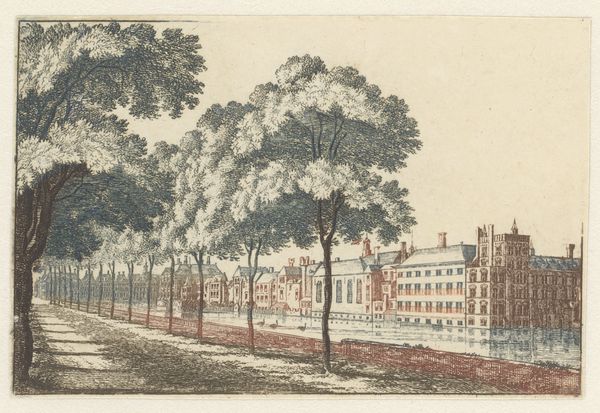
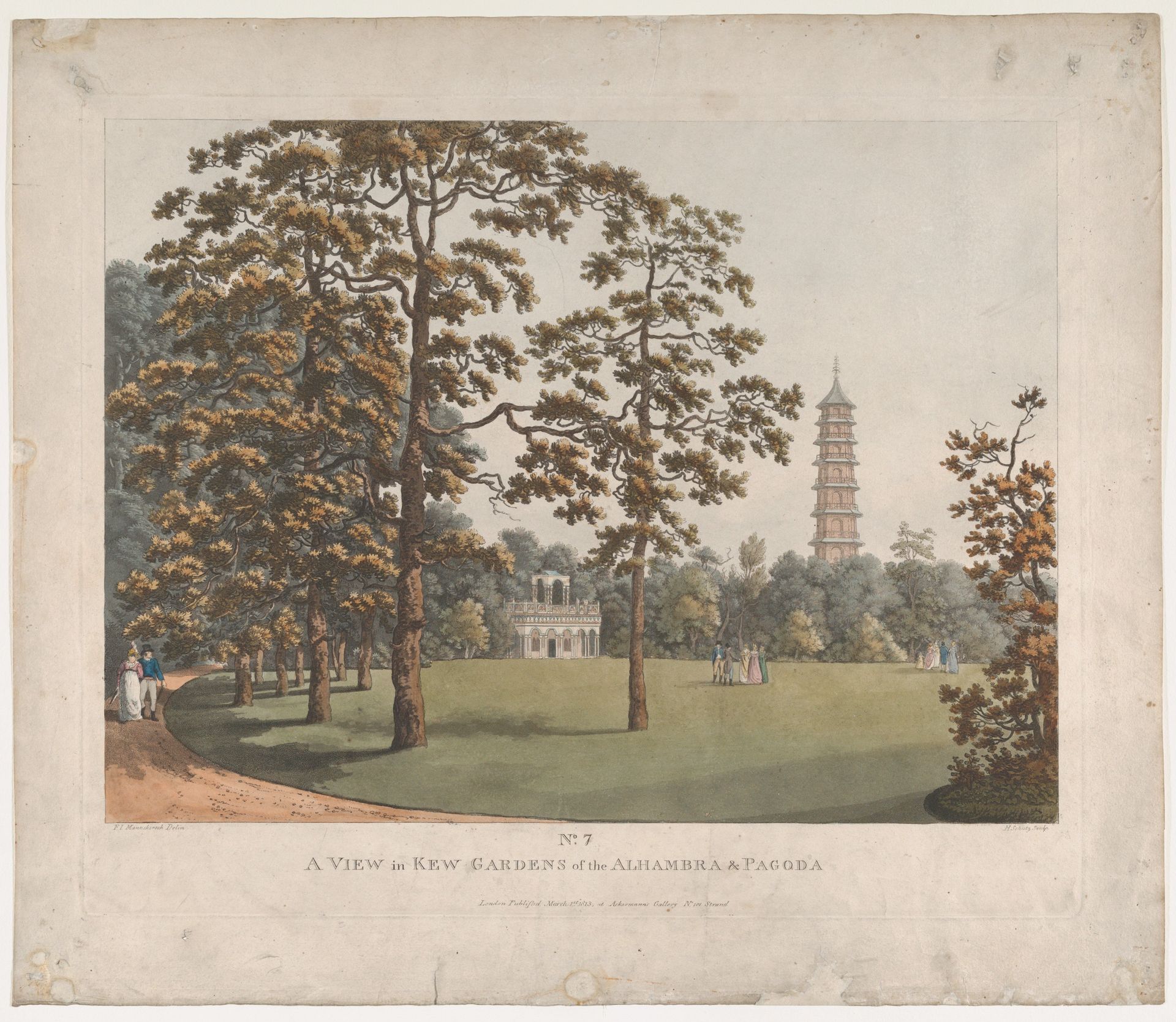
Heinrich Joseph Schutz created this aquatint of ‘A View in Kew Gardens of the Alhambra and the Pagoda’ sometime in the early 19th century. Notice how the composition creates a serene yet structured experience. The prominent trees to the left act as a formal frame that leads the eye across a manicured landscape with architectural features placed as focal points. Schütz uses light and shadow to define the forms and create depth, which gives the image a sense of receding space. Here, the arrangement isn’t just a recording of a physical space; it is a carefully constructed visual environment. The contrasts in texture—the detailed foliage against the smooth lawns—provide a semiotic field, inviting the viewer to decode the cultural values assigned to nature and leisure. It engages with contemporary debates about aesthetics, nature, and the picturesque. Note how the elements come together to create a harmonious view, a controlled vista that speaks to the observer about space and order.
A View in Kew Gardens of the Alhambra and the Pagoda 1813

Heinrich Joseph Schütz
1800 - 1825
The Metropolitan Museum of Art
Metropolitan Museum of Art, New York, NYArtwork details
- Medium
- drawing, painting, print, plein-air, watercolor
- Dimensions
- 14 1/8 x 17 1/4 in. (35.9 x 43.8 cm)
- Location
- Metropolitan Museum of Art, New York, NY
- Copyright
- Public Domain
Tags
drawing
water colours
painting
plein-air
landscape
perspective
watercolor
romanticism
cityscape
Comments
No comments
About this artwork
Heinrich Joseph Schutz created this aquatint of ‘A View in Kew Gardens of the Alhambra and the Pagoda’ sometime in the early 19th century. Notice how the composition creates a serene yet structured experience. The prominent trees to the left act as a formal frame that leads the eye across a manicured landscape with architectural features placed as focal points. Schütz uses light and shadow to define the forms and create depth, which gives the image a sense of receding space. Here, the arrangement isn’t just a recording of a physical space; it is a carefully constructed visual environment. The contrasts in texture—the detailed foliage against the smooth lawns—provide a semiotic field, inviting the viewer to decode the cultural values assigned to nature and leisure. It engages with contemporary debates about aesthetics, nature, and the picturesque. Note how the elements come together to create a harmonious view, a controlled vista that speaks to the observer about space and order.
Comments
No comments