About this artwork
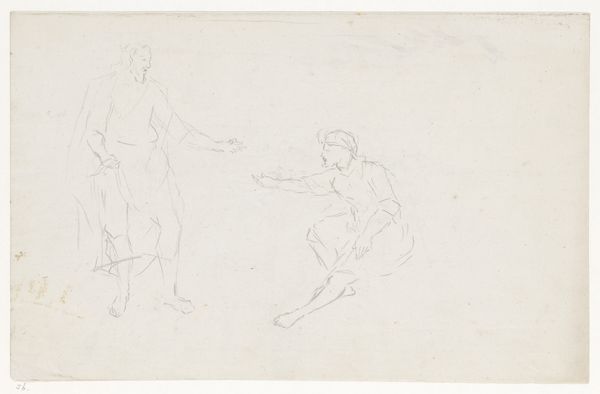
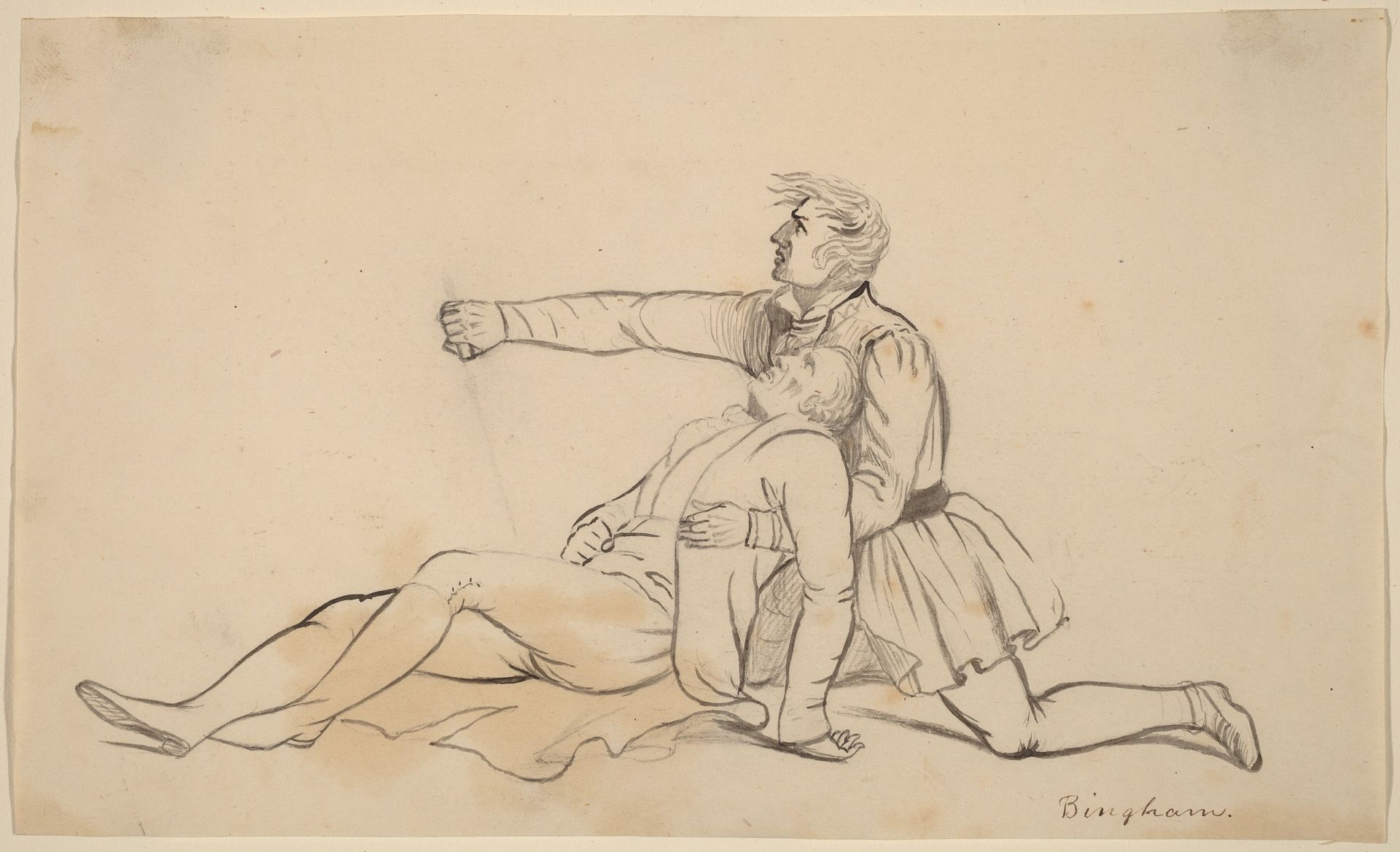
Curator: This is George Caleb Bingham’s “The Death of General Warren,” a pencil drawing with all the urgency and solemnity of a historical tableau. What's your first take? Editor: Stark. Austere. The figures are caught mid-narrative, really economical lines. Like a stage set almost. The materiality is simple pencil, no frills—yet somehow intensely emotional. Curator: Right? The bareness amplifies the drama. The upward gaze of the living figure practically screams defiance. Bingham really boils down the human cost, don't you think? Editor: Definitely. I wonder about the type of pencil used. Look how deeply he gouged the paper to get such stark contrast and emotional density, that paper was certainly machine-made and would likely have been low cost and commercially produced... a direct connection to availability of materials. This informs his approach to history, not as a heroic grand spectacle but as something felt with immediate urgency. Curator: Hmm, good point. So the immediacy comes not just from the subject matter, the raw emotion of battlefield loss, but also from the unpretentious materials themselves. Almost a democratizing effect... less about glorifying the powerful, more about acknowledging shared human experience. And to imagine, this piece might have been part of a study for a much larger composition! Editor: Precisely. And the labour… the repetitive strokes and layering, grounding it in physicality. No escaping the real-world consequences represented here. Makes you think about what he intended this drawing to achieve. Not necessarily art as traditionally elevated spectacle. Curator: I’m intrigued now… could that pencil become a tool of political consciousness? By emphasizing process and material it turns historical moments into lived, material realities? That’s compelling. Editor: I think so, absolutely! Material awareness disrupts any comfortable distance. It calls the artwork out from art and into our social landscape. Curator: Well, seeing "The Death of General Warren" through that lens—the humble graphite line carrying so much emotional and socio-political weight— it reshapes our understanding of history painting entirely. It is really very effective! Editor: It's a new appreciation for Bingham, at least, that's for sure! Something so delicate can bear such profound weight.
The Death of General Warren


Artwork details
- Medium
- drawing, pencil
- Dimensions
- sheet: 12.7 × 21 cm (5 × 8 1/4 in.)
- Copyright
- National Gallery of Art: CC0 1.0
Tags
portrait
drawing
pencil sketch
pencil drawing
romanticism
pencil
portrait drawing
history-painting
academic-art
Comments
No comments
About this artwork
Curator: This is George Caleb Bingham’s “The Death of General Warren,” a pencil drawing with all the urgency and solemnity of a historical tableau. What's your first take? Editor: Stark. Austere. The figures are caught mid-narrative, really economical lines. Like a stage set almost. The materiality is simple pencil, no frills—yet somehow intensely emotional. Curator: Right? The bareness amplifies the drama. The upward gaze of the living figure practically screams defiance. Bingham really boils down the human cost, don't you think? Editor: Definitely. I wonder about the type of pencil used. Look how deeply he gouged the paper to get such stark contrast and emotional density, that paper was certainly machine-made and would likely have been low cost and commercially produced... a direct connection to availability of materials. This informs his approach to history, not as a heroic grand spectacle but as something felt with immediate urgency. Curator: Hmm, good point. So the immediacy comes not just from the subject matter, the raw emotion of battlefield loss, but also from the unpretentious materials themselves. Almost a democratizing effect... less about glorifying the powerful, more about acknowledging shared human experience. And to imagine, this piece might have been part of a study for a much larger composition! Editor: Precisely. And the labour… the repetitive strokes and layering, grounding it in physicality. No escaping the real-world consequences represented here. Makes you think about what he intended this drawing to achieve. Not necessarily art as traditionally elevated spectacle. Curator: I’m intrigued now… could that pencil become a tool of political consciousness? By emphasizing process and material it turns historical moments into lived, material realities? That’s compelling. Editor: I think so, absolutely! Material awareness disrupts any comfortable distance. It calls the artwork out from art and into our social landscape. Curator: Well, seeing "The Death of General Warren" through that lens—the humble graphite line carrying so much emotional and socio-political weight— it reshapes our understanding of history painting entirely. It is really very effective! Editor: It's a new appreciation for Bingham, at least, that's for sure! Something so delicate can bear such profound weight.
Comments
No comments