Copyright: Beatriz Milhazes,Fair Use
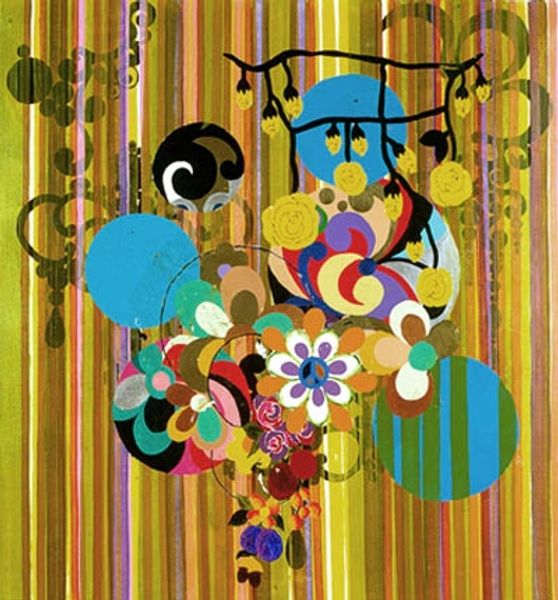
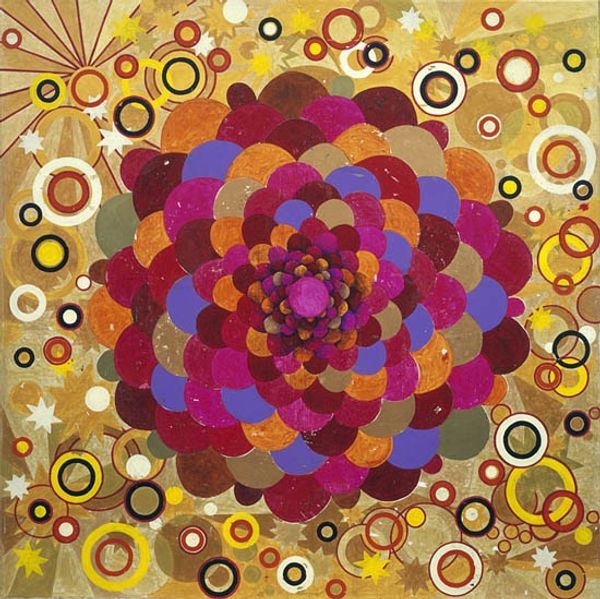
Curator: Let's take a closer look at Beatriz Milhazes's "O Pato," created in 1998 using mixed media. Editor: Immediately, the sheer joyfulness of the palette grabs me – it feels festive, celebratory, like a carnival! Curator: Milhazes is known for her process. It is meticulous. She paints designs on individual plastic sheets which are then collaged onto the canvas, creating layers through a process akin to silkscreen. There is the careful selection and arrangement of those pre-painted motifs that speak volumes about labor. Editor: And each of these circles and floral patterns carries meaning, wouldn't you say? The floral motifs could reference renewal, beauty... the circles, perhaps cycles of life, or the sun itself? They’re not randomly placed; there’s a distinct visual language happening. Curator: I find it fascinating how this blurring between "high art" and the traditionally "decorative" speaks to broader discussions about labor in art. How do we value repetitive, meticulous, historically feminine craftwork within fine art circles? Editor: Precisely. Looking at those concentric circles layered one upon another, it also feels like a window into multiple worlds. Like looking through a kaleidoscope, or a collection of mandalas referencing interconnectedness. Curator: This also intersects with the pattern and decoration movement – challenging ideas about originality. She lifts patterns from lace, textiles, ceramic tiles... What statement is she making about material consumption in this combination of the found and made? Editor: Maybe she is recontextualizing the history and origins of Brazilian popular visual culture for art audiences! Each element calls to mind different traditions that carry their own narrative and collective memories. It’s a dense visual encoding of identity. Curator: It’s thought-provoking to consider the act of claiming. I wonder, how might the work be interpreted through the lens of class and access? She integrates and transforms elements that originate from artisanal realms but places them into a fine art setting. Editor: Right, and it makes us reassess. It invites the viewer to see more than just the visual, it provokes them to consider how the artistic gestures of appropriation, layering, and juxtaposing become significant statements in themselves. Curator: An intense dive that reminds us art always functions within complex cultural systems. Editor: Yes, it asks us to see the world anew, to recognize the wealth of hidden narratives, as much through the images themselves as through how they are materially produced.
Comments
No comments
Be the first to comment and join the conversation on the ultimate creative platform.
 Collect
 React
React Comment
More like this