print, photography
#
print photography
# print
#
archive photography
#
street-photography
#
photography
#
cityscape
#
realism
Dimensions: height 88 mm, width 179 mm
Copyright: Rijks Museum: Open Domain
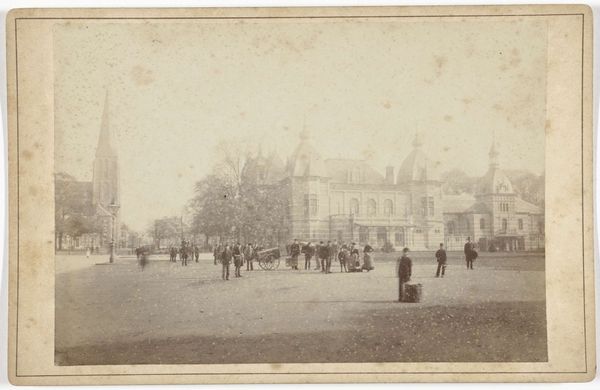
Curator: Looking at this striking print titled “Mariaplaats te Utrecht,” created sometime between 1900 and 1940, I’m immediately struck by how powerfully it evokes the weight of history and the presence of enduring monuments. Editor: It's interesting, seeing a document like this – the street surface itself appears to dominate, doesn't it? I am more focused on the gritty everyday, and wonder about the materiality of the print and how this affected its dissemination as public information. Curator: Absolutely. Consider the tower’s placement; the Domtoren looms in the distance, a visual anchor imbued with centuries of Utrecht's spiritual and civic identity. The people, dwarfed by the urban landscape, become almost incidental, emphasizing the constancy of the built environment. Editor: I can see that. However, these individuals aren't simply dwarfed. The labour required for the urban scene fascinates me. The cobbles are well- maintained, but are they standardized, who made them, who profits and is responsible? The small figures signify a workforce involved in consumption as well. Curator: Yes, that’s insightful. And that central monument, beyond its obvious architectural presence, suggests something of Utrecht’s soul –its steadfastness and tradition – that exists even among the mundane hustle. I find myself thinking of Jung’s archetypes; the tower itself as a potent symbol of aspiration. Editor: Interesting, so much focus on symbolism, when for me, the actual construction interests me much more: the construction methods, stone procurement, logistics; the people in the photograph and where they worked… Were people like us even afforded the option of creating archives such as this print? What sort of societal access did they even have to cultural and creative endeavors? Curator: A pertinent question! Looking at the subtle shifts in perspective and depth within the image, one begins to ponder the relationship between collective memory and the photographer's subjective experience of the space. Editor: Indeed. Ultimately, prints such as this, while documenting place, expose and raise social questions too: of class, and visibility, labor, production. The technology becomes a social artifact itself, inseparable from our reading. Curator: Perhaps that inherent connection is exactly what grants these historical records a timeless, and rather haunting power. Editor: Perhaps. Now I am drawn back to thinking again of the printer, and how many of these images that printer reproduced in one hour, the pace of the technological era! Thanks for sharing your own intriguing perspective.
Comments
No comments
Be the first to comment and join the conversation on the ultimate creative platform.
 Collect
 React
React Comment
More like this