About this artwork
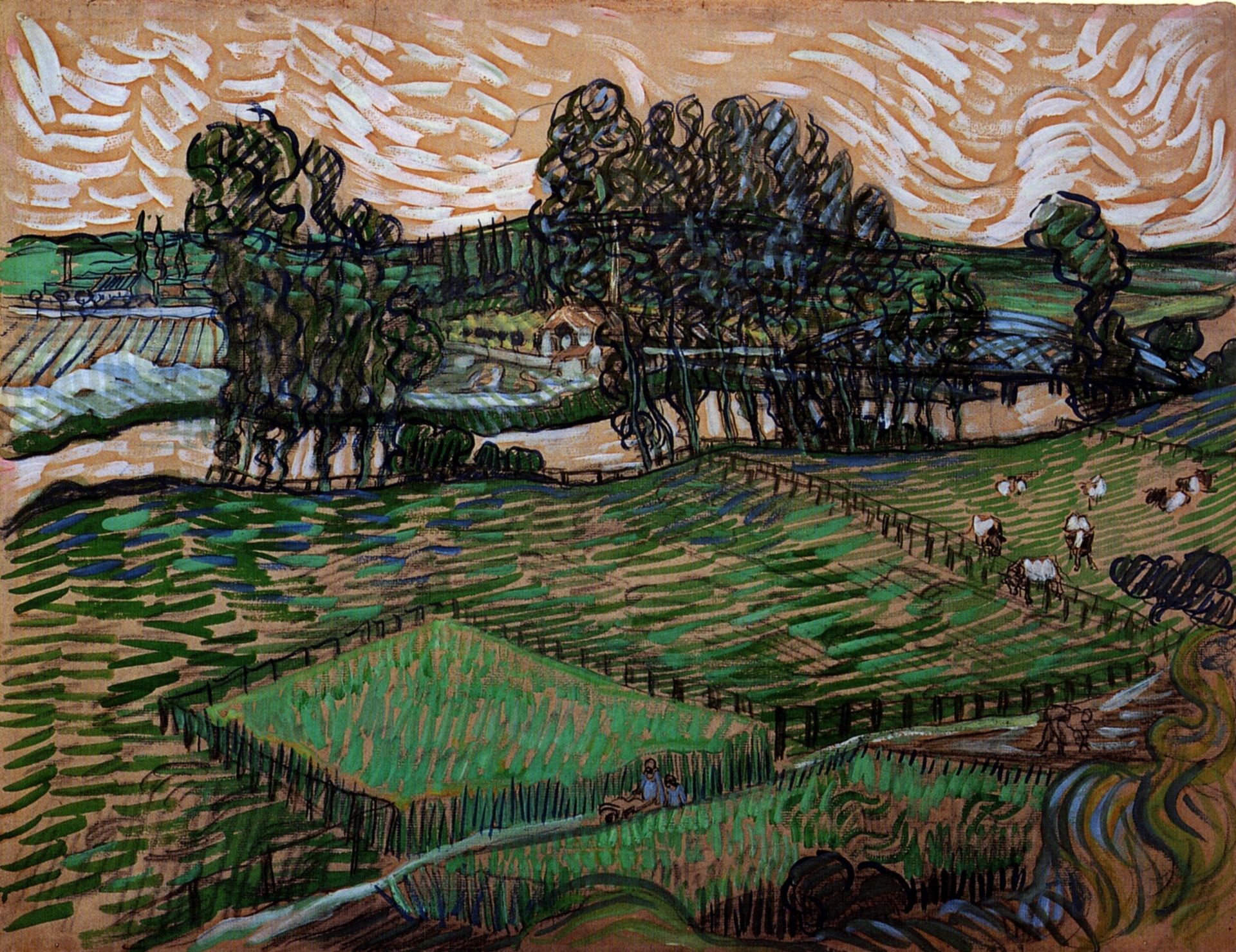
Editor: This is Van Gogh’s "Landscape with Bridge across the Oise," painted in 1890. It looks to me like he’s capturing a calm countryside scene, but those frantic brushstrokes give it an underlying feeling of anxiety. What strikes you most when you look at this work? Curator: It’s fascinating how Van Gogh infuses this seemingly tranquil landscape with such intense emotion, isn't it? Think about the bridge: bridges often symbolize connection, a link between two separate realms. But here, with the agitated lines and almost clashing colours, is it truly a connector, or more of a barrier, a point of transition fraught with tension? Editor: I see what you mean. It doesn't feel very welcoming. The eye definitely jumps around instead of being led peacefully across. Curator: Precisely. And consider the swirling sky: in many cultures, the sky represents the heavens, the divine. Here, however, it appears turbulent, mirroring inner turmoil. Could it be a reflection of Van Gogh's mental state at the time? Are those fields representing nourishment or something else? Editor: Possibly. There's something uneasy about it. A beautiful scene, rendered with such…unrest. Curator: Van Gogh uses visual symbols to hint at much deeper emotional undercurrents. It shows us how our perception of even the most familiar scenes is coloured by our internal state, turning a simple landscape into a powerful mirror of the soul. He offers us visual tools to consider our relationship to both nature and mental health. Editor: I've always loved his art, but seeing it through this lens… it's so much more layered. I appreciate how it invites you to reflect on something beyond the purely aesthetic. Curator: Indeed. His art remains relevant precisely because of this ability to connect with us on a profoundly human level, transcending time and cultural barriers.
Landscape with Bridge across the Oise 1890


Artwork details
- Medium
- painting, plein-air, paper, impasto
- Location
- Tate Modern, London, UK
- Copyright
- Public domain
Tags
tree
painting
plein-air
landscape
river
impressionist landscape
paper
impasto
acrylic on canvas
plant
expressionism
naive art
water
post-impressionism
expressionist
Comments
No comments
About this artwork
Editor: This is Van Gogh’s "Landscape with Bridge across the Oise," painted in 1890. It looks to me like he’s capturing a calm countryside scene, but those frantic brushstrokes give it an underlying feeling of anxiety. What strikes you most when you look at this work? Curator: It’s fascinating how Van Gogh infuses this seemingly tranquil landscape with such intense emotion, isn't it? Think about the bridge: bridges often symbolize connection, a link between two separate realms. But here, with the agitated lines and almost clashing colours, is it truly a connector, or more of a barrier, a point of transition fraught with tension? Editor: I see what you mean. It doesn't feel very welcoming. The eye definitely jumps around instead of being led peacefully across. Curator: Precisely. And consider the swirling sky: in many cultures, the sky represents the heavens, the divine. Here, however, it appears turbulent, mirroring inner turmoil. Could it be a reflection of Van Gogh's mental state at the time? Are those fields representing nourishment or something else? Editor: Possibly. There's something uneasy about it. A beautiful scene, rendered with such…unrest. Curator: Van Gogh uses visual symbols to hint at much deeper emotional undercurrents. It shows us how our perception of even the most familiar scenes is coloured by our internal state, turning a simple landscape into a powerful mirror of the soul. He offers us visual tools to consider our relationship to both nature and mental health. Editor: I've always loved his art, but seeing it through this lens… it's so much more layered. I appreciate how it invites you to reflect on something beyond the purely aesthetic. Curator: Indeed. His art remains relevant precisely because of this ability to connect with us on a profoundly human level, transcending time and cultural barriers.
Comments
No comments