Copyright: Public Domain: Artvee
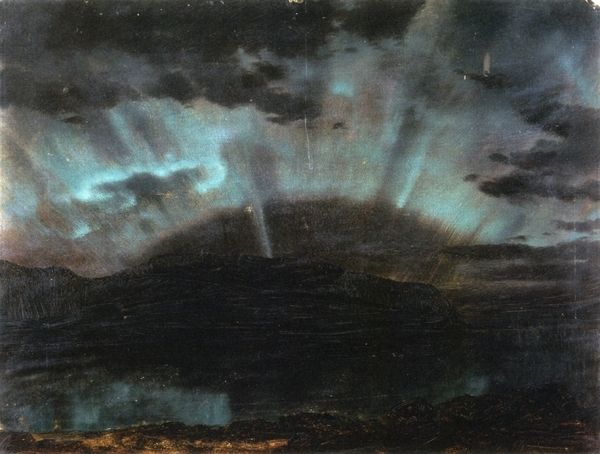
Curator: Frederic Edwin Church's "Aurora Borealis," painted in 1865, presents a striking depiction of the Northern Lights rendered in oil on canvas. Editor: A bit ominous, wouldn't you say? The somber earth tones contrasting with those eerie, ethereal lights...it's compelling. Curator: Indeed. Observe how Church masterfully manipulates color and value to create depth and spatial relationships. Note, especially, the careful attention paid to the light's chromatic dispersion; the gradations moving from white and turquoise through umber and rust articulate form, offering an intricate composition within what is otherwise a transcendental scene. Editor: I am more drawn to the symbolism—the visual language. For centuries, the aurora has been interpreted as both an omen and a sign of profound spiritual significance, seen as bridges to other worlds, paths of souls, cosmic battles reflected above...The small boat down in the landscape… is it stranded, perhaps, a representation of humanity facing something immense and unfathomable? Curator: Its inclusion complicates a simple reading. Structurally, it's placed just off-center, drawing the eye downward and providing scale. Is this "Aurora Borealis" merely a celebration of nature’s grandeur or something deeper? Does it engage with philosophical tenets, questioning man’s place in the face of the infinite? Editor: I see the sublime and the beautiful intertwined here. Those dancing lights, while stunning, evoke a sense of awe mingled with terror. This is where its emotional power lies, reflecting the 19th-century fascination with the power of nature. It's no accident the painting was created during the turmoil of the American Civil War - perhaps it is a sign, from a land of conflict, showing an amazing marvel that still is at peace. Curator: Very insightful, especially given that the Hudson River School, of which Church was a major figure, concerned itself greatly with this kind of sublime vision. We also note a sense of realism amid the almost surreal aurora; an indication of precise and practiced representational fidelity in Church’s hand. Editor: Overall, the painting serves as a fascinating case study of visual culture's capacity to absorb the hopes and anxieties of humanity, using timeless symbols to render what is unseen. Curator: A compelling fusion of artistry and ideology that pushes beyond representational painting, wouldn’t you agree?


 Collect
More like this