mixed-media, collage, paper
#
cubism
#
mixed-media
#
food
#
collage
#
war
#
paper
#
abstraction
#
sketchbook drawing
Dimensions: 63 x 49 cm
Copyright: Public domain US
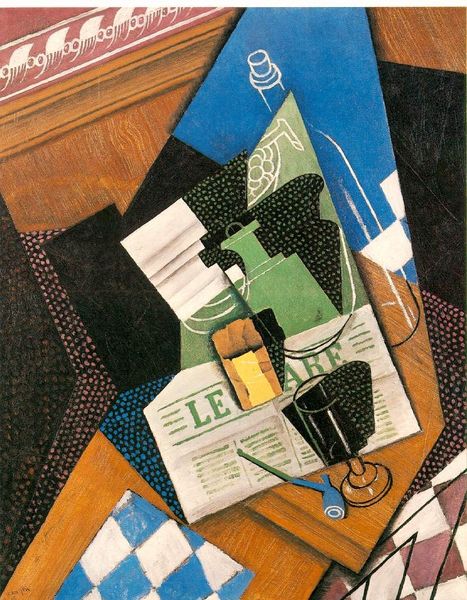
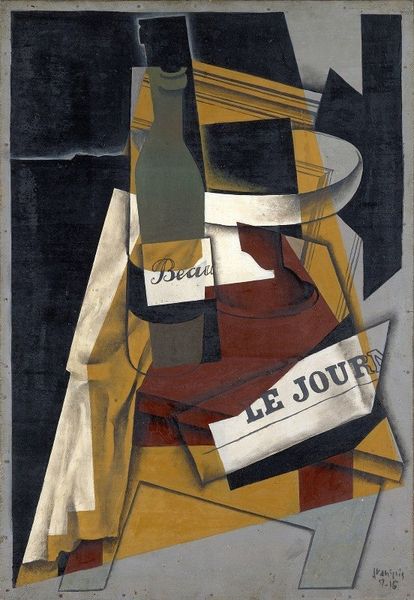
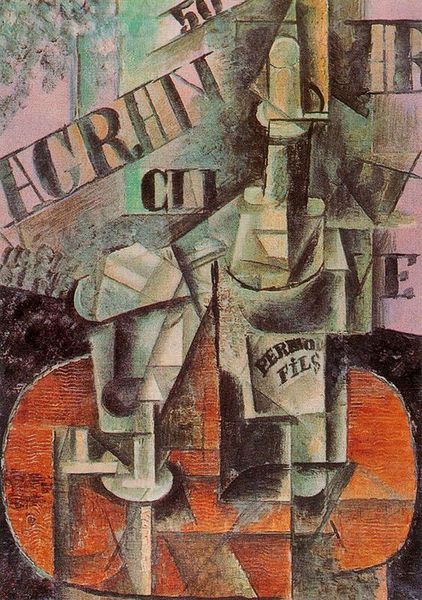
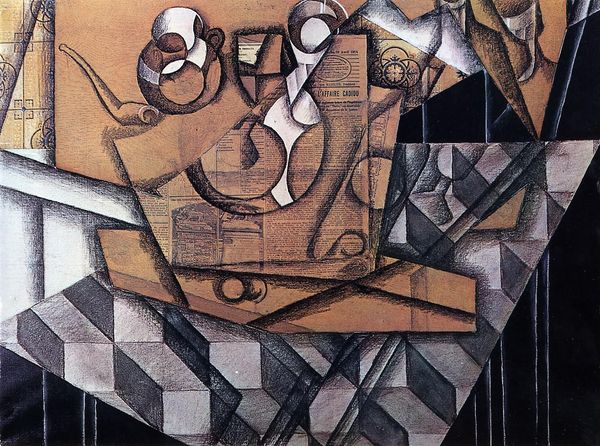
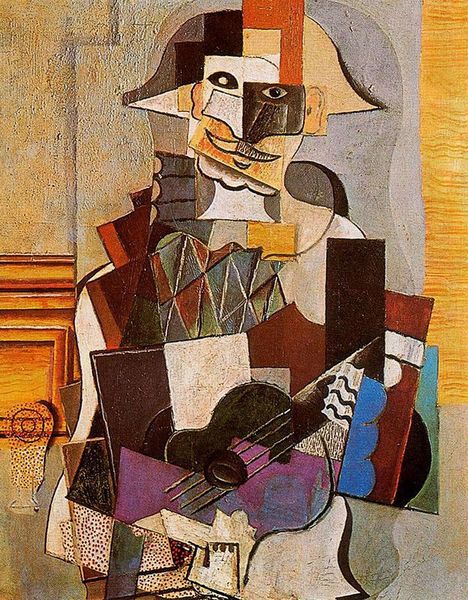
Curator: Ah, here we have Pablo Picasso's "Bottle of Vieux Marc, Glass and Newspaper," created in 1913. It resides here at the Centre Pompidou in Paris. Editor: It feels deliberately fractured, almost anxious. A pile of deconstructed shapes rendered with pasted paper and drawing… are those newspaper clippings layered into the composition? Curator: Yes, that's correct. This is a mixed-media collage, blending paper, newspaper, and drawing to construct a still life. See how he takes these everyday materials and transforms them? It's like visual poetry using the mundane. Notice "Vieux Marc" suggesting old brandy, connecting to archetypal scenes of Parisian café culture. Editor: The "Le Journal" clipping implicates its function— cheap and available for production. But the juxtaposition of a cheap daily newspaper and stylized decorative wallpaper evokes for me the domestic sphere merging into the public sphere... like domestic anxieties of the era played out daily for consumption. Curator: Indeed. This fragmented newspaper evokes contemporary anxieties as Europe was plunging toward war. Picasso, by dissecting and reassembling these ordinary elements, invites the viewer to question reality. Look closely at the dark contouring behind the bottle, evoking almost shadow puppet-like silhouettes. It’s less about direct representation and more about the evocation of concepts through symbolic association. Editor: It’s a stark contrast. On the one hand, we have a sense of refinement: fine spirits, elegant wallpaper. On the other, the rawness of paper, the mass media newspaper – which were being printed quickly and without artistry, serving the lowest common denominator. This intersection exposes hierarchies inherent in objects themselves. Curator: It certainly presents an unraveling of conventional imagery, with the artist deliberately creating a tension between recognition and abstraction. There's something profoundly unsettling about that teetering sense of precarious balance among these objects. It's as if we're not quite able to see the whole story, that is how historical ruptures feel like, am I right? Editor: Absolutely. It’s an enduring question: How do artists repurpose readily-made, functional materials into artistic representation in order to comment about societal pressures? That kind of exploration—the making of meaning— is an alchemic process of taking materials that could otherwise be invisible to most consumers. Curator: Looking at this piece from the viewpoint of visual heritage can open us to the study of signs as carriers of layered memories over time, just waiting to be decoded. Editor: Yes, it really shows how deconstructing material can expose inherent assumptions about art and culture— what can be and what can be said through art.
Comments
No comments
Be the first to comment and join the conversation on the ultimate creative platform.
 Collect
 React
React Comment
More like this