About this artwork
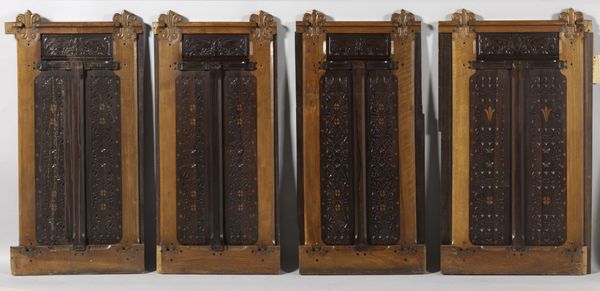
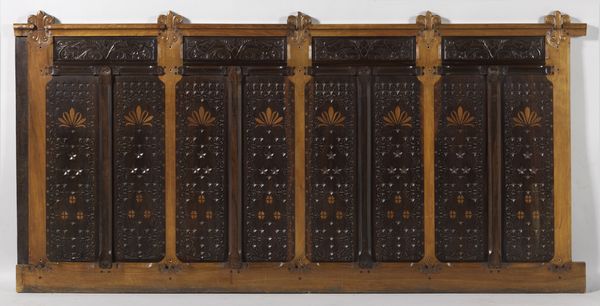
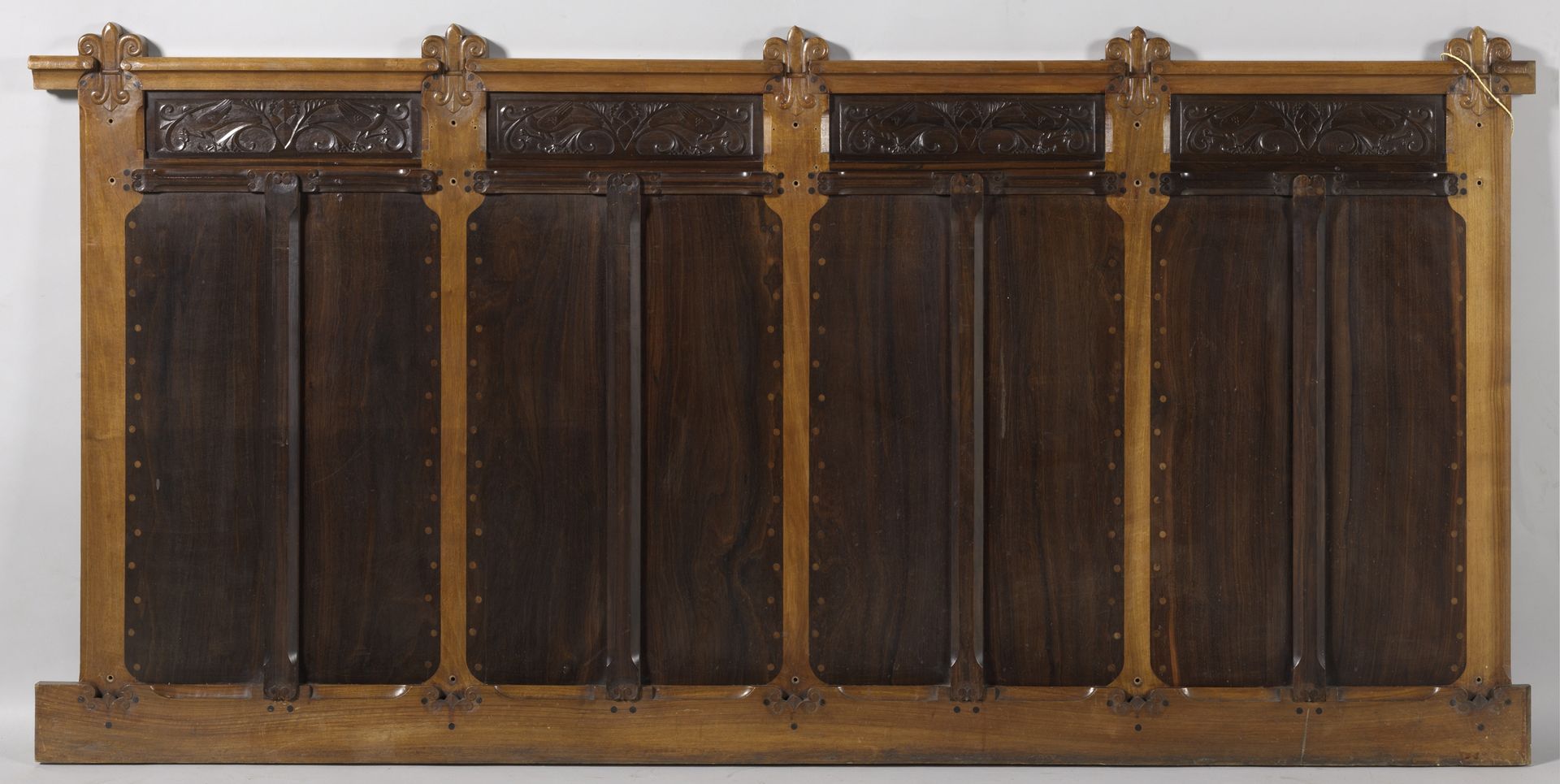
Editor: This is "Deel lambrizering, afkomstig uit het huis van Dentz van Schaick" by Carel Adolph Lion Cachet, dating from around 1900 to 1905. It’s a wood carving, part of the decorative arts collection here at the Rijksmuseum. It has a distinctly Arts and Crafts feel to it. The wood has this wonderful texture and the piece has a warm, brown palette. I find the repetition of forms very striking. How do you interpret this work, focusing on its formal elements? Curator: Precisely. Focusing on its intrinsic qualities, we see a clear articulation of space through the repeated vertical panels. These panels, darker than their surrounding frame, create a rhythmic contrast. Notice the use of line; the vertical lines dominate, drawing the eye upward, while the horizontal carved friezes at the top provide a visual stop, a visual counterpoint. What does the artist achieve with this duality, this counterpoint? Editor: It balances the severity of the vertical lines? Maybe to soften the effect or make it more pleasing? Curator: Indeed. Softening and visual pleasure are key. But also consider the subtle play of light across the surface. The carving creates shadows, adding depth and texture. Look closely at the corners; observe how the artist uses small, ornamental details to further enhance the overall composition. Are they merely decorative, or do they contribute to the overall structural integrity, the 'feeling' of the piece? Editor: I see. They act as accents, like punctuation, defining each section and preventing it from being monotonous. So, even though the design is simple, it's also very carefully thought out. Curator: Precisely. The careful balance and consideration of space. Its composition serves as a compelling demonstration of form following function, typical of the Arts and Crafts ethos. Editor: I’m beginning to see that even in what seems like a simple piece, there’s a rich complexity of structure and surface to decode. Curator: Exactly. By understanding these formal relationships, we gain a deeper appreciation for the work’s artistic intentions.
Deel lambrizering, afkomstig uit het huis van Dentz van Schaick
c. 1900 - 1905

Carel Adolph Lion Cachet
1864 - 1945Location
RijksmuseumArtwork details
- Medium
- mixed-media, carving, wood, architecture
- Dimensions
- height 110.0 cm, width 226.0 cm, depth 5.5 cm
- Location
- Rijksmuseum
- Copyright
- Rijks Museum: Open Domain
Tags
Comments
Share your thoughts
About this artwork
Editor: This is "Deel lambrizering, afkomstig uit het huis van Dentz van Schaick" by Carel Adolph Lion Cachet, dating from around 1900 to 1905. It’s a wood carving, part of the decorative arts collection here at the Rijksmuseum. It has a distinctly Arts and Crafts feel to it. The wood has this wonderful texture and the piece has a warm, brown palette. I find the repetition of forms very striking. How do you interpret this work, focusing on its formal elements? Curator: Precisely. Focusing on its intrinsic qualities, we see a clear articulation of space through the repeated vertical panels. These panels, darker than their surrounding frame, create a rhythmic contrast. Notice the use of line; the vertical lines dominate, drawing the eye upward, while the horizontal carved friezes at the top provide a visual stop, a visual counterpoint. What does the artist achieve with this duality, this counterpoint? Editor: It balances the severity of the vertical lines? Maybe to soften the effect or make it more pleasing? Curator: Indeed. Softening and visual pleasure are key. But also consider the subtle play of light across the surface. The carving creates shadows, adding depth and texture. Look closely at the corners; observe how the artist uses small, ornamental details to further enhance the overall composition. Are they merely decorative, or do they contribute to the overall structural integrity, the 'feeling' of the piece? Editor: I see. They act as accents, like punctuation, defining each section and preventing it from being monotonous. So, even though the design is simple, it's also very carefully thought out. Curator: Precisely. The careful balance and consideration of space. Its composition serves as a compelling demonstration of form following function, typical of the Arts and Crafts ethos. Editor: I’m beginning to see that even in what seems like a simple piece, there’s a rich complexity of structure and surface to decode. Curator: Exactly. By understanding these formal relationships, we gain a deeper appreciation for the work’s artistic intentions.
Comments
Share your thoughts