About this artwork
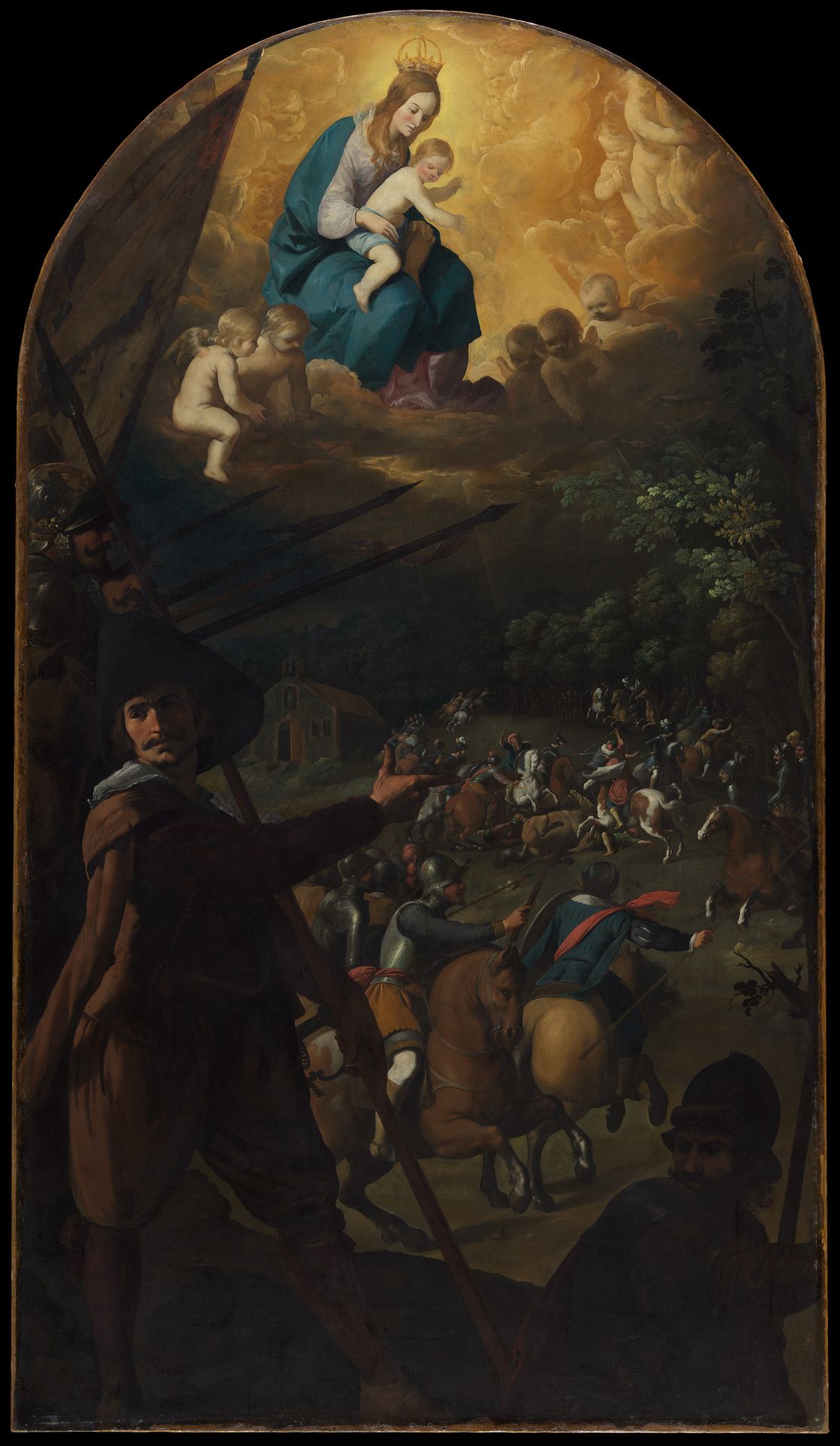
Francisco de Zurbarán painted "Battle between Christians and Muslims at El Sotillo" using oil on canvas. The arched composition is divided horizontally between the terrestrial and the celestial. Dark earth tones in the lower register contrast with the golden hues of the upper register. This visual division isn't just about aesthetics, but also about a structured world-view. Consider the semiotics at play. Down below, a fierce battle rages between Christians and Muslims, while up above, the Virgin Mary and infant Jesus sit serenely amidst angels. This juxtaposition emphasizes the perceived divine endorsement of the Christian cause. The painting employs a visual language deeply embedded in its time, reflecting the religious and political tensions of the 17th century. As you gaze upon it, recognize that its form and structure are not merely decorative but are charged with cultural meaning. It invites us to reflect on how such works actively construct and reinforce specific ideological positions.
Battle between Christians and Muslims at El Sotillo 1637 - 1639

Francisco de Zurbarán
1598 - 1664
The Metropolitan Museum of Art
Metropolitan Museum of Art, New York, NYArtwork details
- Medium
- painting, oil-paint
- Dimensions
- Arched top, 131 7/8 x 75 1/4 in. (335 x 191.1 cm)
- Location
- Metropolitan Museum of Art, New York, NY
- Copyright
- Public Domain
Tags
baroque
painting
oil-paint
landscape
figuration
group-portraits
horse
men
watercolour illustration
history-painting
italian-renaissance
Comments
No comments
About this artwork
Francisco de Zurbarán painted "Battle between Christians and Muslims at El Sotillo" using oil on canvas. The arched composition is divided horizontally between the terrestrial and the celestial. Dark earth tones in the lower register contrast with the golden hues of the upper register. This visual division isn't just about aesthetics, but also about a structured world-view. Consider the semiotics at play. Down below, a fierce battle rages between Christians and Muslims, while up above, the Virgin Mary and infant Jesus sit serenely amidst angels. This juxtaposition emphasizes the perceived divine endorsement of the Christian cause. The painting employs a visual language deeply embedded in its time, reflecting the religious and political tensions of the 17th century. As you gaze upon it, recognize that its form and structure are not merely decorative but are charged with cultural meaning. It invites us to reflect on how such works actively construct and reinforce specific ideological positions.
Comments
No comments