drawing, graphic-art, print, metal, engraving
#
portrait
#
drawing
#
graphic-art
#
self-portrait
#
baroque
#
dutch-golden-age
# print
#
metal
#
engraving
Dimensions: height 121 mm, width 89 mm
Copyright: Rijks Museum: Open Domain
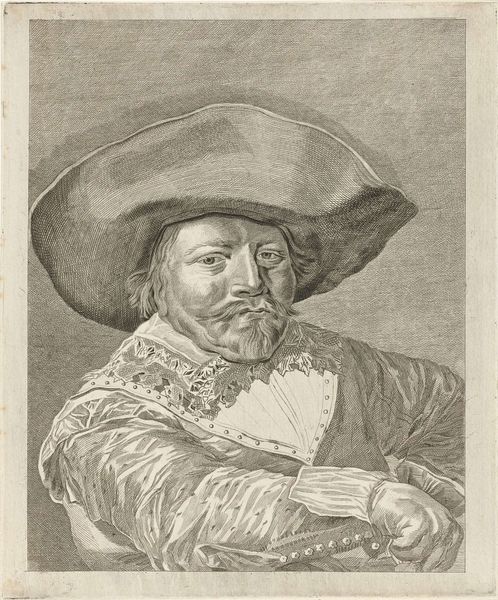
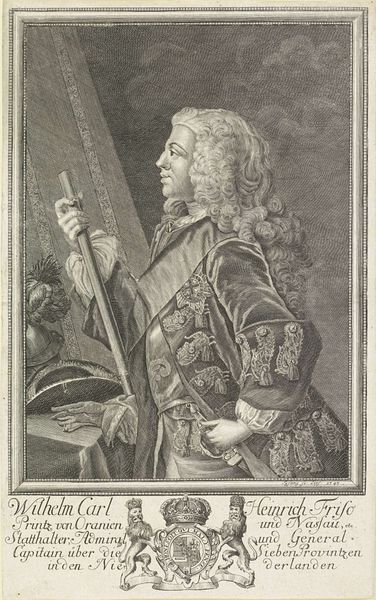
Editor: We're looking at a self-portrait by Peeter Snijers, dating from sometime between 1694 and 1752. It appears to be a print, possibly an engraving. The artist is holding his palette and brushes, gazing off to the side. There's a certain dignity in his bearing... What can you tell us about this work, and perhaps its context? Curator: Well, considering its social and cultural moment, we can observe a burgeoning interest in the artist as an individual, separate from simply being a craftsman. The self-portrait becomes a declaration of identity and status. Snijers presents himself with the tools of his trade, yes, but also with a certain stylishness in dress – indicating a position of some comfort and, perhaps, aspiration. Editor: A declaration, you say? How would it function that way? Curator: The image, reproduced as a print, circulated within artistic and educated circles. It’s a form of self-promotion, aligning him with the broader artistic trends of the Dutch Golden Age, even though he was working later, and in Antwerp. The choice of engraving also speaks to a desire for wider distribution than, say, a unique painting might achieve. Editor: So it's strategic. Does the existence of these prints change the art world? Curator: Absolutely. Reproducible images democratize access to art, impacting how artists build reputations and engage with their audiences. The ‘politics of imagery’ are at play here. These prints enable Snijers to craft and control his public image in a way that wasn't possible before the rise of printmaking. It solidifies the idea of the artist as a personality. Editor: That's fascinating. I had considered this a somewhat simple, straightforward portrait. I see much more there now. Curator: Exactly. The power of the artwork is in how it shapes and reflects its world. There is always more than just what appears on the surface.
Comments
No comments
Be the first to comment and join the conversation on the ultimate creative platform.
 Collect
 React
React Comment
More like this