About this artwork
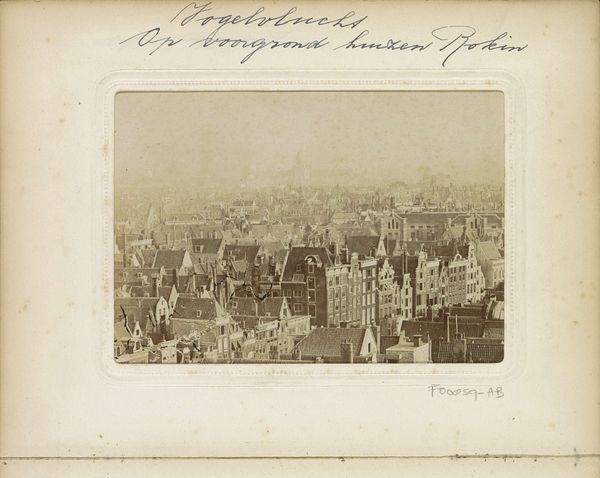
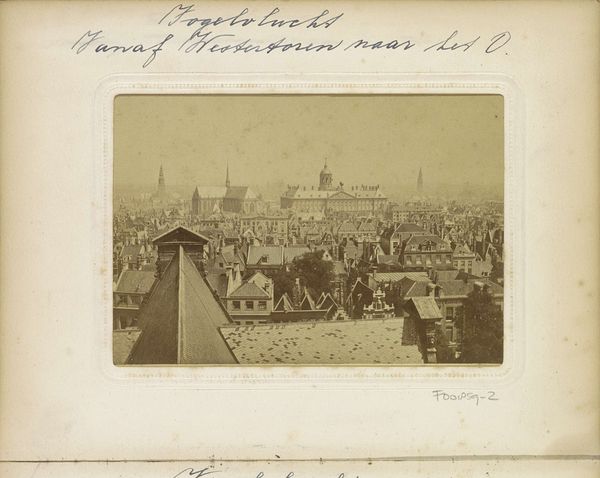
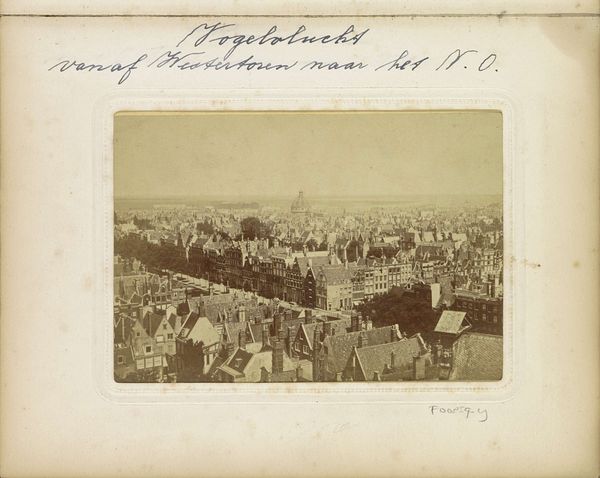
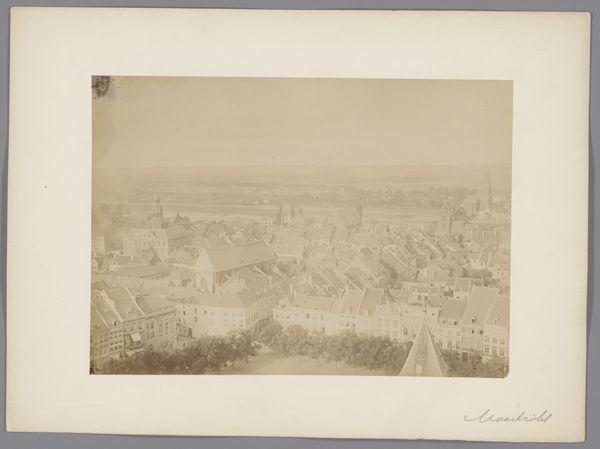
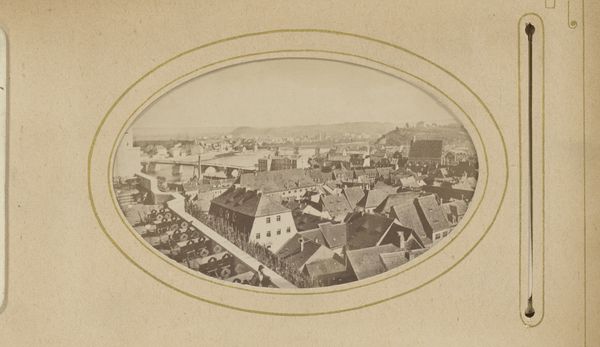
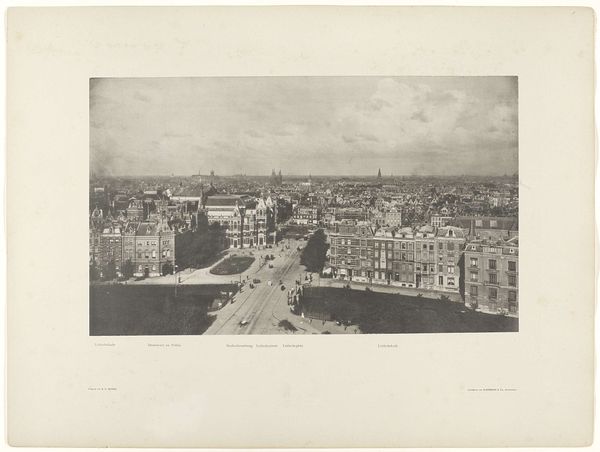
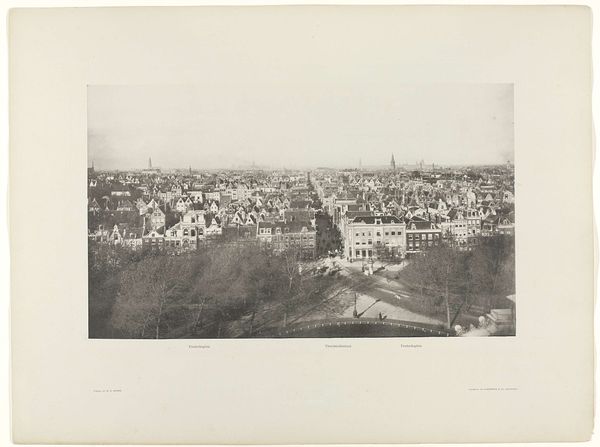
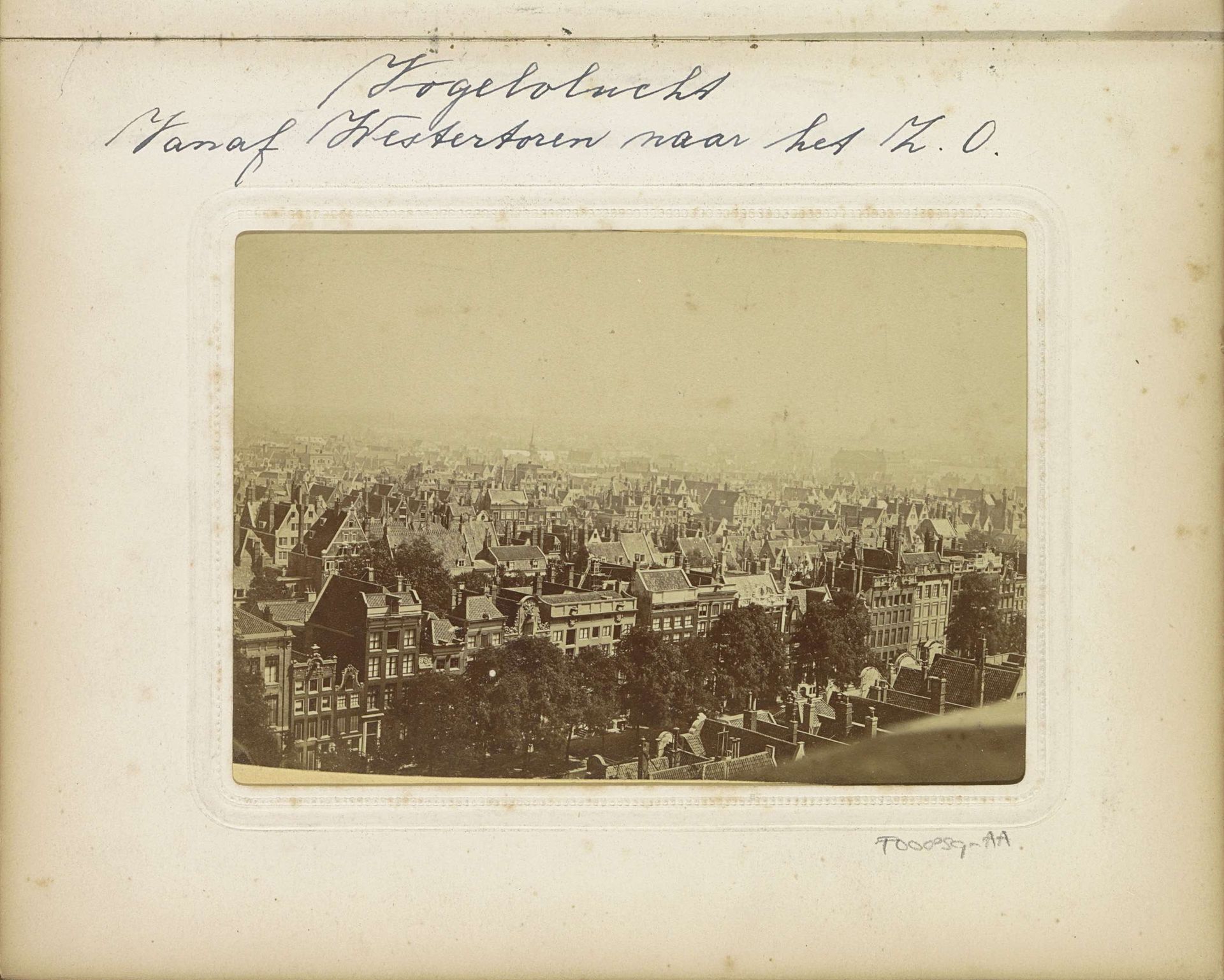
Curator: Here we have Pieter Oosterhuis's "Panorama of Amsterdam, seen from the Westertoren in a South-Easterly Direction", dating from approximately 1850 to 1875. It’s a remarkable early photographic print that offers a bird's-eye view of the city. Editor: My first impression? It’s like looking at a sea of rooftops! They seem to stretch on forever into a hazy, almost dreamlike distance. It’s really striking how dense the city appears. Curator: Indeed. Consider the technical challenge of creating such an image at this time. The Westertoren, one of Amsterdam's tallest structures, served as the perfect vantage point. The photograph would have been vital for urban planning, and perhaps even for military strategy. It showcases how photography quickly became intertwined with governance and public knowledge. Editor: I’m less concerned with the 'how' and more with the 'why.' I see the loneliness in those rooftops. So many stories lived under each one of them and you can barely discern them! Curator: I understand your sense of anonymity. Yet, look closer: the image captures Amsterdam's transition from a mercantile power to a modern urban center. Note how church spires punctuate the skyline; power structures made visible in the cityscape. Oosterhuis presents not just a view, but an ideology about how this space functions. Editor: Spoil sport! Here I am lost in melancholic rooftops and societal implications. Just kidding! I love how these photos bring us back into our collective visual memory! You can literally feel yourself being brought back in time! Curator: That collective memory is important to preserve! Before photography, cityscapes were often idealized in painting and drawings, but the photograph offered unprecedented realism. These photographic records were pivotal in shaping historical understanding and civic pride. Editor: Well said! It truly highlights the powerful and complex layers that inform a simple 'bird's-eye view.' So thank you, Pieter, for that gift to us! Curator: My pleasure. By combining aesthetic wonder and historical analysis, the conversation that blooms from Oosterhuis’ work is still deeply important.
Panorama van Amsterdam, gezien vanaf de Westertoren in zuidoostelijke richting
1850 - 1875

Pieter Oosterhuis
1816 - 1885Location
RijksmuseumArtwork details
- Medium
- print, photography
- Dimensions
- height 108 mm, width 167 mm
- Location
- Rijksmuseum
- Copyright
- Rijks Museum: Open Domain
Tags
dutch-golden-age
photography
cityscape
realism
Comments
Be the first to share your thoughts about this work.
About this artwork
Curator: Here we have Pieter Oosterhuis's "Panorama of Amsterdam, seen from the Westertoren in a South-Easterly Direction", dating from approximately 1850 to 1875. It’s a remarkable early photographic print that offers a bird's-eye view of the city. Editor: My first impression? It’s like looking at a sea of rooftops! They seem to stretch on forever into a hazy, almost dreamlike distance. It’s really striking how dense the city appears. Curator: Indeed. Consider the technical challenge of creating such an image at this time. The Westertoren, one of Amsterdam's tallest structures, served as the perfect vantage point. The photograph would have been vital for urban planning, and perhaps even for military strategy. It showcases how photography quickly became intertwined with governance and public knowledge. Editor: I’m less concerned with the 'how' and more with the 'why.' I see the loneliness in those rooftops. So many stories lived under each one of them and you can barely discern them! Curator: I understand your sense of anonymity. Yet, look closer: the image captures Amsterdam's transition from a mercantile power to a modern urban center. Note how church spires punctuate the skyline; power structures made visible in the cityscape. Oosterhuis presents not just a view, but an ideology about how this space functions. Editor: Spoil sport! Here I am lost in melancholic rooftops and societal implications. Just kidding! I love how these photos bring us back into our collective visual memory! You can literally feel yourself being brought back in time! Curator: That collective memory is important to preserve! Before photography, cityscapes were often idealized in painting and drawings, but the photograph offered unprecedented realism. These photographic records were pivotal in shaping historical understanding and civic pride. Editor: Well said! It truly highlights the powerful and complex layers that inform a simple 'bird's-eye view.' So thank you, Pieter, for that gift to us! Curator: My pleasure. By combining aesthetic wonder and historical analysis, the conversation that blooms from Oosterhuis’ work is still deeply important.
Comments
Be the first to share your thoughts about this work.