About this artwork
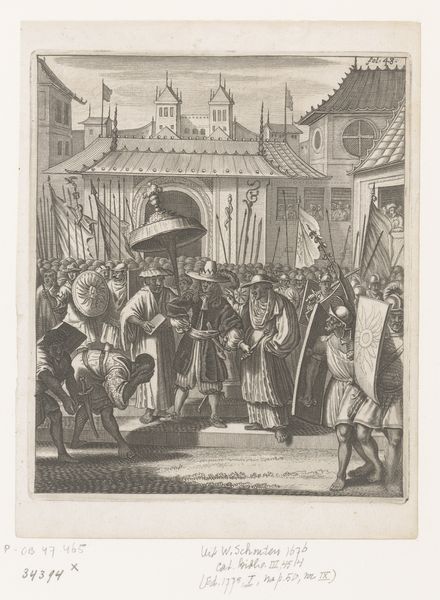
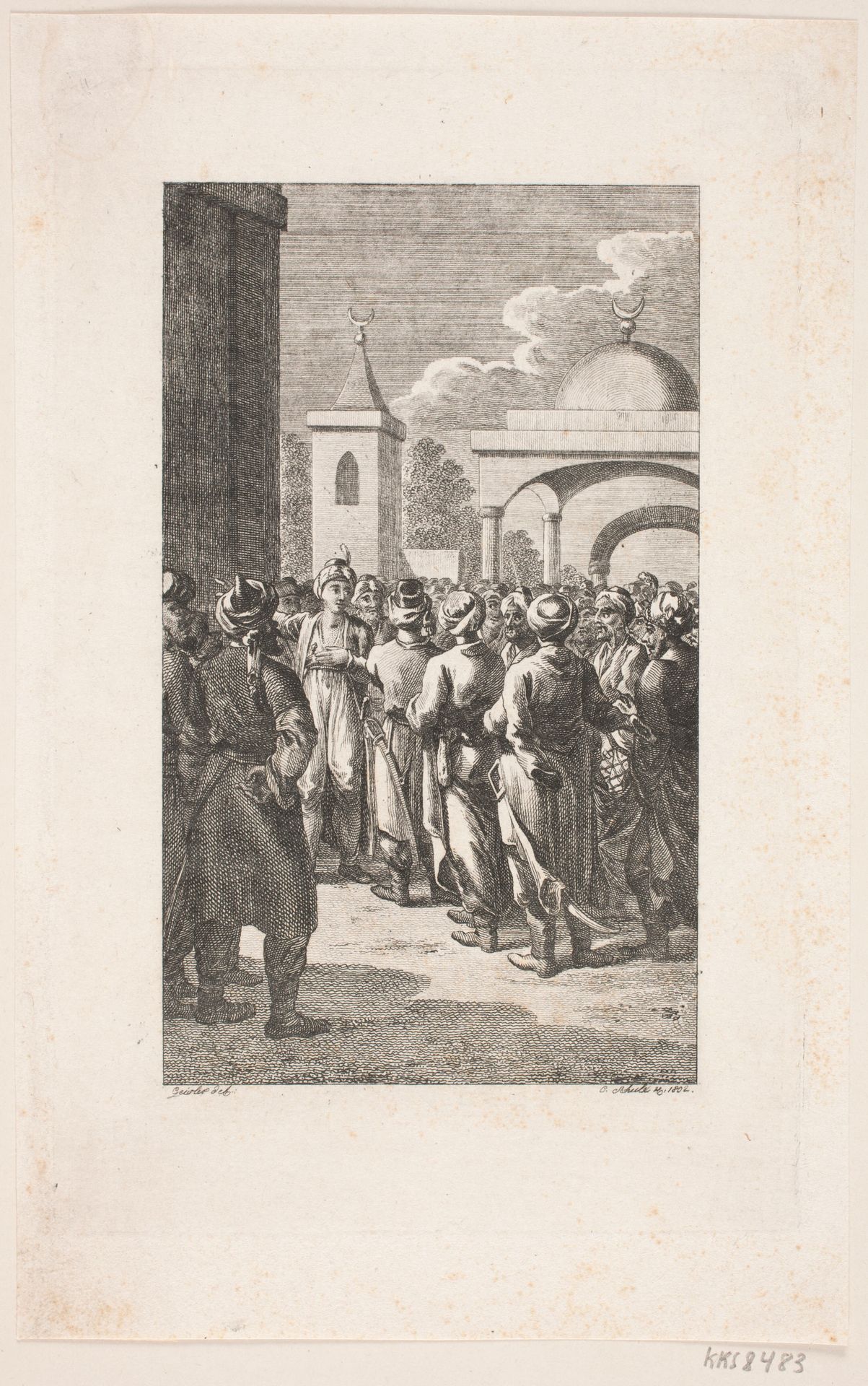
Curator: This is Georg Christian Schule's "Tyrkisk gadescene," created in 1802. It's a print, an engraving actually, depicting a street scene in what was then Ottoman Turkey. What strikes you most about it? Editor: Immediately, it's the monochromatic intensity—almost austere. All that laboriously etched detail. It feels heavy somehow, despite being a relatively small print. The social context is implicit; I want to know the kind of artisanal production it involved and where was this print intended to be consumed? Curator: That sense of density certainly contributes to the mood. Consider the repeating motifs--the turbans, the domes topped with crescent moons. Schule is deploying those familiar signs of Orientalism. It certainly gives the image symbolic weight as a record. Editor: Orientalism indeed! You see that too. It highlights the social perspective; it seems to me, focusing as it does on creating this vision, a Westerner's exoticised vision constructed via the work. It feels consumed by consumption itself. What kind of circulation would a scene such as this command? Curator: Absolutely. And what purpose did this imagined image serve? In Schule's cultural milieu, the 'Orient' represented a space of fantasy, a reservoir of symbols representing despotism and sensual luxury. A society outside of European understanding. Editor: It certainly feels constructed as a commodity of cultural difference, which in turn depends on material distribution and accessible production means to become powerful as image. A romantic ideal filtered through accessible manufacture? Curator: Precisely. Perhaps for Schule and his audience, these repeated symbols served as a visual shorthand, conjuring an entire world, but viewed with European values. Consider that imposing building, as opposed to the crowd of similar looking people. A clear demonstration of social power, right? Editor: Agreed. That imposition reflects its purpose of dissemination and ideological position so sharply through the use of a reproducible material. Curator: Looking again at this print, the more subtle nuances in Schulze’s portrayal start to appear and begin to raise unanswered questions regarding his possible intentions. Editor: Absolutely. For me, this has really underlined how crucial the modes of making are to unlocking such works of art.
Tyrkisk gadescene 1802


Artwork details
- Medium
- print, engraving
- Dimensions
- 151 mm (height) x 96 mm (width) (plademaal)
- Location
- SMK - Statens Museum for Kunst
Tags
landscape
figuration
romanticism
orientalism
line
cityscape
genre-painting
history-painting
engraving
Comments
No comments
About this artwork
Curator: This is Georg Christian Schule's "Tyrkisk gadescene," created in 1802. It's a print, an engraving actually, depicting a street scene in what was then Ottoman Turkey. What strikes you most about it? Editor: Immediately, it's the monochromatic intensity—almost austere. All that laboriously etched detail. It feels heavy somehow, despite being a relatively small print. The social context is implicit; I want to know the kind of artisanal production it involved and where was this print intended to be consumed? Curator: That sense of density certainly contributes to the mood. Consider the repeating motifs--the turbans, the domes topped with crescent moons. Schule is deploying those familiar signs of Orientalism. It certainly gives the image symbolic weight as a record. Editor: Orientalism indeed! You see that too. It highlights the social perspective; it seems to me, focusing as it does on creating this vision, a Westerner's exoticised vision constructed via the work. It feels consumed by consumption itself. What kind of circulation would a scene such as this command? Curator: Absolutely. And what purpose did this imagined image serve? In Schule's cultural milieu, the 'Orient' represented a space of fantasy, a reservoir of symbols representing despotism and sensual luxury. A society outside of European understanding. Editor: It certainly feels constructed as a commodity of cultural difference, which in turn depends on material distribution and accessible production means to become powerful as image. A romantic ideal filtered through accessible manufacture? Curator: Precisely. Perhaps for Schule and his audience, these repeated symbols served as a visual shorthand, conjuring an entire world, but viewed with European values. Consider that imposing building, as opposed to the crowd of similar looking people. A clear demonstration of social power, right? Editor: Agreed. That imposition reflects its purpose of dissemination and ideological position so sharply through the use of a reproducible material. Curator: Looking again at this print, the more subtle nuances in Schulze’s portrayal start to appear and begin to raise unanswered questions regarding his possible intentions. Editor: Absolutely. For me, this has really underlined how crucial the modes of making are to unlocking such works of art.
Comments
No comments