About this artwork
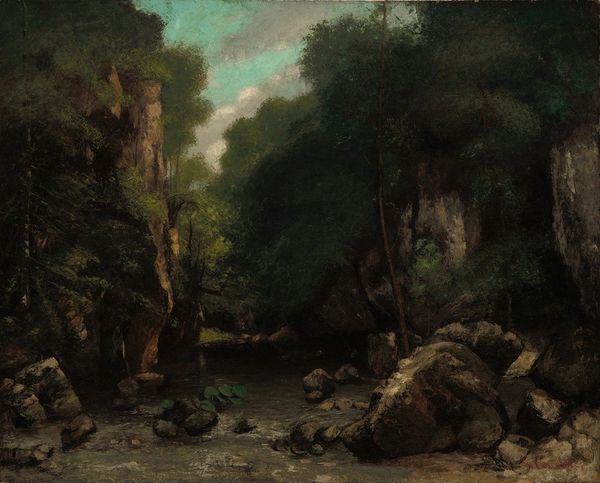
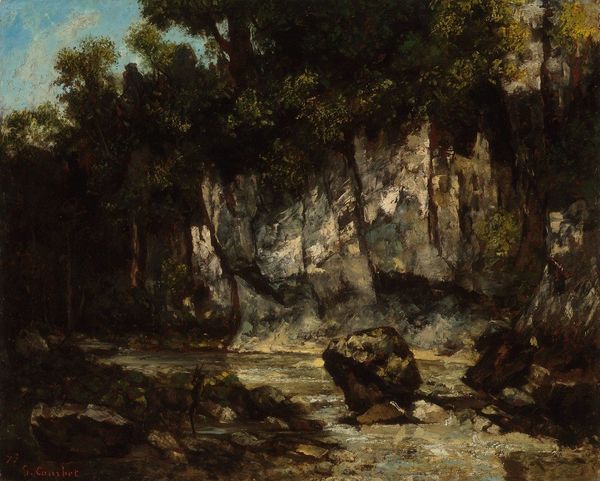
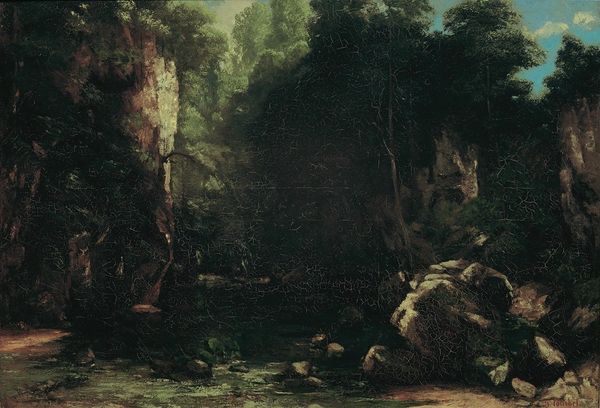
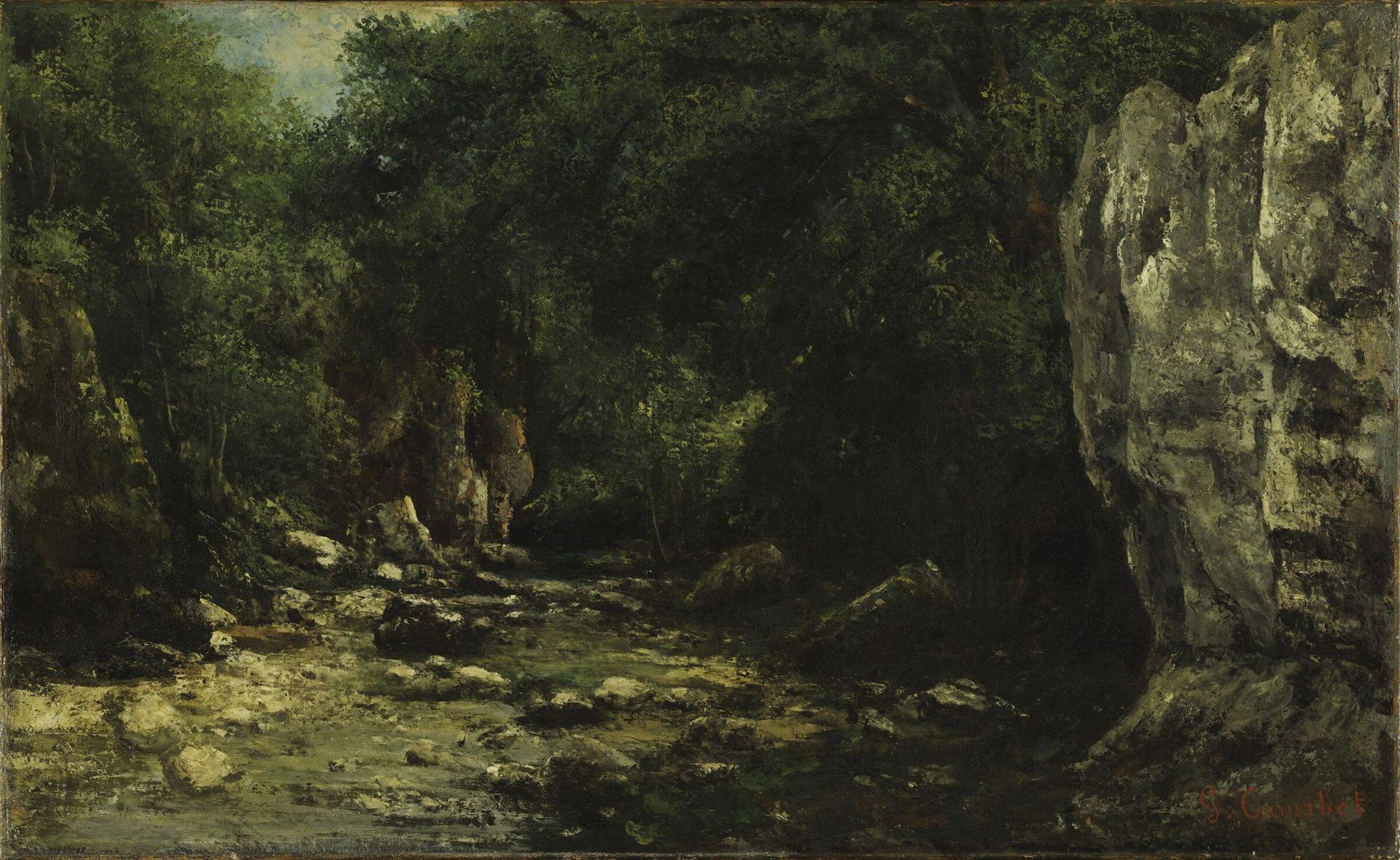
Curator: Gustave Courbet painted "A Brook at Le Puits Noir, near Ornans," and it now resides at the Harvard Art Museums. Editor: It feels so tactile! Look at the density of the paint, especially in those rocks on the right. It’s almost sculptural. Curator: Courbet was deeply invested in representing the landscape of his native Franche-Comté. He challenged the academic painting traditions. His paintings were very material. Editor: Absolutely. You can see Courbet working the paint to mimic the very textures of rock, water, and foliage. It really speaks to his engagement with the physical labor of painting. Curator: And his choice of subject matter—a humble brook instead of a grand historical scene—was a deliberate act, challenging the established hierarchy of genres. Editor: Yes, in a way, he’s democratizing art, placing value on the everyday, on the tangible world around him. It’s a radical materiality, connecting labor to subject matter. Curator: Seeing the way the paint has been used makes one contemplate the socio-political implications of the representation. Editor: Exactly, this wasn’t just about pretty scenery, was it? It’s about asserting the importance of the physical world, challenging artistic and social hierarchies.
A Brook at Le puits noir, near Ornans
c. 1864


Artwork details
- Dimensions
- 55 x 89 cm (21 5/8 x 35 1/16 in.) framed: 79.4 x 113 x 8.9 cm (31 1/4 x 44 1/2 x 3 1/2 in.)
- Location
- Harvard Art Museums
- Copyright
- CC0 1.0
Comments
Share your thoughts
About this artwork
Curator: Gustave Courbet painted "A Brook at Le Puits Noir, near Ornans," and it now resides at the Harvard Art Museums. Editor: It feels so tactile! Look at the density of the paint, especially in those rocks on the right. It’s almost sculptural. Curator: Courbet was deeply invested in representing the landscape of his native Franche-Comté. He challenged the academic painting traditions. His paintings were very material. Editor: Absolutely. You can see Courbet working the paint to mimic the very textures of rock, water, and foliage. It really speaks to his engagement with the physical labor of painting. Curator: And his choice of subject matter—a humble brook instead of a grand historical scene—was a deliberate act, challenging the established hierarchy of genres. Editor: Yes, in a way, he’s democratizing art, placing value on the everyday, on the tangible world around him. It’s a radical materiality, connecting labor to subject matter. Curator: Seeing the way the paint has been used makes one contemplate the socio-political implications of the representation. Editor: Exactly, this wasn’t just about pretty scenery, was it? It’s about asserting the importance of the physical world, challenging artistic and social hierarchies.
Comments
Share your thoughts