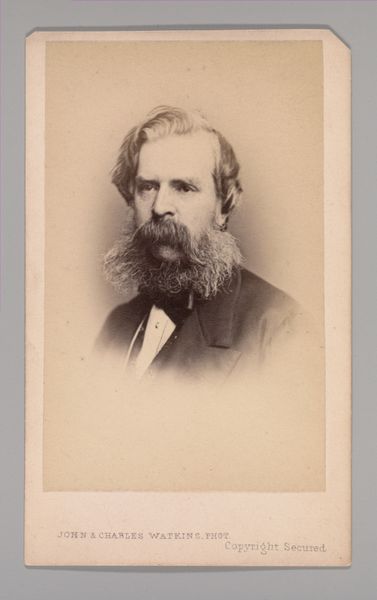
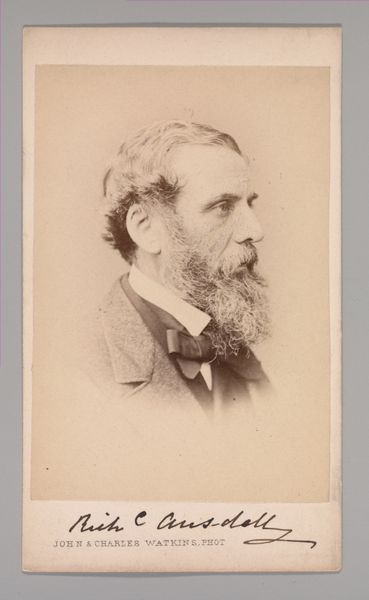
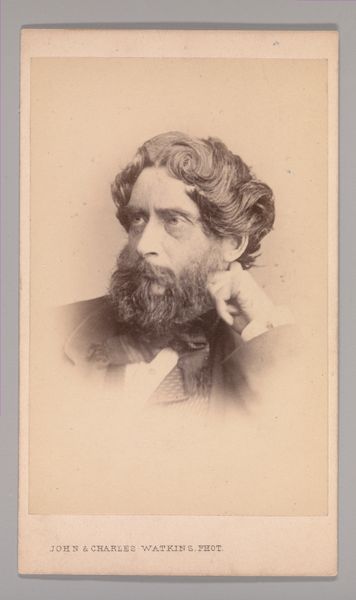
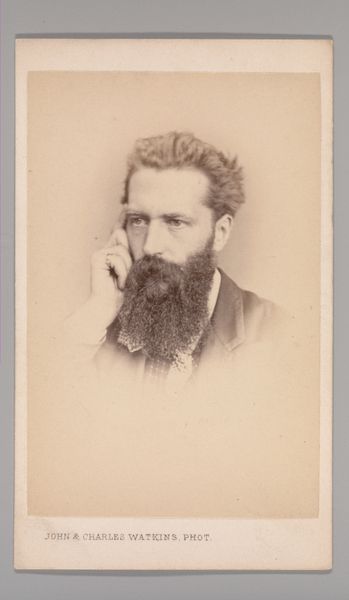
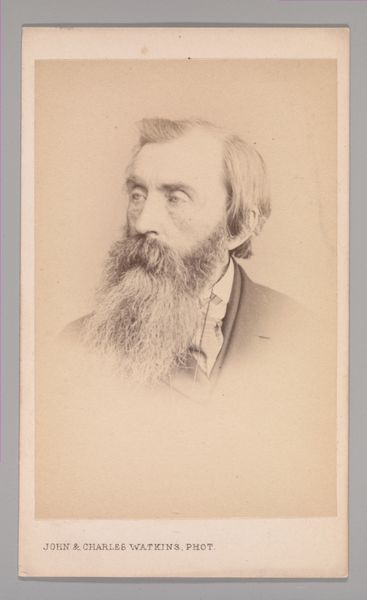
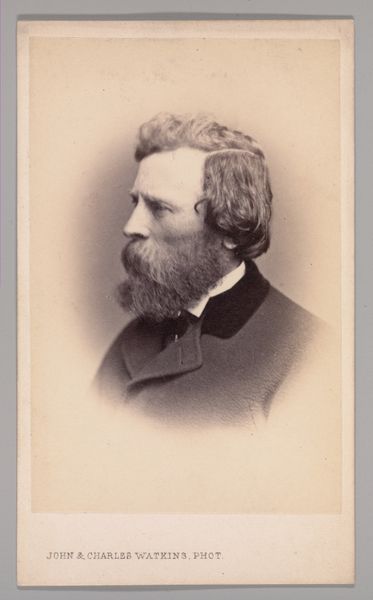
![[William Calder Marshall] by John and Charles Watkins](https://d2w8kbdekdi1gv.cloudfront.net/eyJidWNrZXQiOiAiYXJ0ZXJhLWltYWdlcy1idWNrZXQiLCAia2V5IjogImFydHdvcmtzLzQ4MjhjZDA1LTZhMGMtNDkyNS1hNjc4LWJjZGIzMmM1Y2FkMC80ODI4Y2QwNS02YTBjLTQ5MjUtYTY3OC1iY2RiMzJjNWNhZDBfZnVsbC5qcGciLCAiZWRpdHMiOiB7InJlc2l6ZSI6IHsid2lkdGgiOiAxOTIwLCAiaGVpZ2h0IjogMTkyMCwgImZpdCI6ICJpbnNpZGUifX19)
1860s
[William Calder Marshall]

John and Charles Watkins
1840 - 1875
The Metropolitan Museum of Art
Metropolitan Museum of Art, New York, NYListen to curator's interpretation
Curatorial notes
Editor: Here we have an albumen print from the 1860s by John and Charles Watkins, a portrait of William Calder Marshall. The tones are soft, almost sepia, giving it a dreamlike quality, and the texture is smooth but seems delicate. How do you read the composition and material elements of this photograph? Curator: Its power lies primarily in its formal balance and the careful modulation of light. Notice the subject’s positioning: centrally located, creating symmetry that stabilizes the composition. The tonal range, skillfully manipulated within the albumen print process, sculpts the face, emphasizing the sitter's features. Editor: The light and shadow seem to highlight his seriousness, or maybe even stoicism? Curator: Precisely. Consider how the photographers use the light to define the form of his beard, almost cloud-like, yet distinct in its texture. It becomes not merely facial hair but a compositional element that contributes to the overall aesthetic weight. Editor: So, without any historical information, we can still understand something about the image's impact based purely on how it looks? Curator: Absolutely. We can deduce relationships, create meaning from juxtapositions of light and dark, and interpret the surface itself as a carrier of intentionality. The smoothness of the print juxtaposed with the intricate detail of the beard creates a visual tension, pushing us to further contemplate its qualities. Editor: That’s a great point. I was so focused on the subject’s expression. Paying closer attention to the contrast in textures creates a richer interpretation. Curator: Indeed. The photographic print itself, its physical presence, is also important as a medium in shaping the forms and affecting our experience. It prompts us to examine how visual rhetoric creates and sustains significance in the piece.