

1695
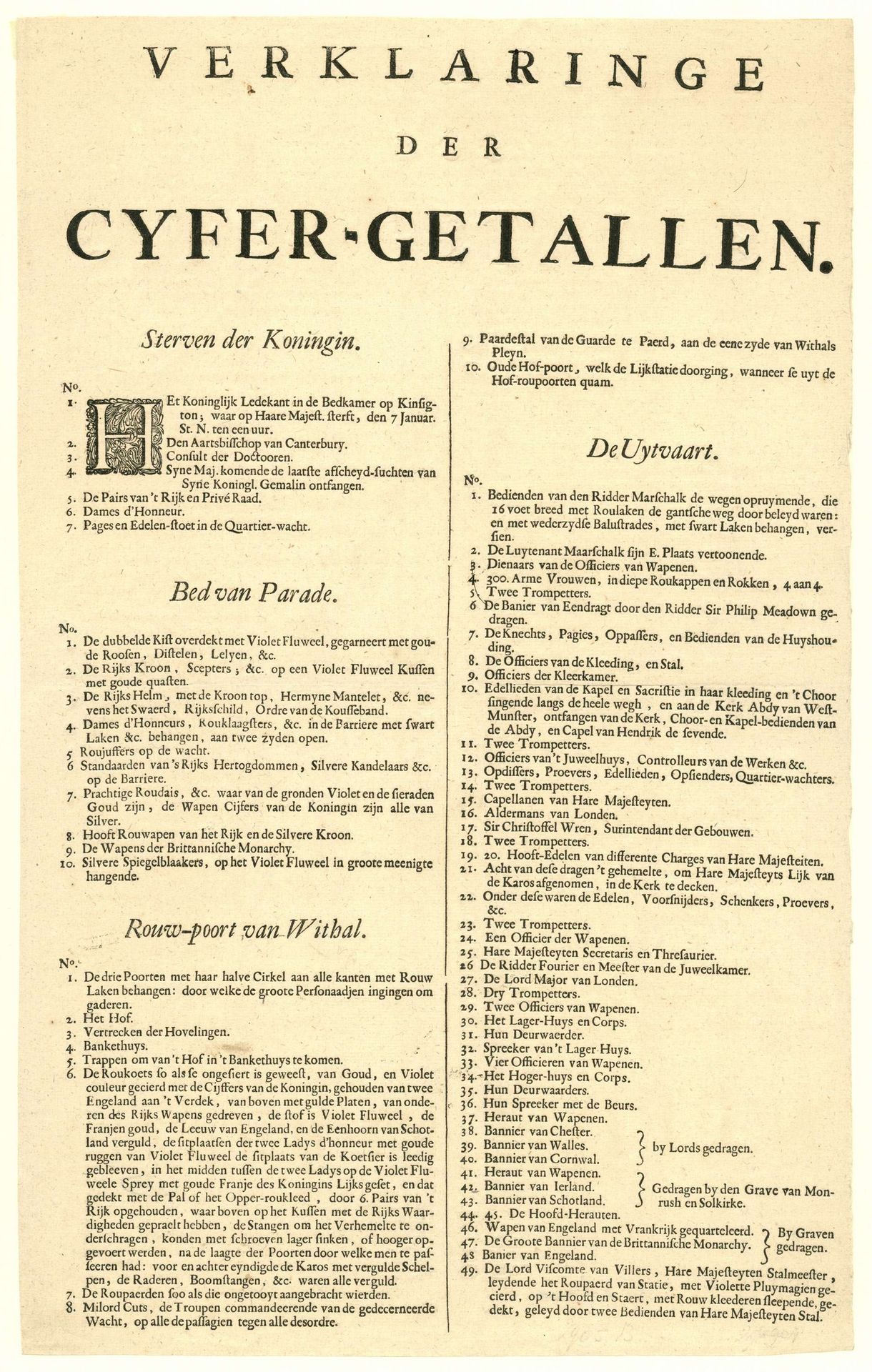
Legenda bij de eerste vier platen uit de prentenserie over het overlijden en de lijkstatie van Maria II Stuart, koningin van Engeland, 1695

Pieter Persoy
1668 - 1714Location
RijksmuseumListen to curator's interpretation
Curatorial notes
Curator: Here, we’re looking at “Legenda bij de eerste vier platen uit de prentenserie over het overlijden en de lijkstatie van Maria II Stuart, koningin van Engeland, 1695,” a print made by Pieter Persoy in 1695. Editor: It’s so densely packed with text. Immediately, it evokes a sense of historical weight, almost like peering into a forgotten manuscript, perhaps detailing royal protocols and societal ranks involved in Queen Mary’s passing. I am interested in the material. Is that etching or engraving? Curator: Actually, this piece combines both techniques. The image is primarily an engraving, which allowed for finer lines and greater detail, crucial for conveying the elaborate costumes and heraldry depicted. It is a reproductive print intended for a wide audience, illustrating complex mourning rituals, social hierarchies, and material displays during a queen’s funeral. Editor: The way it meticulously catalogues every detail of the procession speaks volumes about the values of that era, the emphasis on ritual and spectacle and the ways this translates to maintaining a strict hierarchy. It feels like a document asserting order in the face of mortality. Tell me more of the purpose of prints in society at this moment. Curator: Exactly. Prints like these served to disseminate information and propaganda and reinforce social norms across geographical space and social strata. This detailed documentation of the queen's funeral became a crucial marker for royal authority, utilizing mass-produced imagery as an instrument for both national mourning and reinforcing dynastic continuity and societal expectations surrounding power and succession. The materiality also speaks to printmaking processes as inherently social in their very reproduction. Editor: Absolutely! I’m struck by how such structured grief is also a reflection of an intricate system—almost like stage direction—where every costume, gesture, and symbolic item contributed to a narrative designed for broad societal consumption. It almost neutralizes personal affect in favor of collective performance, no? Curator: In many ways, that's very perceptive. It is hard to fathom, given our contemporary inclination toward the personal, but its social dimensions also offer deep insight into historical production, consumption, and belief. Editor: It leaves one pondering about where such ostentatious ceremony intersects sincere mourning, perhaps reminding me to be grateful that modern grief tends to leave room for individual processing and privacy. Curator: Well said, both materially and socially a reflection of its time.