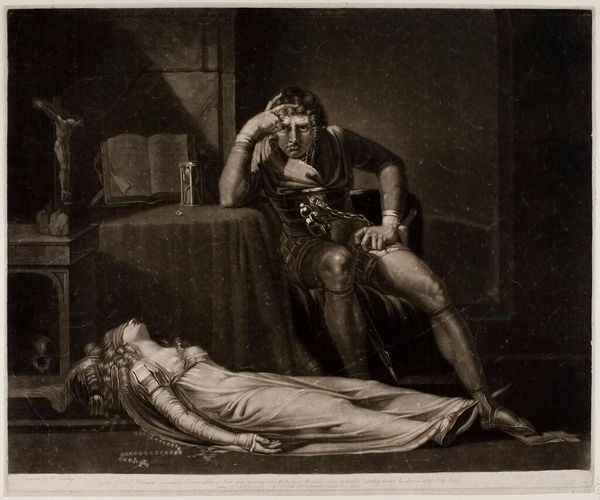
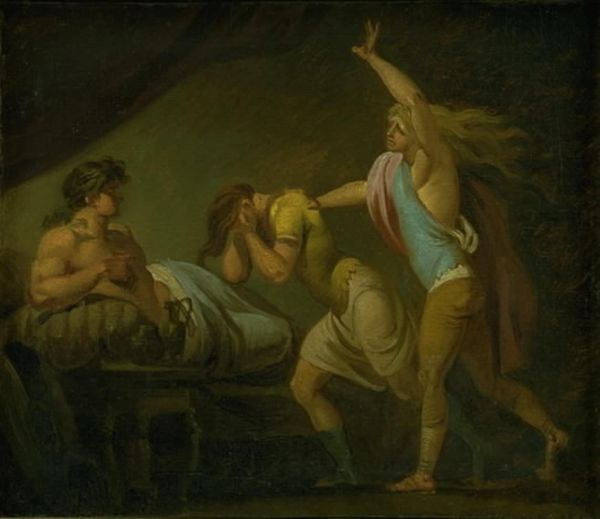
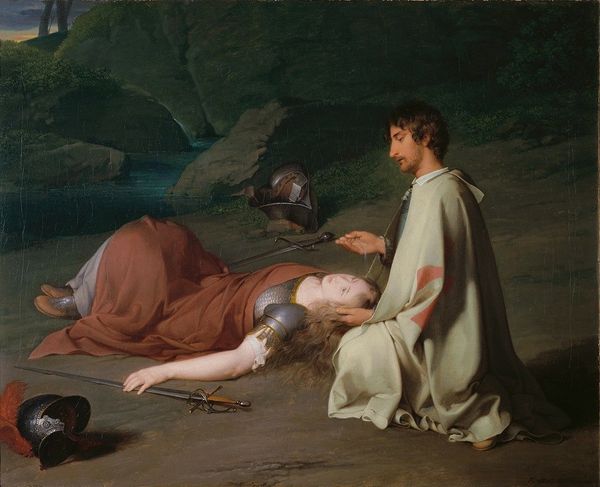
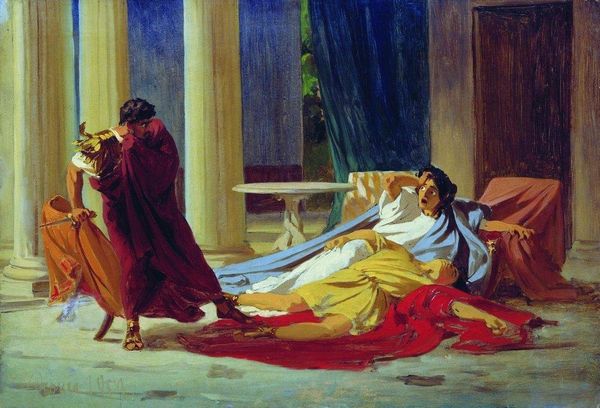
The Italian Count (Ezzelin Bracciaferro, 'Iron Arm', Musing over Meduna, Destroyed by him for Disloyalty, during His Absence in the Holy Land) 1780
0:00
0:00

painting, oil-paint
#
portrait
#
narrative-art
#
painting
#
oil-paint
#
oil painting
#
portrait reference
#
neo expressionist
#
romanticism
#
history-painting
#
facial portrait
#
portrait art
#
fine art portrait
Copyright: Public domain
In Henry Fuseli's 1780 painting, "The Italian Count," we see a starkly lit scene dominated by contrasting forms. The rigid angles of the architecture confine the composition, emphasizing the Count's turbulent emotional state. Fuseli uses a dramatic tenebrism effect, casting deep shadows that heighten the psychological tension between the Count and the lifeless figure at his feet. The sword, leaning against the wall, is a harsh vertical line which punctuates the somber mood. The red of the Count's attire and the draped cloth draw the eye. This staging of the scene employs semiotic codes that invite us to interpret the dynamics of power, betrayal, and death. The Count's posture is a study in conflicted feelings, as his gesture of contemplation suggests remorse. Fuseli prompts viewers to explore the complexities of human emotions, acknowledging that art's purpose is to provoke thought and re-evaluation.
Comments
No comments
Be the first to comment and join the conversation on the ultimate creative platform.
 Collect
 React
React Comment
More like this