1949
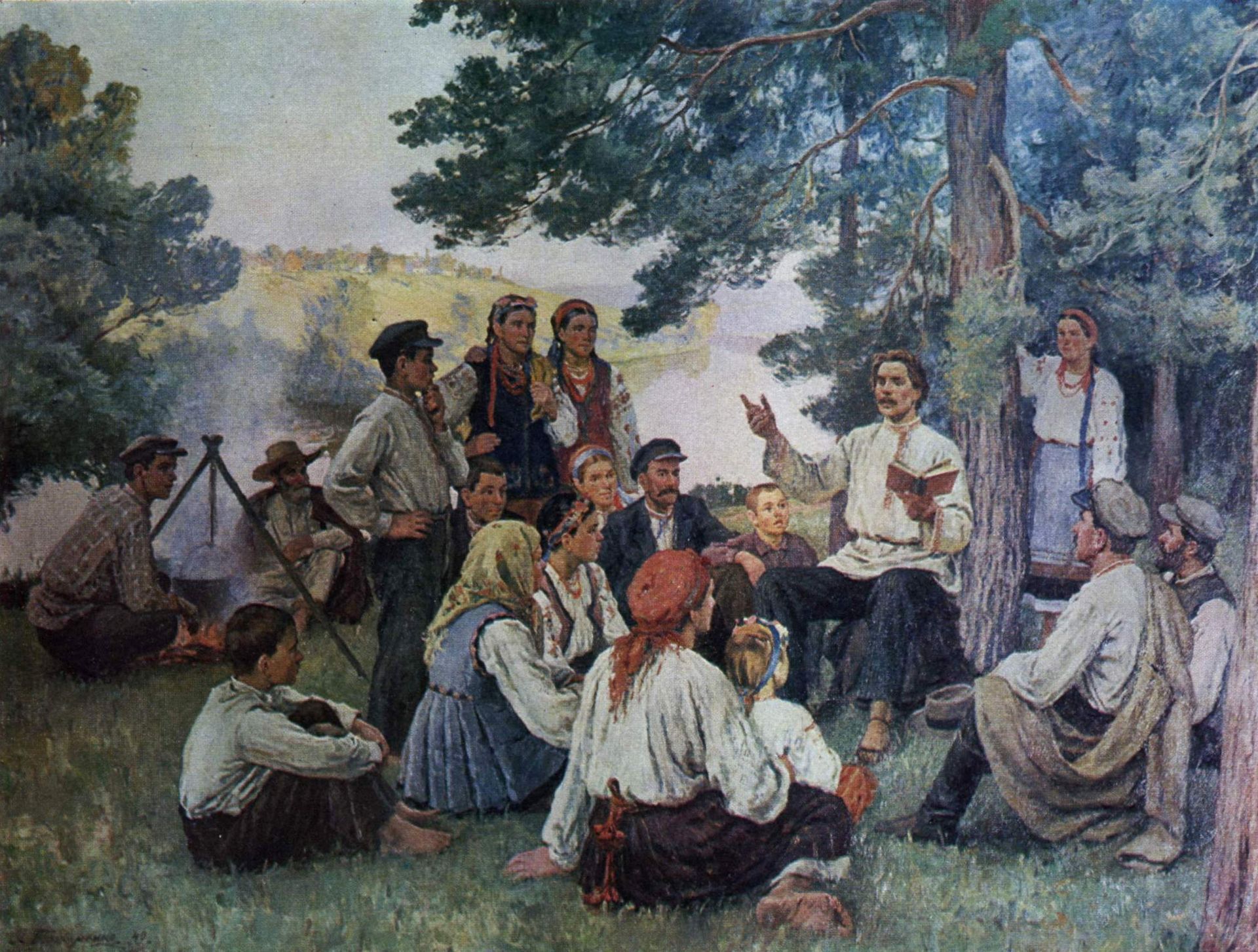
Gorky Reads Shevchenko's Works to Peasants in the Village of Manuilovtsi

Listen to curator's interpretation
Curatorial notes
Curator: Looking at this idyllic scene, I am struck by the sense of collective absorption. What do you see? Editor: It does exude a sense of unity. Though, perhaps unity under a specific, imposed narrative? The painting, rendered in oil on canvas, is entitled "Gorky Reads Shevchenko's Works to Peasants in the Village of Manuilovtsi". It's dated 1949, by Karpo Trokhymenko. Curator: Imposed how? Gorky and Shevchenko were towering figures representing Ukrainian culture. Surely, sharing their works is inherently beneficial, empowering even? Editor: Of course, on the surface, disseminating literature appears purely positive. But in the context of post-war Soviet Union, Socialist Realism was often deployed as a tool for ideological indoctrination. Who decides which voices are amplified? Note how carefully the faces are painted – everyone looks receptive and... perhaps too uniform? It raises questions about artistic freedom. Curator: It's interesting to consider what messages are conveyed, but doesn’t it speak to cultural pride too? This is clearly a very deliberately posed setting, almost staged. The composition reinforces this: Gorky elevated in the center, figures attentively arranged around him. Editor: Precisely. Art served the state, and here, Ukrainian cultural figures are mobilized in that project. And consider the intended audience: What would they think? How would this scene resonate with people intimately familiar with their work? And further – could there be tensions between those identifying primarily as Ukrainian versus as Soviet? The intersection of identity, power, and cultural narrative feels vital here. Curator: Indeed. Even without overt propaganda, there's an inescapable political dimension here. A seemingly simple act of literary sharing is loaded with broader cultural implications, particularly relating to the construction of identity and belonging in the wake of war and Soviet power. What a powerful image. Editor: It's a reminder to engage with these kinds of works critically. Never accept them at face value. Keep challenging, keep questioning.