About this artwork
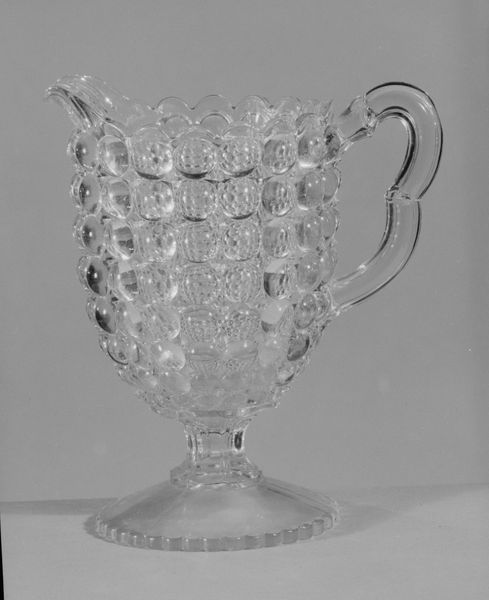
This compote was made by Adams and Company. Its clear glass and detailed craftsmanship invite us to explore the interplay of form and function. Notice how the overall structure presents a play of circles: from the spherical adornments on the stem to the bowl's textured surface, covered in raised, bubble-like forms. These shapes catch and refract light, creating a visual texture that enlivens the piece, and the symmetrical arrangement of elements, from the base to the bowl, offers a sense of balance and order. This compote also prompts us to consider the cultural codes embedded in its design. Is it purely decorative, or does it suggest social meanings? The arrangement of circles on its surface might destabilize fixed meanings, inviting new ways of thinking about space and representation. Consider how the formal qualities of the compote interact with its potential use and symbolic value, reminding us that every artwork is a site of ongoing interpretation.
Compote
1870 - 1890

Adams and Company
@adamsandcompany
The Metropolitan Museum of Art
Metropolitan Museum of Art, New York, NYArtwork details
- Medium
- glass, sculpture
- Dimensions
- H. 4 3/4 in. (12.1 cm); Diam. 5 1/2 in. (14 cm)
- Location
- Metropolitan Museum of Art, New York, NY
- Copyright
- Public Domain
Tags
glass
sculpture
Comments
Be the first to share your thoughts about this work.
About this artwork
This compote was made by Adams and Company. Its clear glass and detailed craftsmanship invite us to explore the interplay of form and function. Notice how the overall structure presents a play of circles: from the spherical adornments on the stem to the bowl's textured surface, covered in raised, bubble-like forms. These shapes catch and refract light, creating a visual texture that enlivens the piece, and the symmetrical arrangement of elements, from the base to the bowl, offers a sense of balance and order. This compote also prompts us to consider the cultural codes embedded in its design. Is it purely decorative, or does it suggest social meanings? The arrangement of circles on its surface might destabilize fixed meanings, inviting new ways of thinking about space and representation. Consider how the formal qualities of the compote interact with its potential use and symbolic value, reminding us that every artwork is a site of ongoing interpretation.
Comments
Be the first to share your thoughts about this work.