About this artwork
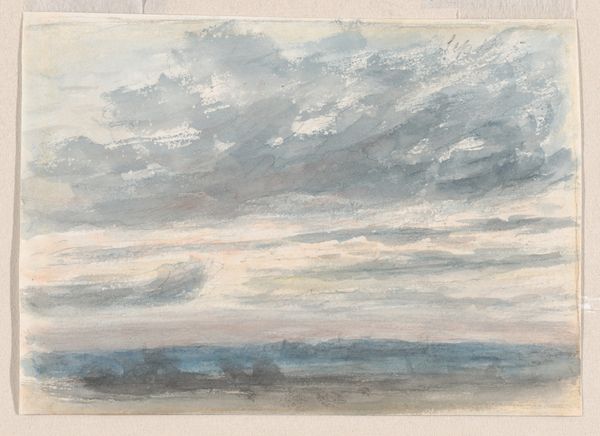
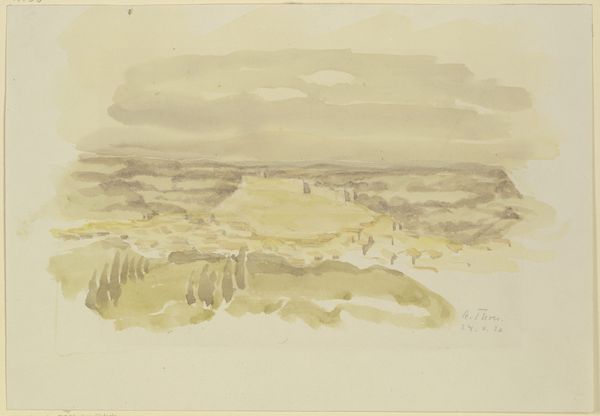
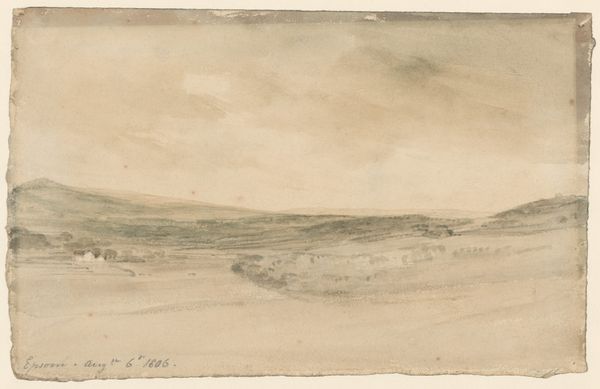
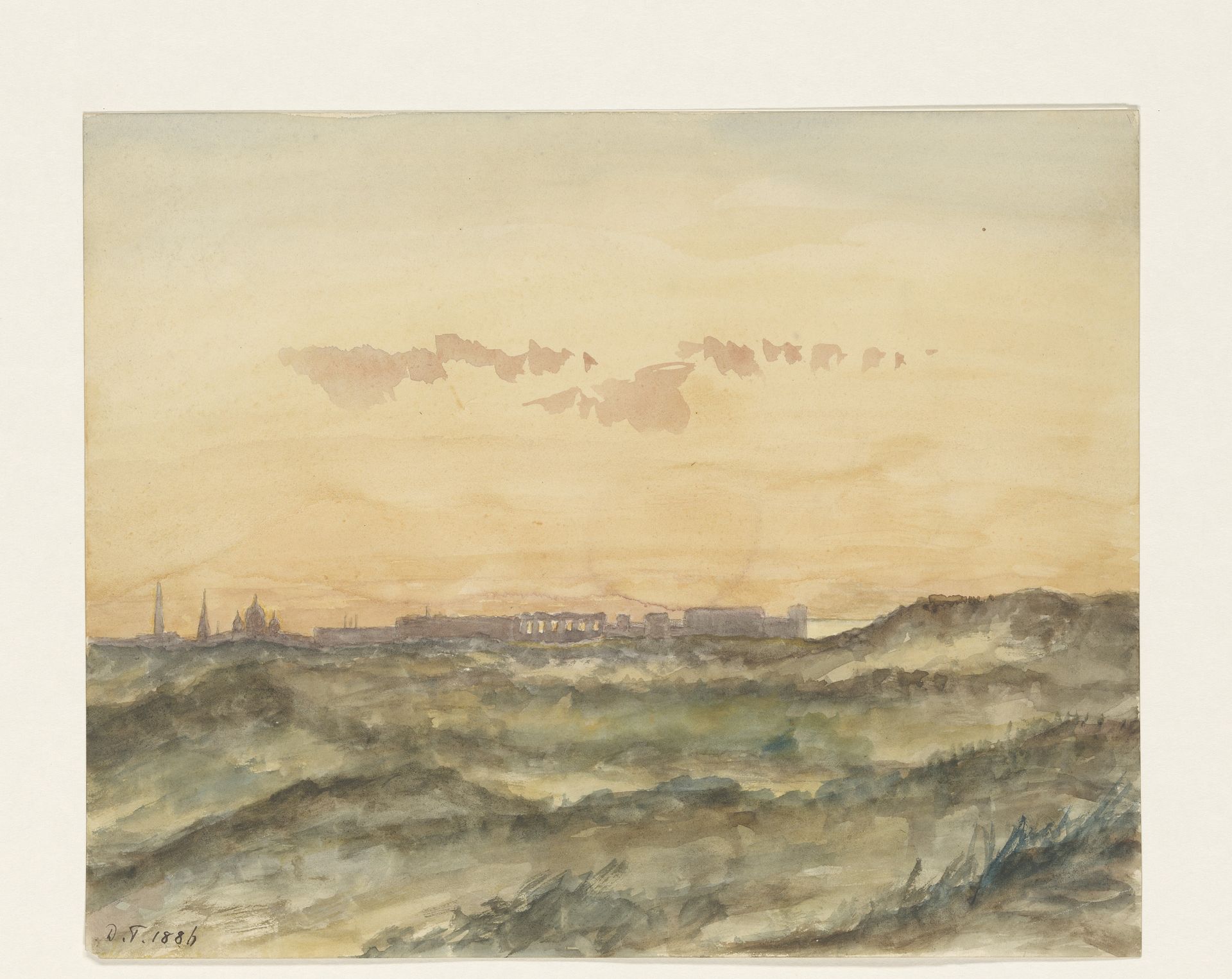
Editor: Here we have Dirk Arnoldus Tavenraat's watercolor, "Landscape with the Silhouette of a City in the Distance," possibly from the late 1880s. The washes of color are really interesting. It makes me think about atmospheric perspective. What do you make of its apparent simplicity? Curator: Its simplicity belies a complex relationship to labor and artistic production. Consider the use of watercolor. It allowed for quick, on-site work—plein air—suggesting a shift in artistic labor, a democratized process. Was this accessible to all, or did material constraints persist, limiting participation based on social standing? Editor: That's interesting, I hadn't thought about the access to materials aspect. I guess the ‘everydayness’ fools me. What about the scene itself, does that contribute to its meaning? Curator: Absolutely. The cityscape, reduced to a distant silhouette, highlights a tension. Are we meant to admire the landscape's inherent qualities, or is the looming city a marker of industrial progress and the changing social structures that implies? What materials fuelled that growth and who controlled their production? Think about the paper itself: wood pulp was becoming increasingly common. How does this shift from rag paper affect the work's longevity and its value as a commodity? Editor: So you’re suggesting that even something that looks pretty straightforward can reflect huge social changes. It makes you think about more than just the image itself. Curator: Precisely. Examining the means of production – the pigments, paper, the very act of outdoor painting - unveils a deeper commentary on art's place within the rapidly changing industrial landscape of the late 19th century. Editor: I see that now, viewing the painting through this lens completely shifts my understanding! Thank you!
Landschap met in de verte het silhouet van een stad
Possibly 1886 - 1889

Dirk Arnoldus Tavenraat
1845 - 1930Location
RijksmuseumArtwork details
- Medium
- painting, plein-air, watercolor
- Dimensions
- height 211 mm, width 264 mm
- Location
- Rijksmuseum
- Copyright
- Rijks Museum: Open Domain
Tags
Comments
Share your thoughts
About this artwork
Editor: Here we have Dirk Arnoldus Tavenraat's watercolor, "Landscape with the Silhouette of a City in the Distance," possibly from the late 1880s. The washes of color are really interesting. It makes me think about atmospheric perspective. What do you make of its apparent simplicity? Curator: Its simplicity belies a complex relationship to labor and artistic production. Consider the use of watercolor. It allowed for quick, on-site work—plein air—suggesting a shift in artistic labor, a democratized process. Was this accessible to all, or did material constraints persist, limiting participation based on social standing? Editor: That's interesting, I hadn't thought about the access to materials aspect. I guess the ‘everydayness’ fools me. What about the scene itself, does that contribute to its meaning? Curator: Absolutely. The cityscape, reduced to a distant silhouette, highlights a tension. Are we meant to admire the landscape's inherent qualities, or is the looming city a marker of industrial progress and the changing social structures that implies? What materials fuelled that growth and who controlled their production? Think about the paper itself: wood pulp was becoming increasingly common. How does this shift from rag paper affect the work's longevity and its value as a commodity? Editor: So you’re suggesting that even something that looks pretty straightforward can reflect huge social changes. It makes you think about more than just the image itself. Curator: Precisely. Examining the means of production – the pigments, paper, the very act of outdoor painting - unveils a deeper commentary on art's place within the rapidly changing industrial landscape of the late 19th century. Editor: I see that now, viewing the painting through this lens completely shifts my understanding! Thank you!
Comments
Share your thoughts