About this artwork
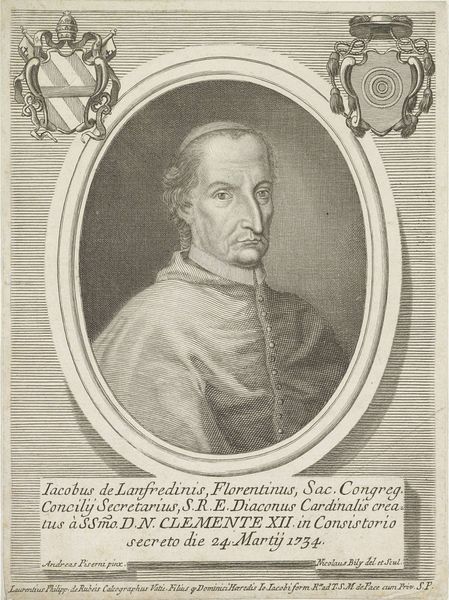
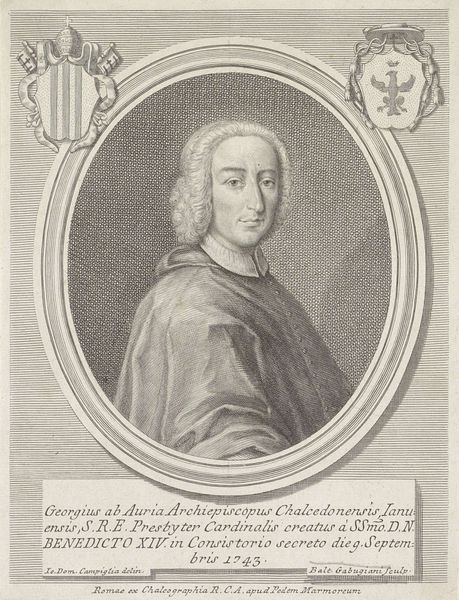
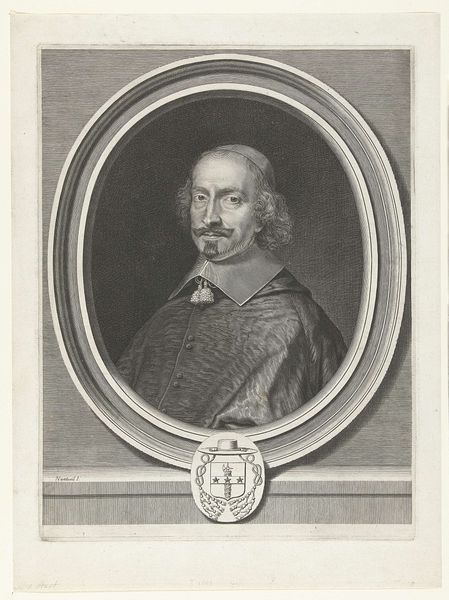
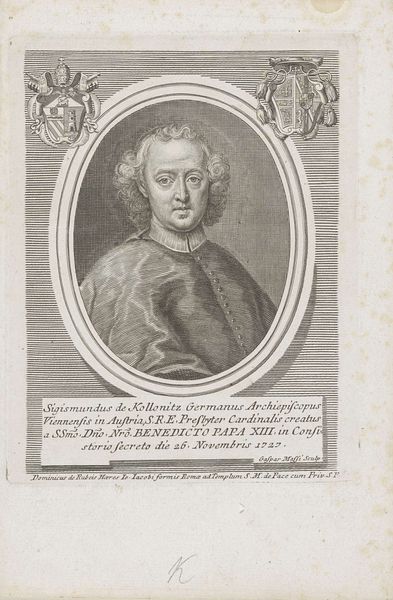
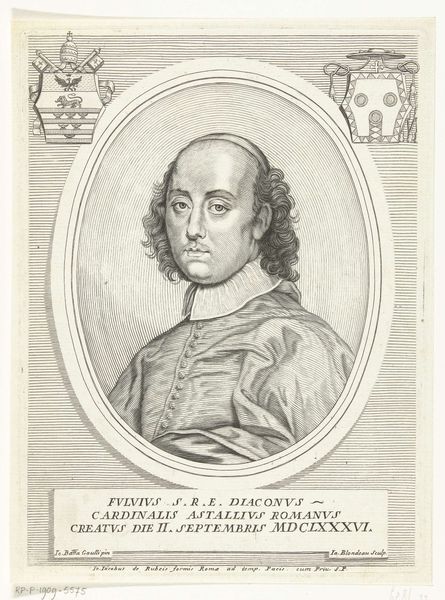
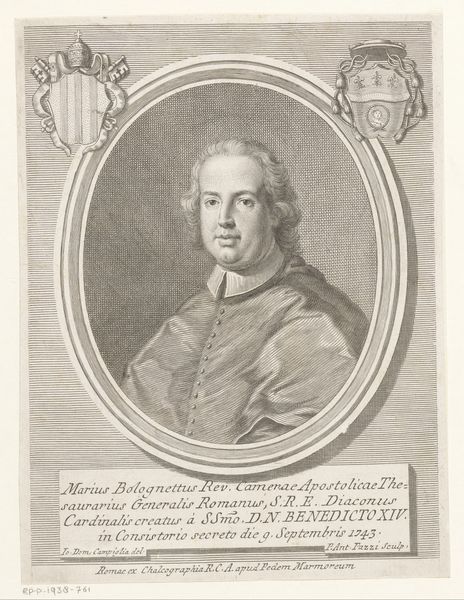
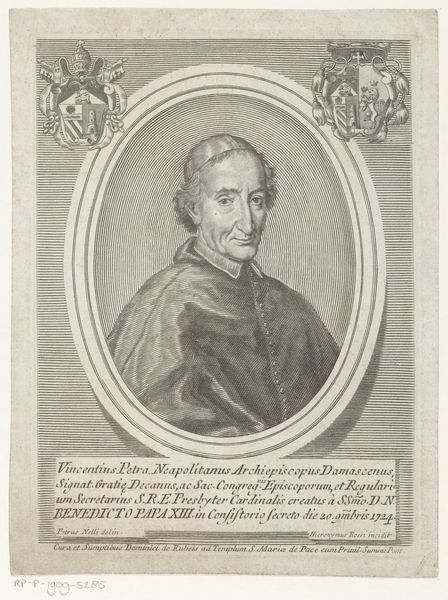
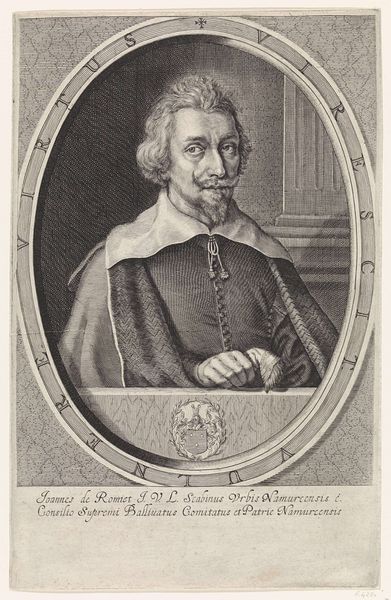
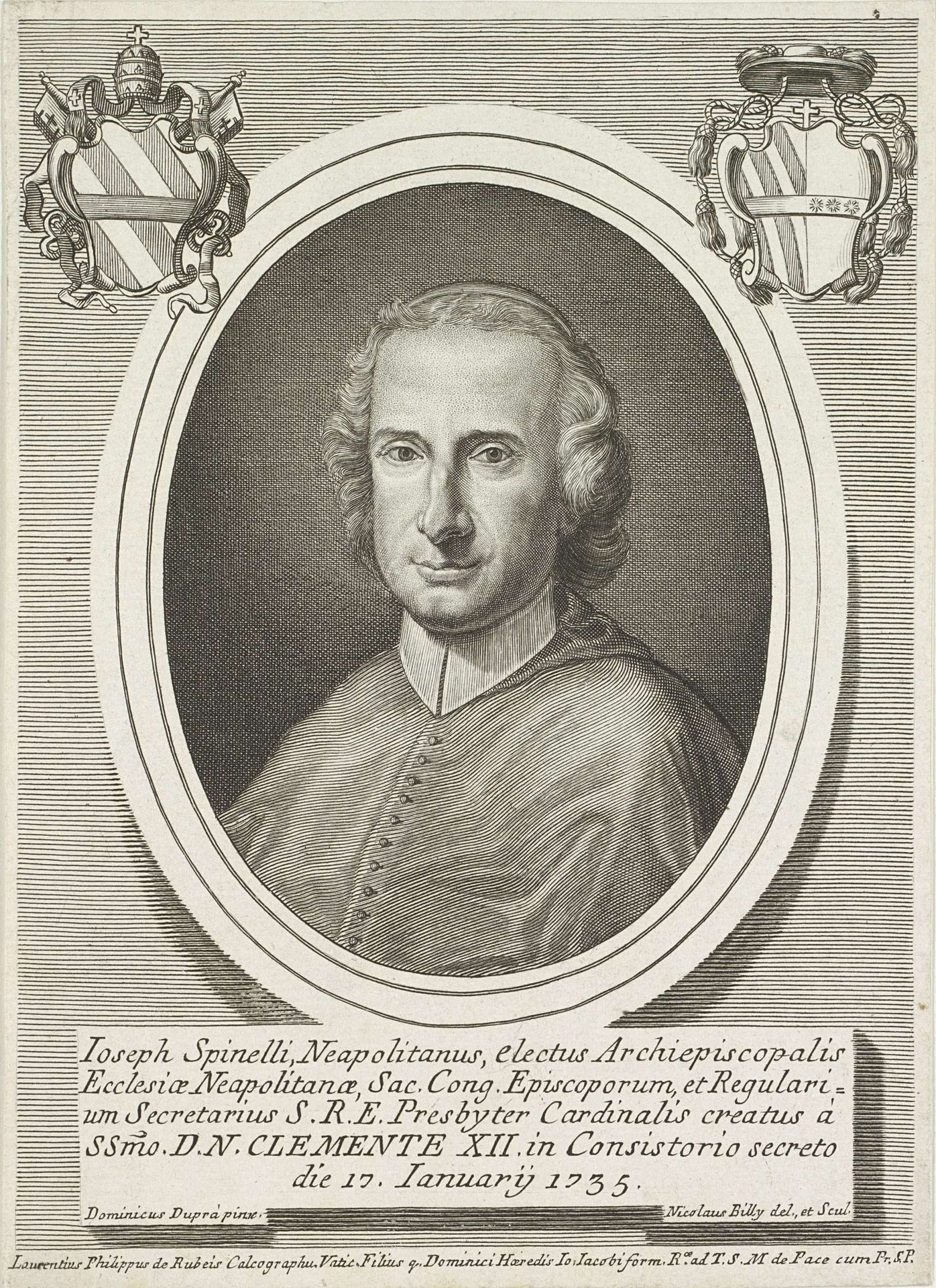
Curator: Here, we have "Portret van kardinaal Giuseppe Spinelli," an engraving dating roughly from 1750 to 1800, by Nicolo Billy. Editor: The somber and somewhat detached expression is striking. The lines of the face are meticulously etched, but it doesn’t quite convey a warmth of personality, does it? Almost as if the sitter is performing a role. Curator: Precisely. Portraiture in this era was deeply intertwined with social and political power. The subject, Cardinal Spinelli, held a prominent position within the church, and the portrait itself functions as a kind of propaganda, reinforcing his status and authority. Consider the ornate heraldry flanking his image, underscoring his lineage and significance. Editor: It’s interesting how the print medium, in this instance, amplifies the sense of authority. The precise lines, almost mechanical in their execution, speak to a broader context of the institutional power held by the church at the time. The inscription below the portrait emphasizes titles and affiliations – it’s about reinforcing existing social structures. Curator: Yes, and even the oval frame can be seen as a symbol of containment, fitting the individual neatly into a pre-defined category within the social hierarchy. I wonder, what narratives are intentionally omitted or subdued here? For example, we get very little about his personal attributes or life experiences, don’t you agree? Editor: Absolutely, the focus remains solely on his clerical identity. It is about power first, and person maybe last, if at all. Curator: The gaze is fixed and unwavering, though somewhat lacking affect. It's not really inviting engagement, but rather demanding deference. We must keep in mind the art market’s dynamics too, though: it is an engraving. It could be easily reproduced, disseminating this particular representation of power. Editor: And I see the production of these prints and the image itself, therefore, part of a continuous play in constructing and reinforcing ideas and concepts about power, influence, and role through imagery, both then and for future generations.

Artwork details
- Dimensions
- height 224 mm, width 160 mm
- Copyright
- Rijks Museum: Open Domain
Comments
Share your thoughts
About this artwork
Curator: Here, we have "Portret van kardinaal Giuseppe Spinelli," an engraving dating roughly from 1750 to 1800, by Nicolo Billy. Editor: The somber and somewhat detached expression is striking. The lines of the face are meticulously etched, but it doesn’t quite convey a warmth of personality, does it? Almost as if the sitter is performing a role. Curator: Precisely. Portraiture in this era was deeply intertwined with social and political power. The subject, Cardinal Spinelli, held a prominent position within the church, and the portrait itself functions as a kind of propaganda, reinforcing his status and authority. Consider the ornate heraldry flanking his image, underscoring his lineage and significance. Editor: It’s interesting how the print medium, in this instance, amplifies the sense of authority. The precise lines, almost mechanical in their execution, speak to a broader context of the institutional power held by the church at the time. The inscription below the portrait emphasizes titles and affiliations – it’s about reinforcing existing social structures. Curator: Yes, and even the oval frame can be seen as a symbol of containment, fitting the individual neatly into a pre-defined category within the social hierarchy. I wonder, what narratives are intentionally omitted or subdued here? For example, we get very little about his personal attributes or life experiences, don’t you agree? Editor: Absolutely, the focus remains solely on his clerical identity. It is about power first, and person maybe last, if at all. Curator: The gaze is fixed and unwavering, though somewhat lacking affect. It's not really inviting engagement, but rather demanding deference. We must keep in mind the art market’s dynamics too, though: it is an engraving. It could be easily reproduced, disseminating this particular representation of power. Editor: And I see the production of these prints and the image itself, therefore, part of a continuous play in constructing and reinforcing ideas and concepts about power, influence, and role through imagery, both then and for future generations.
Comments
Share your thoughts