graphic-art, collage, print, typography, woodcut
#
graphic-art
#
collage
# print
#
book
#
typography
#
dada
#
woodcut
Dimensions: 8 x 5 13/16 x 3/16 in. (20.32 x 14.76 x 0.48 cm) (closed)
Copyright: No Copyright - United States
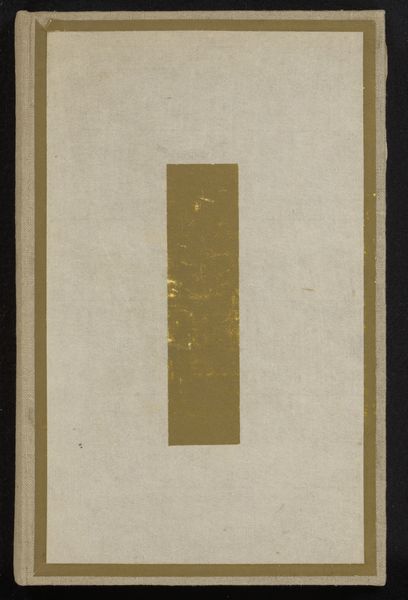
Curator: So, here we have Jean Arp’s book cover for Tristan Tzara’s "Vingt-cinq poèmes," or "Twenty-Five Poems," published in 1918 as part of the Collection Dada Zurich. It includes ten woodcut illustrations. Editor: Right away, I get a very specific feeling from this. There’s a raw, almost primal energy here, a real punch in such a compact space. I keep wanting to touch it. Does anyone else feel this compulsion? Curator: Absolutely, and that’s very Dada, isn’t it? Breaking down the barriers between art and life, inviting tactile, intuitive responses. It challenges the traditional idea of the book cover as merely a decorative or descriptive element. Editor: I think what really hits me is the simplicity, this almost childlike rendering. Like shapes you’d see in a Rorschach test, dark silhouettes intertwined on this amber field. Makes you ask, what *are* those? And does it even matter? Curator: That ambiguity is key. Remember the context: 1918, the end of the First World War. Dada emerged as a direct response to the perceived absurdity and moral bankruptcy that led to the conflict. Abstraction became a weapon. Editor: Exactly! It feels rebellious in its seeming meaninglessness, a total rejection of old narratives. Even the typography has a sort of anti-establishment feel, like, we don’t even need fancy fonts to get our point across. Raw truth, unfiltered emotion. Curator: And the Collection Dada Zurich part is so significant. It positions the work firmly within a network of radical artists and poets. The movement itself as an intervention against established norms, rejecting the art world's complicity in the war effort. Editor: Makes you wonder about Tristan Tzara's poems inside. I bet they mirrored the anarchic spirit, the experimental wordplay you find here. I imagine a book where form and content were deliberately colliding, disrupting assumptions. Curator: Absolutely, a book becomes more than just a book. It is transformed into a performative space, a meeting place between the reader, the artist, and the socio-political moment of its making. It’s pretty exciting to consider, actually. Editor: So true! A tangible little bomb of creative and cultural defiance from the past. What a testament to art’s ability to push boundaries!
Comments

minneapolisinstituteofart almost 2 years ago
⋮
One of the first major books of the antiestablishment Dada movement (1915–23), Twenty-five Poems resulted from the collaboration of the German-French painter and sculptor Jean Arp and French avant-garde poet and essayist Tristin Tzara, the principal founders of Zurich Dada. An early proponent of pure abstraction, Arp exhibited his first abstract works in 1915. For this project, he created a series of ten abstract black-and-white woodcuts as visual complements to Tzara’s nihilist poems, which rejected the idea that life has meaning. In exploring abstraction, Arp attempted to free himself from “traditional forms of art,” adopting a universal organic morphology and exploring the idea of chance in art. A highly influential author and performer, Tzara described the nihilist intent of his Dada poems in the following passage: “I destroy the drawers of the brain and of social organization: spread demoralization wherever I go and cast my hand from heaven to hell, my eyes from hell to heaven, restore the fecund wheel of a universal circus to objective forces and the imagination of every individual.”


Join the conversation
Join millions of artists and users on Artera today and experience the ultimate creative platform.
 Collect
More like this