About this artwork
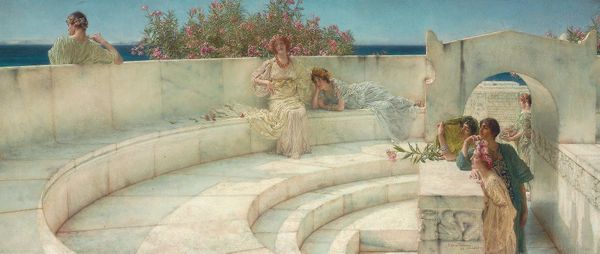
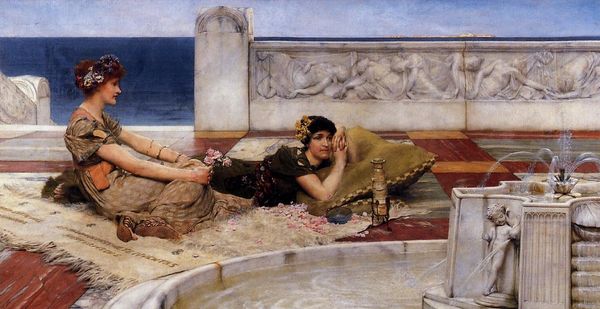
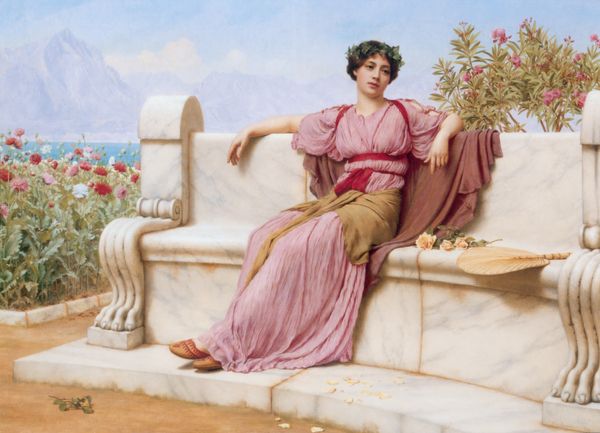
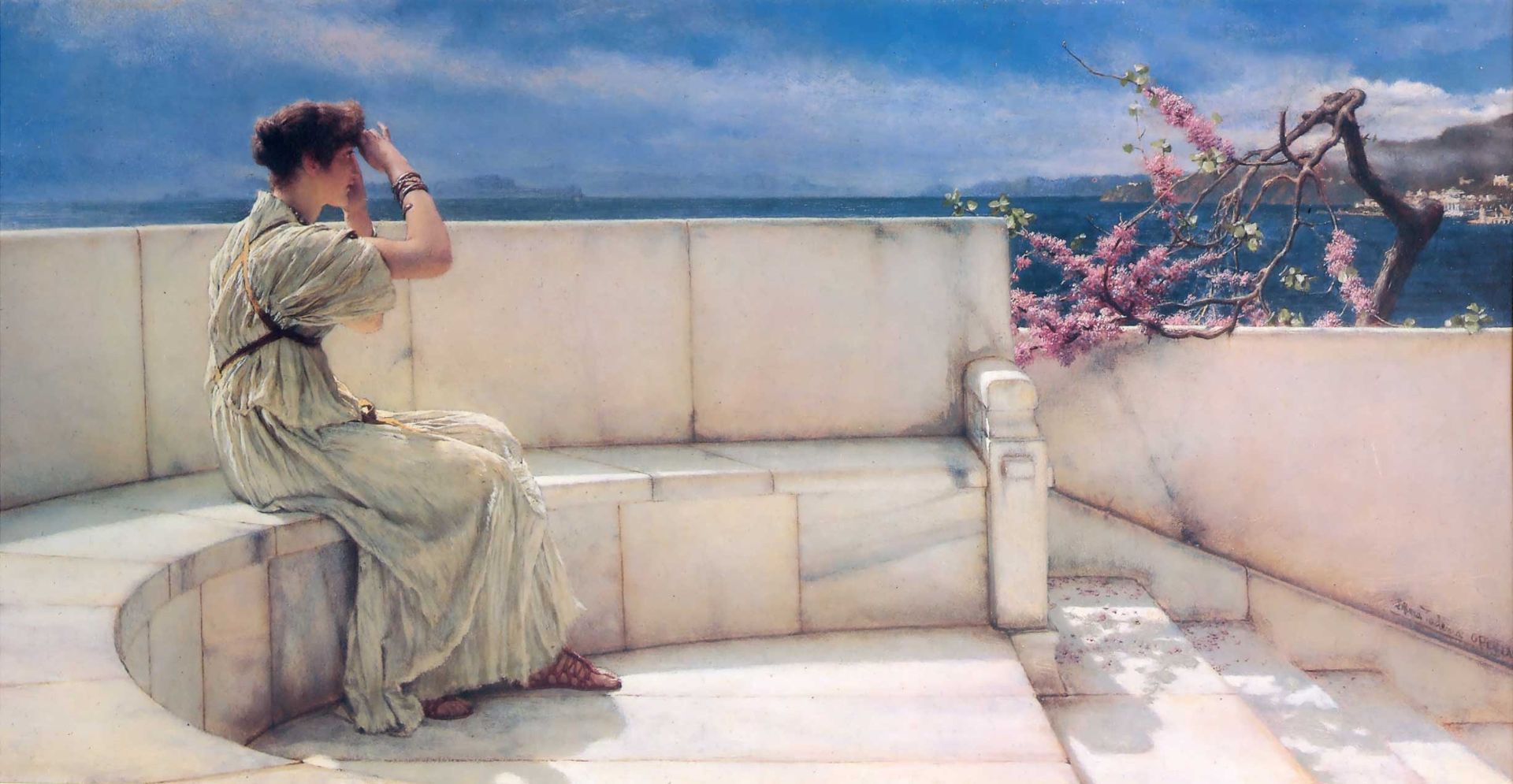
Editor: We're looking at "Expectations" by Lawrence Alma-Tadema, painted in 1885. It seems to be made with oil paint, and it's currently held in a private collection. There's such a wistful mood here, like this woman is waiting for something... How do you interpret this work? Curator: Immediately, I'm drawn to the composition. The cool marble contrasts sharply with the vibrant, almost fleeting, blossoms to the right, creating a powerful visual dichotomy. Consider the structure of the marble bench; its linear rigidity sets a clear foreground. And what of the way the artist uses line and color to guide your eye across the canvas? Editor: The woman in the foreground definitely commands attention, but it's interesting you focus so much on the inanimate objects surrounding her. Is that a conscious decision? Curator: Indeed. Formalism places great emphasis on the object as an autonomous structure, complete within itself. Look closely at how the drape of her dress interacts with the geometry of the bench. Notice how the artist uses tonal modulations in her dress to direct the viewer’s eyes back and forth across the scene. Are we observing a deliberate repetition here, almost a structural echo? Editor: I see what you mean, how the lines and colors interact almost independently of the subject matter. It’s like a story told through shapes and light. I hadn't considered that. Curator: Precisely. The intrinsic qualities – color, line, texture, space – all contribute to an artwork’s deeper meaning. Editor: I guess I've always looked for meaning in the subject first. Curator: Perhaps this exercise has revealed another avenue, and further means to analyze visual representation? Editor: Definitely. I see that focusing on the composition itself can be just as telling as the narrative behind the piece.

Artwork details
- Dimensions
- 45 x 66.1 cm
- Location
- Private Collection
- Copyright
- Public domain
Tags
Comments
Share your thoughts
About this artwork
Editor: We're looking at "Expectations" by Lawrence Alma-Tadema, painted in 1885. It seems to be made with oil paint, and it's currently held in a private collection. There's such a wistful mood here, like this woman is waiting for something... How do you interpret this work? Curator: Immediately, I'm drawn to the composition. The cool marble contrasts sharply with the vibrant, almost fleeting, blossoms to the right, creating a powerful visual dichotomy. Consider the structure of the marble bench; its linear rigidity sets a clear foreground. And what of the way the artist uses line and color to guide your eye across the canvas? Editor: The woman in the foreground definitely commands attention, but it's interesting you focus so much on the inanimate objects surrounding her. Is that a conscious decision? Curator: Indeed. Formalism places great emphasis on the object as an autonomous structure, complete within itself. Look closely at how the drape of her dress interacts with the geometry of the bench. Notice how the artist uses tonal modulations in her dress to direct the viewer’s eyes back and forth across the scene. Are we observing a deliberate repetition here, almost a structural echo? Editor: I see what you mean, how the lines and colors interact almost independently of the subject matter. It’s like a story told through shapes and light. I hadn't considered that. Curator: Precisely. The intrinsic qualities – color, line, texture, space – all contribute to an artwork’s deeper meaning. Editor: I guess I've always looked for meaning in the subject first. Curator: Perhaps this exercise has revealed another avenue, and further means to analyze visual representation? Editor: Definitely. I see that focusing on the composition itself can be just as telling as the narrative behind the piece.
Comments
Share your thoughts