About this artwork
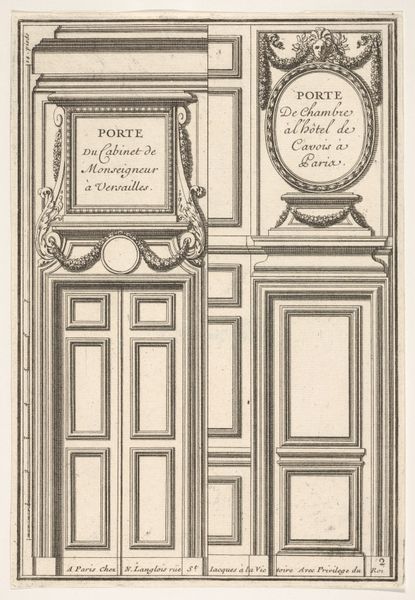
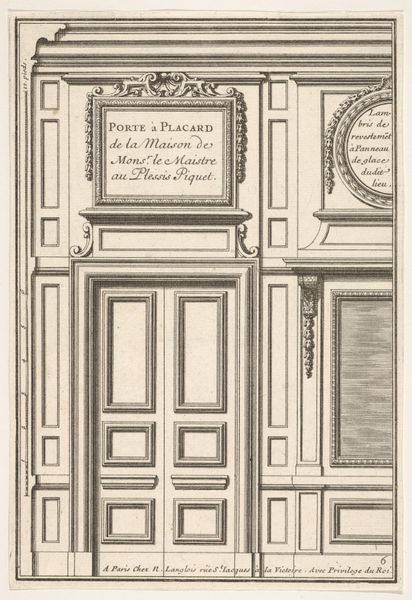
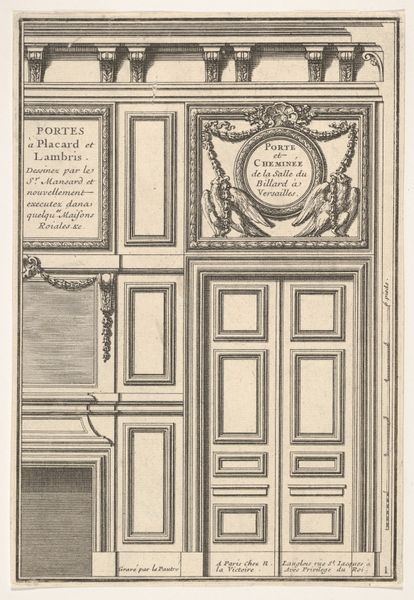
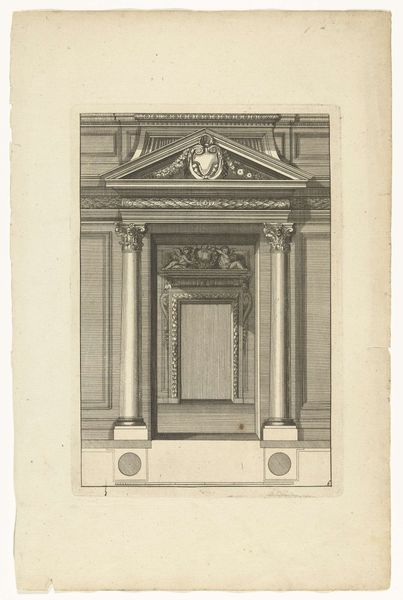
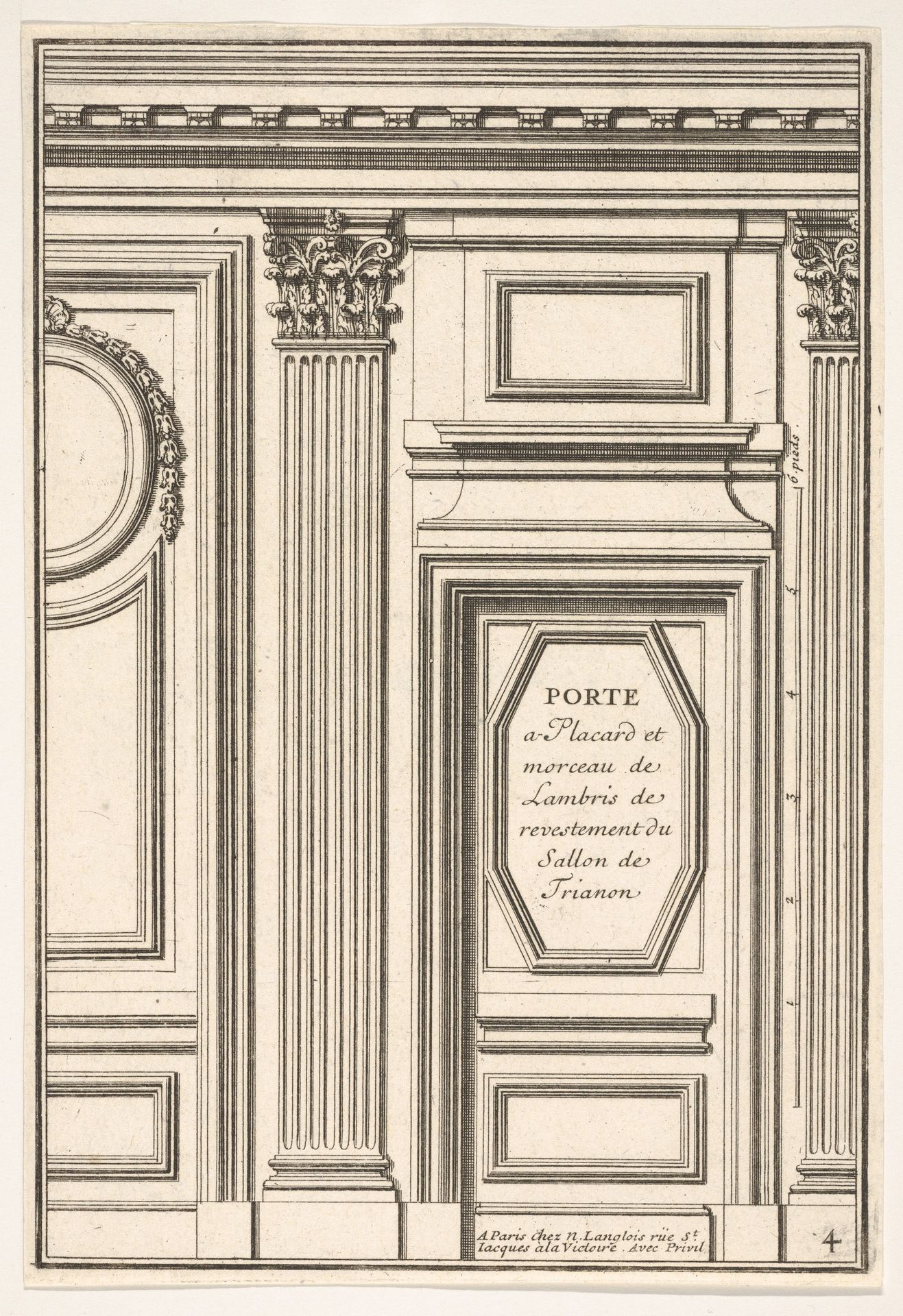
Curator: Looking at this print, my first impression is one of poised stillness. Everything seems meticulously planned and elegantly restrained, a dance between structure and ornamentation. What do you see? Editor: Well, initially, I see potential for Instagram! The detail is so intricate and clean; the lines almost vibrate off the page. It has a calming symmetry, but, you know, also kind of screams "Versailles-era realness" in a maximalist way. Curator: Indeed. What we have here is "Door and Part of the Wainscot in the restored Salon of the Trianon Palace," plate IV from the series 'Portes a Placard et Lambris', a baroque period etching created sometime between 1618 and 1682 by Jean Le Pautre. The print provides a detailed study of architectural elements. Analyzing its visual rhetoric allows us to reflect on class structures in Louis XIV's France. Editor: So, total opulence intended to awe, huh? I see it! It definitely works, even now. Think about how much design aims to create feelings of either cozy intimacy or soaring ambition. I find that interesting because spaces have the power to make people feel so self-conscious. This seems calculated to do just that. Curator: Precisely. The meticulous detail and the rather ostentatious design point to the era's culture of display and power. These elaborate designs helped to maintain a visual hierarchy and perpetuate societal norms, defining specific spatial identities for those in positions of power while emphasizing the exclusion of others. Editor: Yeah. This doorway wasn't built for everyone. Makes you think, doesn’t it? Art and design are powerful because of their ability to embed power structures...or subvert them! I kind of dig how it challenges you, even now. Curator: Definitely. It’s an invitation to look critically, not just at its aesthetic components, but the historical narratives embedded in the image. Editor: For me, it is also how these etchings let you see behind the curtain and understand just how deliberately palaces sought to control your perception.
Door and Part of the Wainscot in the restored Salon of the Trianon Palace, plate IV from the Series 'Portes a Placard et Lambris', published as part of 'L'Architecture à la Mode'
1618 - 1682


Artwork details
- Medium
- drawing, print, etching, architecture
- Dimensions
- image: 7 11/16 x 5 1/4 in. (19.5 x 13.3 cm)
- Location
- Metropolitan Museum of Art, New York, NY
- Copyright
- Public Domain
Tags
Comments
Share your thoughts
About this artwork
Curator: Looking at this print, my first impression is one of poised stillness. Everything seems meticulously planned and elegantly restrained, a dance between structure and ornamentation. What do you see? Editor: Well, initially, I see potential for Instagram! The detail is so intricate and clean; the lines almost vibrate off the page. It has a calming symmetry, but, you know, also kind of screams "Versailles-era realness" in a maximalist way. Curator: Indeed. What we have here is "Door and Part of the Wainscot in the restored Salon of the Trianon Palace," plate IV from the series 'Portes a Placard et Lambris', a baroque period etching created sometime between 1618 and 1682 by Jean Le Pautre. The print provides a detailed study of architectural elements. Analyzing its visual rhetoric allows us to reflect on class structures in Louis XIV's France. Editor: So, total opulence intended to awe, huh? I see it! It definitely works, even now. Think about how much design aims to create feelings of either cozy intimacy or soaring ambition. I find that interesting because spaces have the power to make people feel so self-conscious. This seems calculated to do just that. Curator: Precisely. The meticulous detail and the rather ostentatious design point to the era's culture of display and power. These elaborate designs helped to maintain a visual hierarchy and perpetuate societal norms, defining specific spatial identities for those in positions of power while emphasizing the exclusion of others. Editor: Yeah. This doorway wasn't built for everyone. Makes you think, doesn’t it? Art and design are powerful because of their ability to embed power structures...or subvert them! I kind of dig how it challenges you, even now. Curator: Definitely. It’s an invitation to look critically, not just at its aesthetic components, but the historical narratives embedded in the image. Editor: For me, it is also how these etchings let you see behind the curtain and understand just how deliberately palaces sought to control your perception.
Comments
Share your thoughts