About this artwork
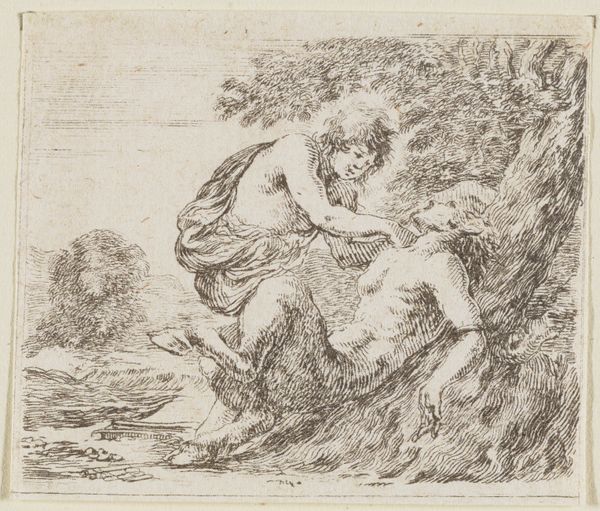
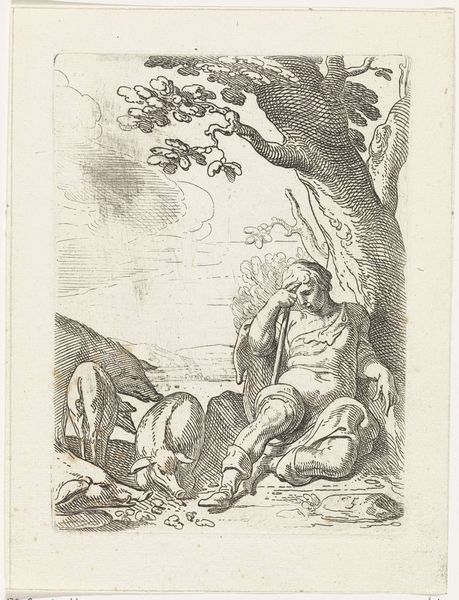
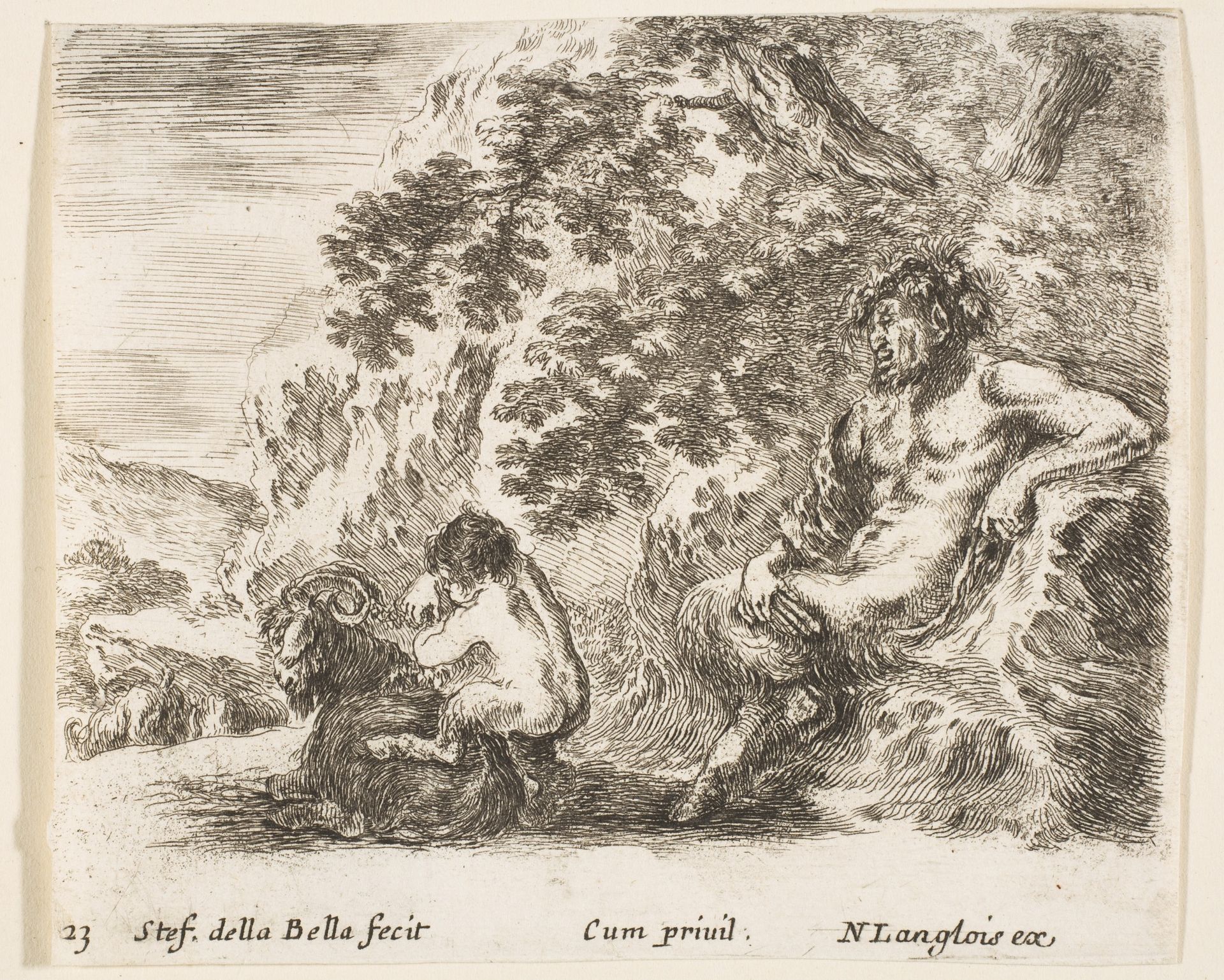
Editor: Here we have Stefano della Bella’s etching, "Plate 23: a satyr sitting against a tree…", dating back to the 1640s. The cross-hatching creates such intricate details! The satyr's languid pose sets a calm, almost idyllic mood, despite his overtly sexual nature. How does the piece speak to you? Curator: It speaks to the pervasive influence of classical mythology on the Baroque period, and its public role. Della Bella’s choice to depict a satyr, traditionally figures of unrestrained desire, alongside a child and goat offers an interesting commentary on innocence versus experience, no? How these themes would resonate with audiences in 17th century Europe? Editor: That’s a good point. I was focused on the figures themselves, but the arrangement definitely invites further thought. Is it meant to be an allegory, perhaps? Curator: Perhaps. Consider the format too: an etching intended for distribution. Who was this imagery catering to, and what socio-political statement was Della Bella making by circulating such a piece? Was he subtly critiquing the aristocracy or perhaps reaffirming classical ideals within a changing world? Editor: So, understanding the audience shapes our interpretation. It challenges this view of pastoral calm by implying this tension between ‘natural’ impulse and social norms. Curator: Exactly! The “idyllic mood” you described is in dialogue with potentially subversive imagery, shaping and complicating its reception, even now, centuries later. What new interpretations do you have now? Editor: I didn’t initially consider its controversial themes. Viewing art through this historical, distribution lens definitely sheds a different light! Curator: Agreed! Art is rarely created in a vacuum. Its impact lies in its cultural dialogue.
Plate 23: a satyr sitting against a tree to right and holding a flute in his right hand, a child playing with a goat to left, from 'Diversi capricci'
1639 - 1649

Stefano della Bella
1610 - 1664
The Metropolitan Museum of Art
Metropolitan Museum of Art, New York, NYArtwork details
- Medium
- drawing, print, etching, engraving
- Dimensions
- Sheet: 3 1/4 × 3 13/16 in. (8.2 × 9.7 cm)
- Location
- Metropolitan Museum of Art, New York, NY
- Copyright
- Public Domain
Tags
drawing
narrative-art
baroque
etching
landscape
classical-realism
figuration
child
pencil drawing
genre-painting
engraving
Comments
Be the first to share your thoughts about this work.
About this artwork
Editor: Here we have Stefano della Bella’s etching, "Plate 23: a satyr sitting against a tree…", dating back to the 1640s. The cross-hatching creates such intricate details! The satyr's languid pose sets a calm, almost idyllic mood, despite his overtly sexual nature. How does the piece speak to you? Curator: It speaks to the pervasive influence of classical mythology on the Baroque period, and its public role. Della Bella’s choice to depict a satyr, traditionally figures of unrestrained desire, alongside a child and goat offers an interesting commentary on innocence versus experience, no? How these themes would resonate with audiences in 17th century Europe? Editor: That’s a good point. I was focused on the figures themselves, but the arrangement definitely invites further thought. Is it meant to be an allegory, perhaps? Curator: Perhaps. Consider the format too: an etching intended for distribution. Who was this imagery catering to, and what socio-political statement was Della Bella making by circulating such a piece? Was he subtly critiquing the aristocracy or perhaps reaffirming classical ideals within a changing world? Editor: So, understanding the audience shapes our interpretation. It challenges this view of pastoral calm by implying this tension between ‘natural’ impulse and social norms. Curator: Exactly! The “idyllic mood” you described is in dialogue with potentially subversive imagery, shaping and complicating its reception, even now, centuries later. What new interpretations do you have now? Editor: I didn’t initially consider its controversial themes. Viewing art through this historical, distribution lens definitely sheds a different light! Curator: Agreed! Art is rarely created in a vacuum. Its impact lies in its cultural dialogue.
Comments
Be the first to share your thoughts about this work.