About this artwork
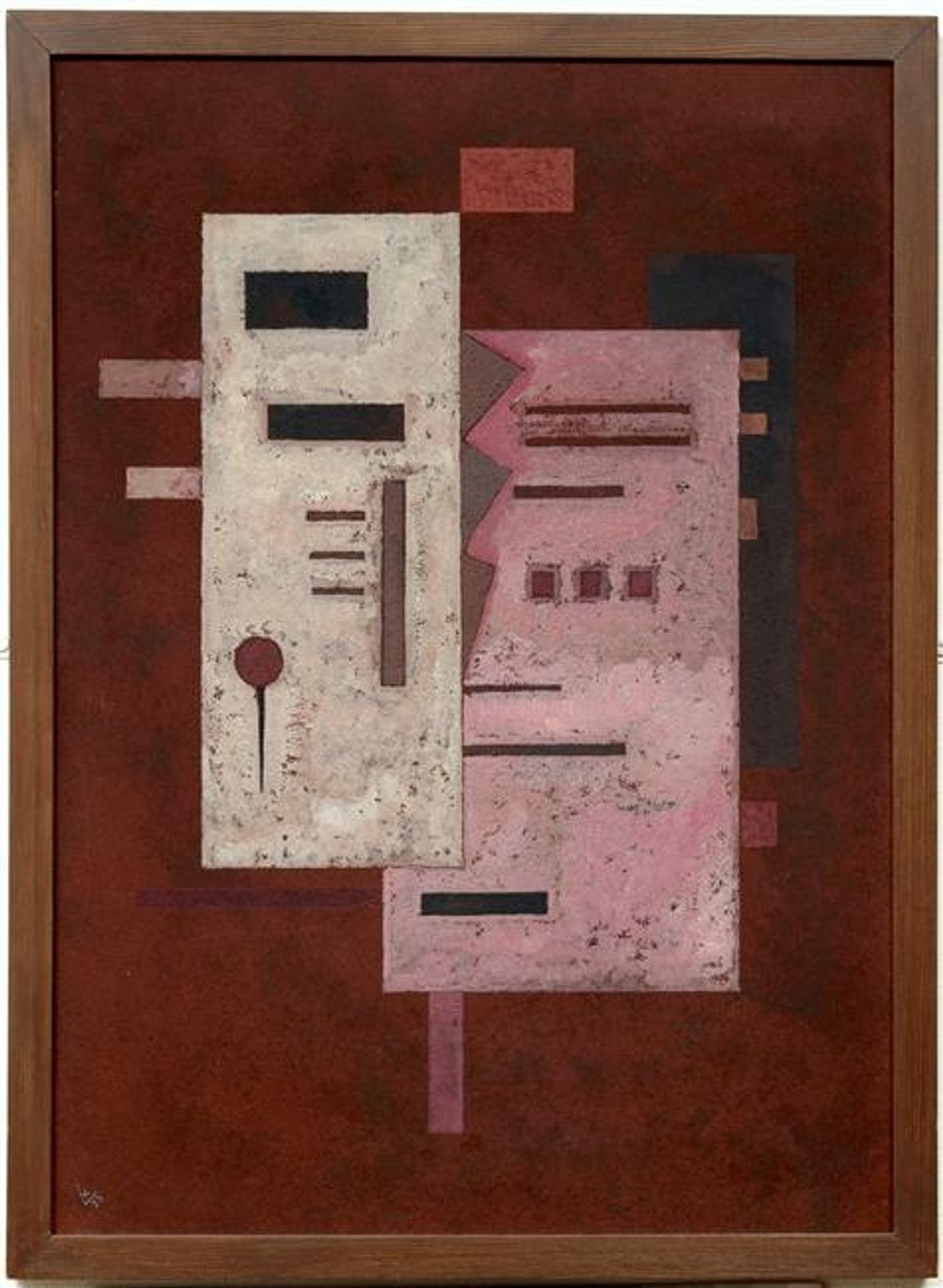
Wassily Kandinsky made this painting, "Soft Roughness," with oil on cardboard, and what strikes me first is its unexpected palette. The surface has this gritty, textured feel, like the paint was applied and then worried, almost rubbed back. It's not smooth or polished, but rather raw and immediate. Look at the way the white rectangle on the left seems to hover against the rust-red background, its edges softened and blurred. And then there’s this tiny red circle with a tail, like a misplaced comma, sitting on the surface like an afterthought, yet crucial to the whole composition. Kandinsky’s work always feels like a conversation, maybe a dialogue between representation and abstraction, or between the planned and the accidental, with echoes of artists like Paul Klee, who shared a similar interest in childlike imagery and the poetry of simple forms. Ultimately, I think that art is a reminder that meaning is always in motion, always open to interpretation, and that’s what makes it so alive.
Soft roughness
1933

Wassily Kandinsky
1866 - 1944Location
Musée des Beaux-Arts de Nantes, Nantes, FranceArtwork details
- Dimensions
- 41.8 x 57.5 cm
- Location
- Musée des Beaux-Arts de Nantes, Nantes, France
- Copyright
- Public domain
Comments
Share your thoughts
About this artwork
Wassily Kandinsky made this painting, "Soft Roughness," with oil on cardboard, and what strikes me first is its unexpected palette. The surface has this gritty, textured feel, like the paint was applied and then worried, almost rubbed back. It's not smooth or polished, but rather raw and immediate. Look at the way the white rectangle on the left seems to hover against the rust-red background, its edges softened and blurred. And then there’s this tiny red circle with a tail, like a misplaced comma, sitting on the surface like an afterthought, yet crucial to the whole composition. Kandinsky’s work always feels like a conversation, maybe a dialogue between representation and abstraction, or between the planned and the accidental, with echoes of artists like Paul Klee, who shared a similar interest in childlike imagery and the poetry of simple forms. Ultimately, I think that art is a reminder that meaning is always in motion, always open to interpretation, and that’s what makes it so alive.
Comments
Share your thoughts