About this artwork
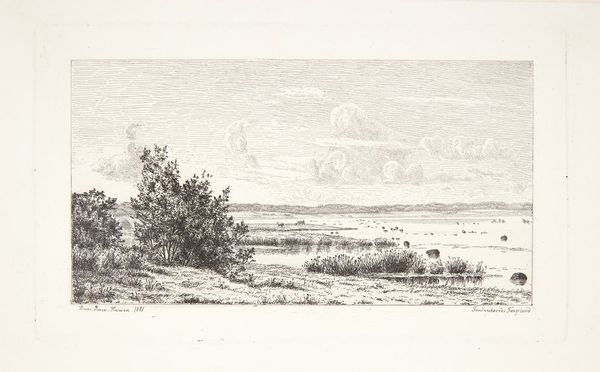
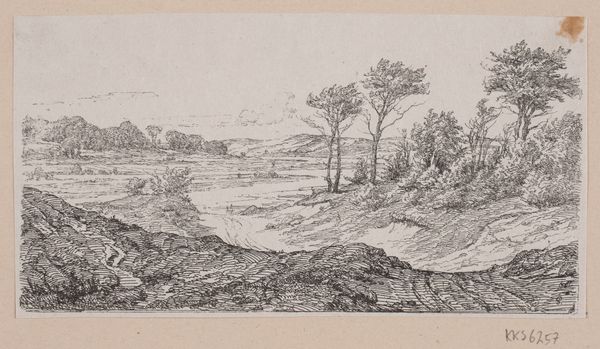
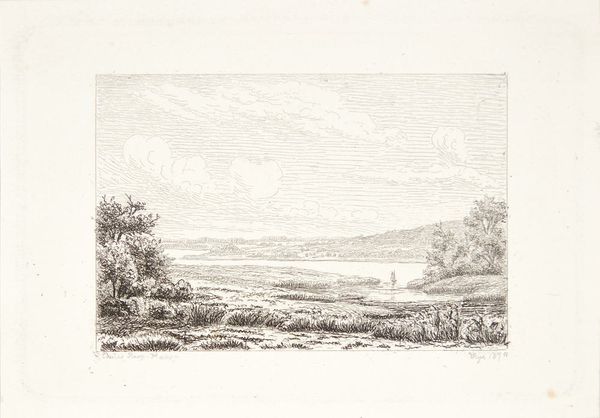
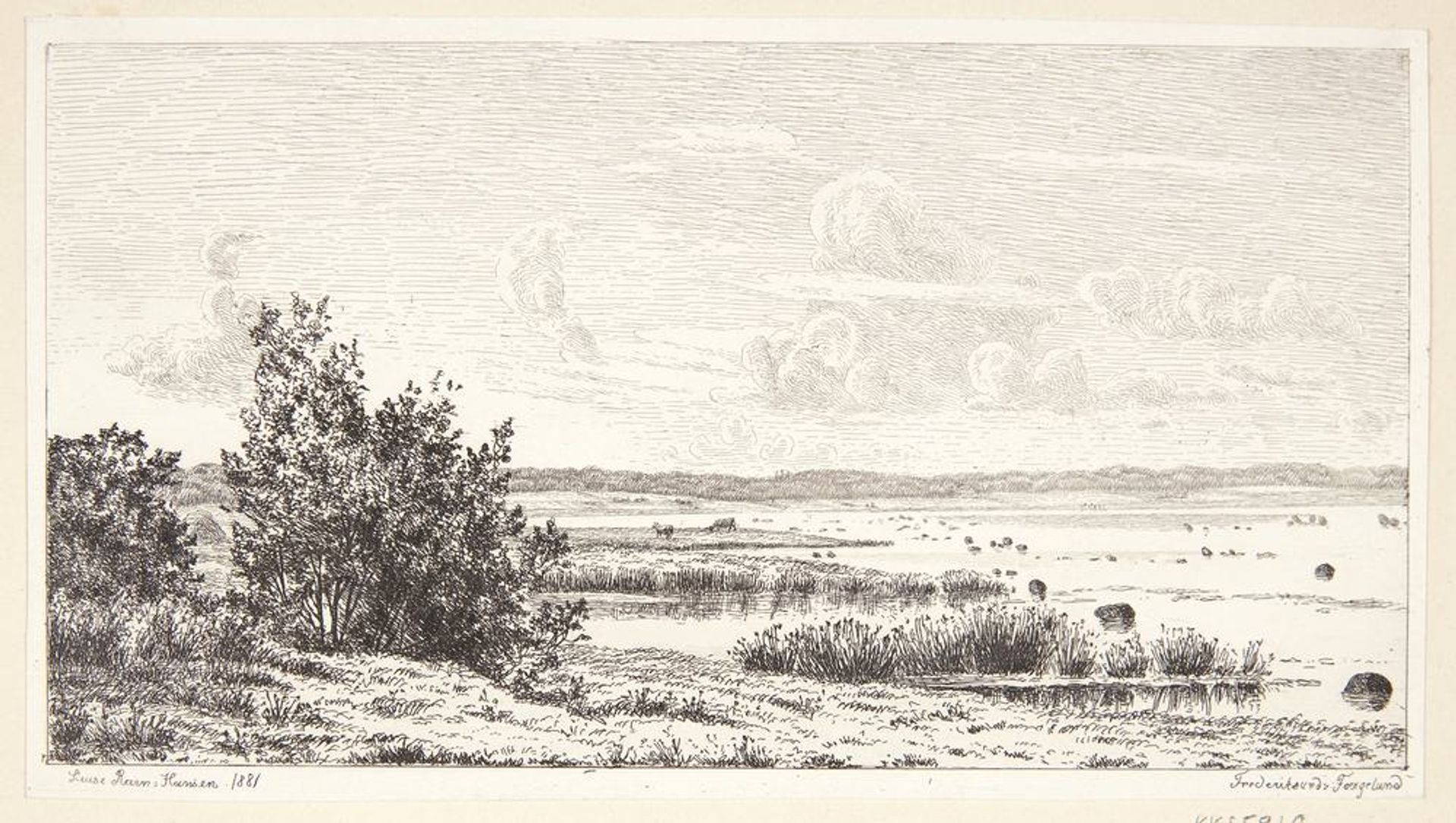
Editor: So, this is Louise Ravn-Hansen’s "Frederikssund Færgelund" from 1881, an etching printed on paper. It feels incredibly serene, almost melancholic with the muted tones. What can you tell me about it? Curator: Notice how the scene is constructed: trees and tufts of grass populate the foreground, establishing a sense of place. And then that liminal space of water… Do you feel drawn in, or held at bay? Editor: A little of both, actually. There's something calming about it, but the starkness prevents full immersion. Curator: Precisely. It captures a longing for something just beyond reach, doesn't it? In landscapes, water often represents the subconscious, a place of mystery and reflection. What associations arise when you see that reflected light and atmosphere? Editor: I think about stillness and waiting, but also the possibility of movement – a journey perhaps? I guess the title reinforces that. Curator: Yes. Frederikssund suggests a place of passage, a crossing. But notice, it is not romanticized. This realism isn't merely about accurate depiction. It conveys an authentic sense of place and being. Editor: I see what you mean. The limited palette focuses my attention on composition and line. I’m beginning to consider this piece in a different light now. Curator: Visual art always contains the spirit of a culture. By understanding its symbols, we better understand ourselves. Editor: I think I understand better how symbols evoke deep responses within us that might seem, at first, purely emotional or aesthetic.
Frederikssund Færgelund 1881


Artwork details
- Medium
- print, etching
- Dimensions
- 118 mm (height) x 212 mm (width) (bladmål)
- Location
- SMK - Statens Museum for Kunst
Tags
etching
landscape
realism
Comments
No comments
About this artwork
Editor: So, this is Louise Ravn-Hansen’s "Frederikssund Færgelund" from 1881, an etching printed on paper. It feels incredibly serene, almost melancholic with the muted tones. What can you tell me about it? Curator: Notice how the scene is constructed: trees and tufts of grass populate the foreground, establishing a sense of place. And then that liminal space of water… Do you feel drawn in, or held at bay? Editor: A little of both, actually. There's something calming about it, but the starkness prevents full immersion. Curator: Precisely. It captures a longing for something just beyond reach, doesn't it? In landscapes, water often represents the subconscious, a place of mystery and reflection. What associations arise when you see that reflected light and atmosphere? Editor: I think about stillness and waiting, but also the possibility of movement – a journey perhaps? I guess the title reinforces that. Curator: Yes. Frederikssund suggests a place of passage, a crossing. But notice, it is not romanticized. This realism isn't merely about accurate depiction. It conveys an authentic sense of place and being. Editor: I see what you mean. The limited palette focuses my attention on composition and line. I’m beginning to consider this piece in a different light now. Curator: Visual art always contains the spirit of a culture. By understanding its symbols, we better understand ourselves. Editor: I think I understand better how symbols evoke deep responses within us that might seem, at first, purely emotional or aesthetic.
Comments
No comments