

About this artwork
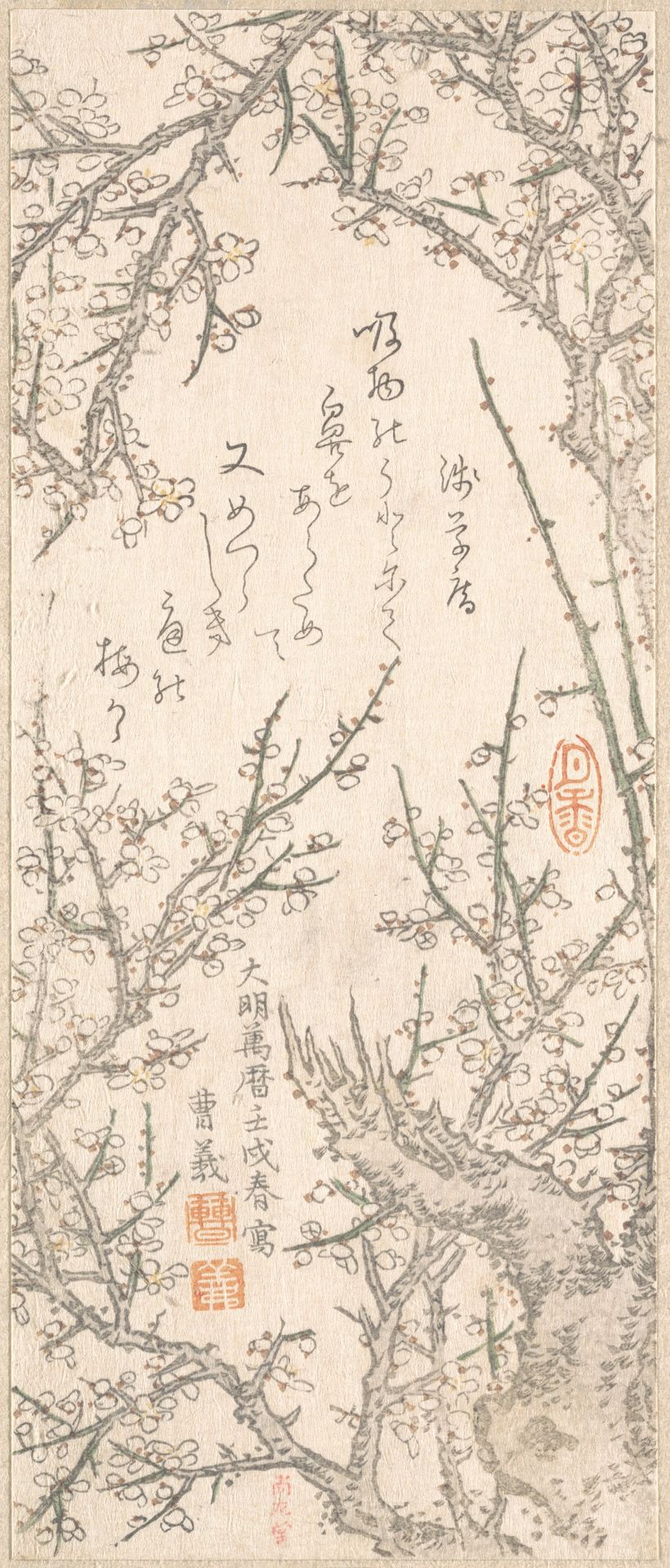
This is Kitao Shigemasa’s vertical woodblock print, “Plum Tree in Blossom,” made in Japan around 1760. Notice how the composition is structured by the curving branches of the plum tree. They create a delicate, almost lace-like frame around the calligraphic text. The plum blossoms, rendered in subtle whites and grays, dot the branches like tiny jewels. This creates a visual rhythm, guiding the eye through the image. The artist plays with positive and negative space, using the pale background to accentuate the intricate lines of the branches and the delicate forms of the blossoms. This use of space is not merely decorative, but also contributes to the overall sense of harmony and balance. The poem and the image, though distinct, function together to create a unified aesthetic experience. Consider how the artist uses these formal elements—line, space, and composition—to evoke a sense of tranquility and the quiet beauty of nature. This print reminds us that art is not just about representation, but also about the interplay of form and meaning.
Plum Tree in Blossom
1813


Artwork details
- Medium
- print, woodblock-print
- Dimensions
- 8 3/16 x 3 7/16 in. (20.8 x 8.7 cm)
- Location
- Metropolitan Museum of Art, New York, NY
- Copyright
- Public Domain
Tags
Comments
Share your thoughts
About this artwork
This is Kitao Shigemasa’s vertical woodblock print, “Plum Tree in Blossom,” made in Japan around 1760. Notice how the composition is structured by the curving branches of the plum tree. They create a delicate, almost lace-like frame around the calligraphic text. The plum blossoms, rendered in subtle whites and grays, dot the branches like tiny jewels. This creates a visual rhythm, guiding the eye through the image. The artist plays with positive and negative space, using the pale background to accentuate the intricate lines of the branches and the delicate forms of the blossoms. This use of space is not merely decorative, but also contributes to the overall sense of harmony and balance. The poem and the image, though distinct, function together to create a unified aesthetic experience. Consider how the artist uses these formal elements—line, space, and composition—to evoke a sense of tranquility and the quiet beauty of nature. This print reminds us that art is not just about representation, but also about the interplay of form and meaning.
Comments
Share your thoughts