About this artwork
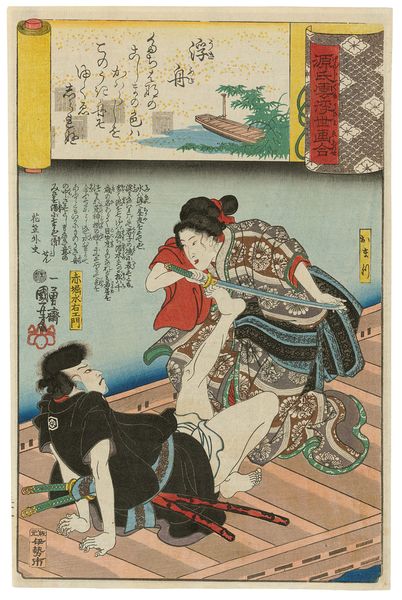
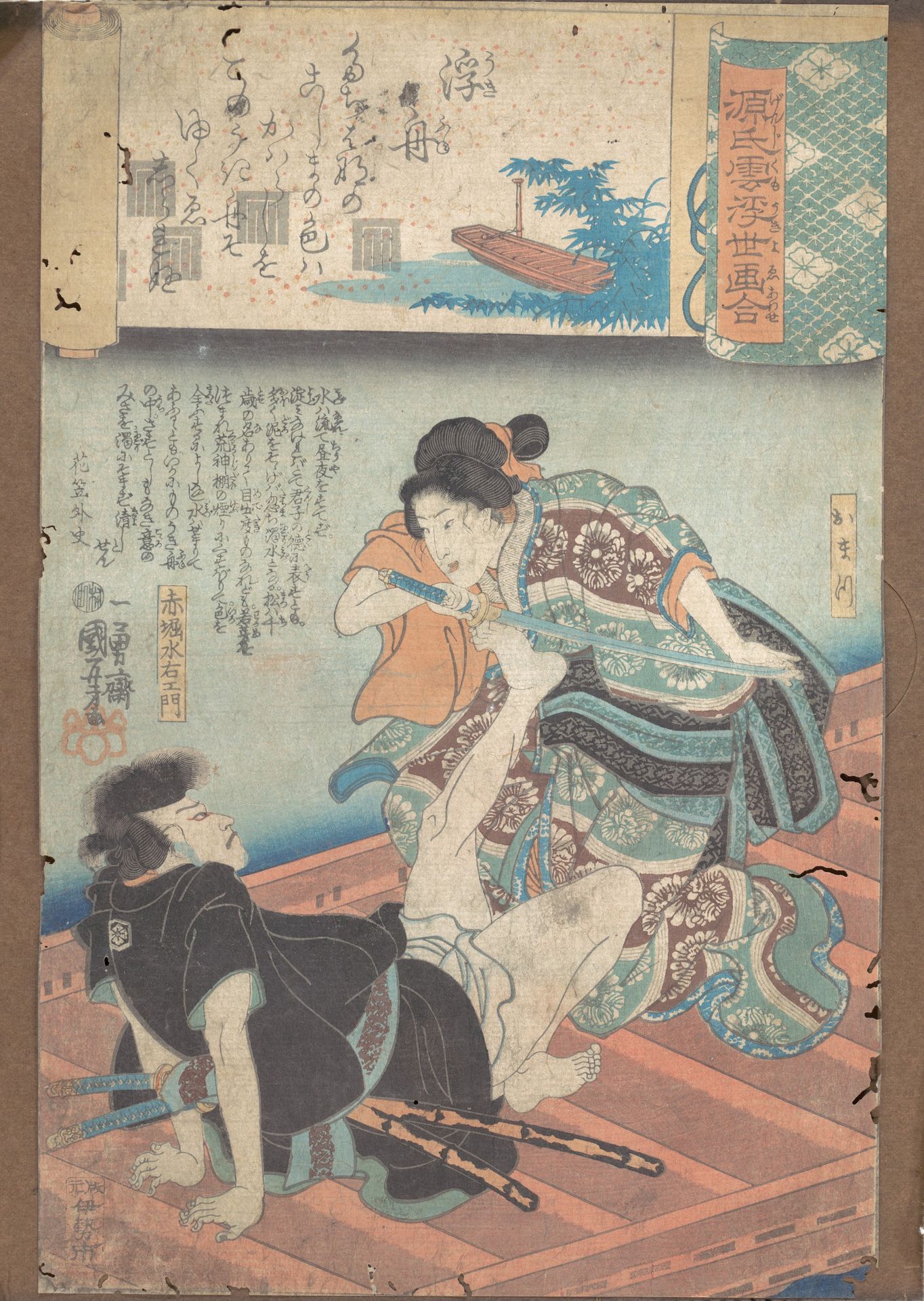
Utagawa Kuniyoshi created this woodblock print, "A Boat upon the Waters," now housed at the Met. Notice the tense drama unfolding within the confined space of a boat, defined by strong diagonal lines and the striking contrast between the figures and the cool tones of water and sky. Kuniyoshi's design plays with semiotic codes of power and vulnerability. The woman, poised with a sword, disrupts traditional gender roles. Her patterned kimono, a mix of organic motifs, contrasts with the rigid structure of the boat's wooden planks. The fallen man, disarmed, becomes a study in dynamic foreshortening and raw emotion. The upper register of the composition provides a placid contrast, but also an ironic commentary. Here, the landscape is presented in a traditional, almost idyllic manner, with geometric patterns, symbolizing the distance between the violence of lived experience and idealized representation.
A Boat upon the Waters 1835 - 1856

Utagawa Kuniyoshi 歌川國芳
1797 - 1861
The Metropolitan Museum of Art
Metropolitan Museum of Art, New York, NYArtwork details
- Medium
- print, woodblock-print
- Dimensions
- 13 1/2 x 9 in. (34.3 x 22.9 cm)
- Location
- Metropolitan Museum of Art, New York, NY
- Copyright
- Public Domain
Tags
narrative-art
asian-art
ukiyo-e
figuration
woodblock-print
Comments
No comments
About this artwork
Utagawa Kuniyoshi created this woodblock print, "A Boat upon the Waters," now housed at the Met. Notice the tense drama unfolding within the confined space of a boat, defined by strong diagonal lines and the striking contrast between the figures and the cool tones of water and sky. Kuniyoshi's design plays with semiotic codes of power and vulnerability. The woman, poised with a sword, disrupts traditional gender roles. Her patterned kimono, a mix of organic motifs, contrasts with the rigid structure of the boat's wooden planks. The fallen man, disarmed, becomes a study in dynamic foreshortening and raw emotion. The upper register of the composition provides a placid contrast, but also an ironic commentary. Here, the landscape is presented in a traditional, almost idyllic manner, with geometric patterns, symbolizing the distance between the violence of lived experience and idealized representation.
Comments
No comments