About this artwork
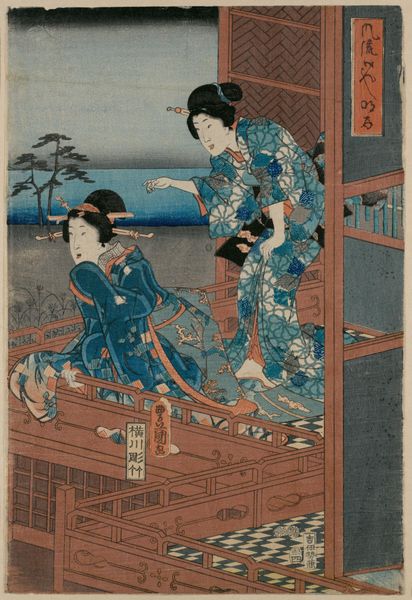
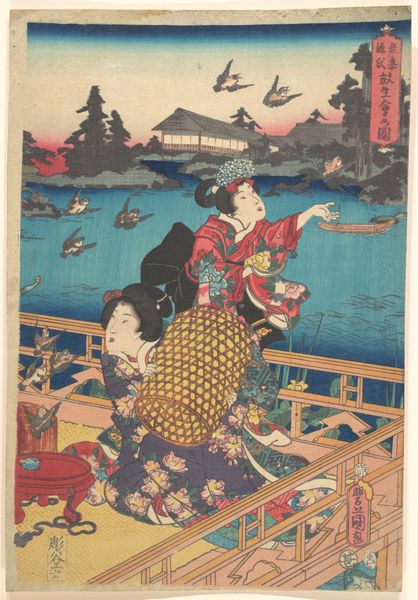
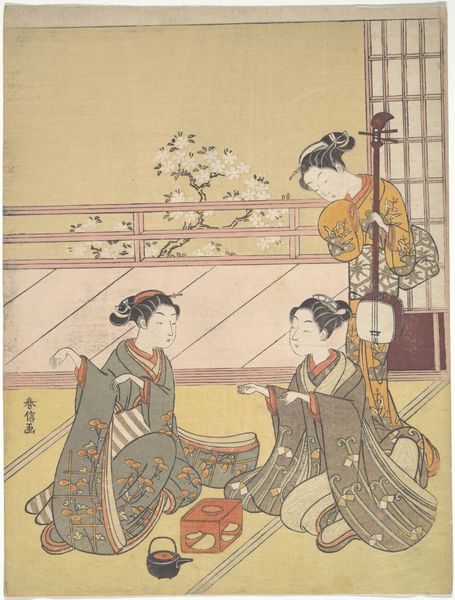
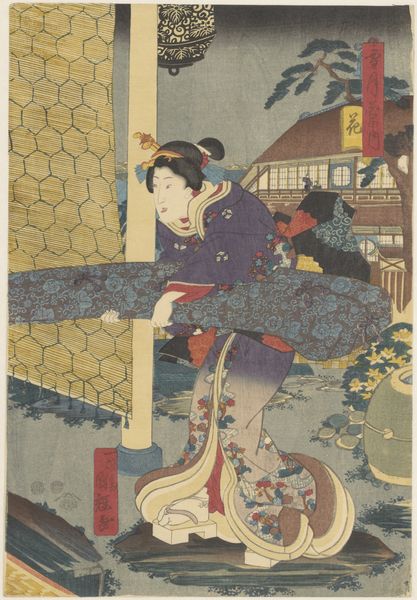
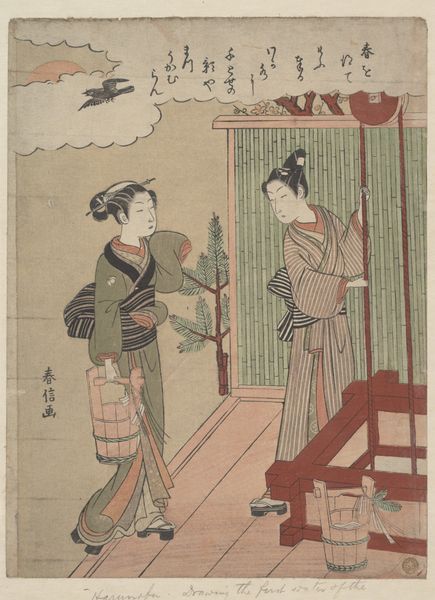
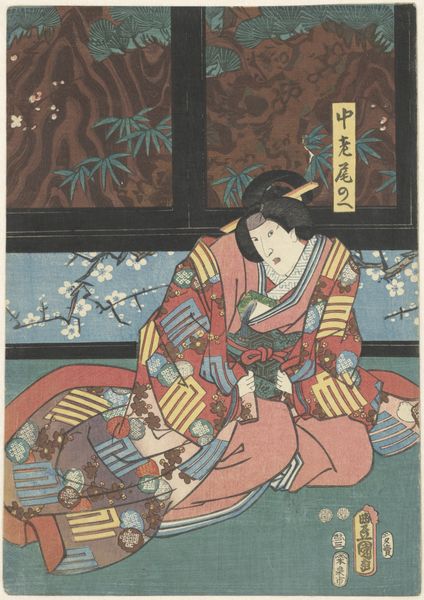
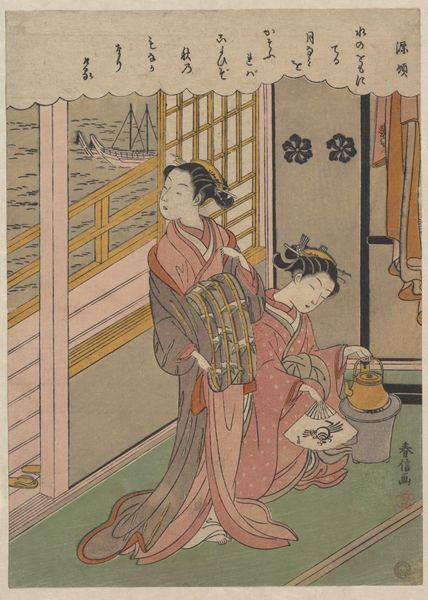
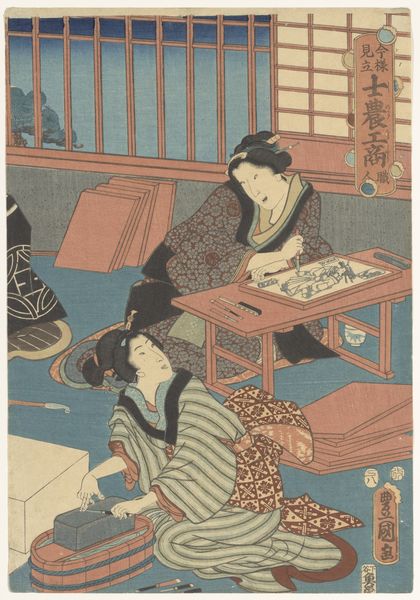
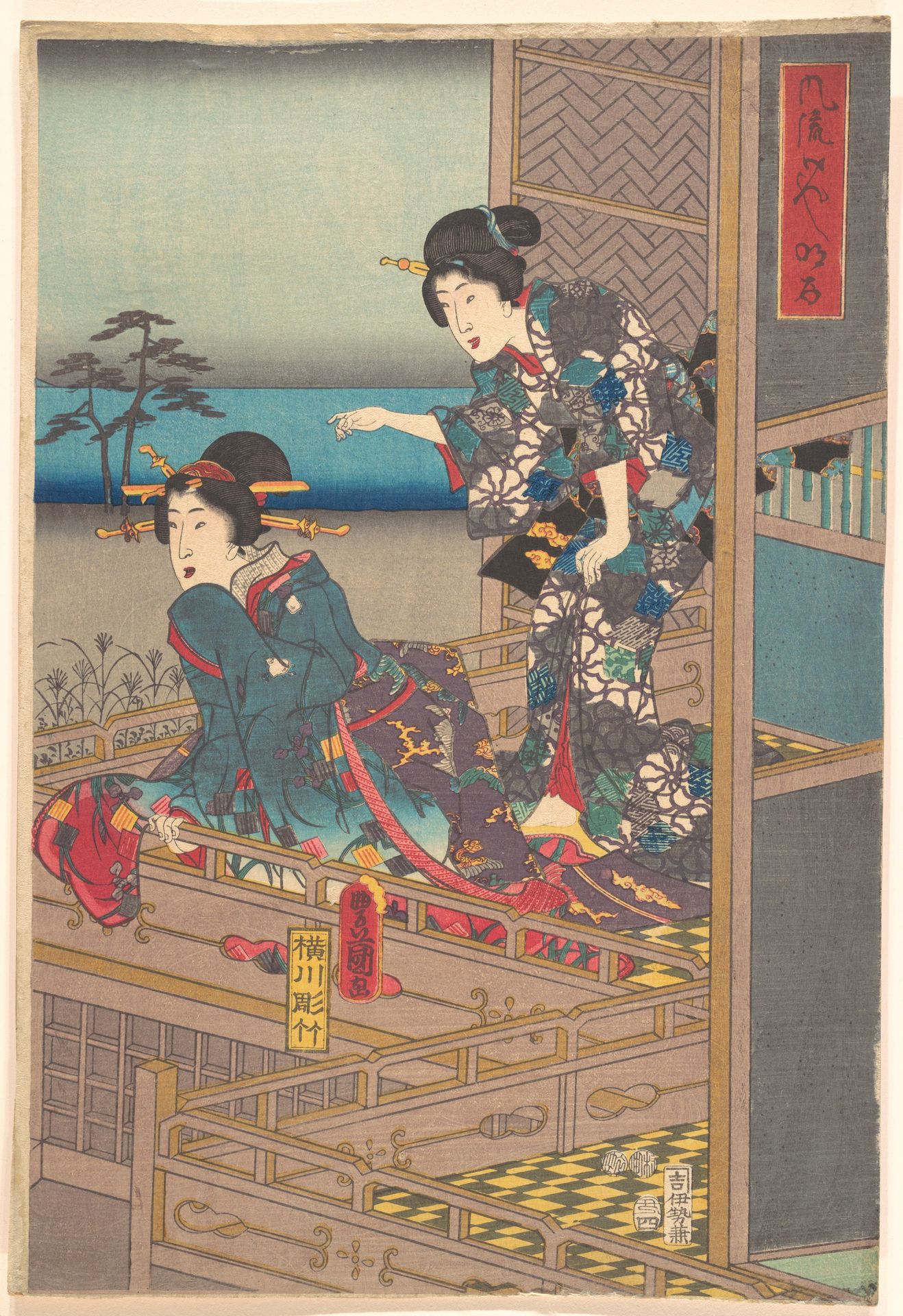
This print by Utagawa Kunisada, now at the Metropolitan Museum of Art, presents a complex interplay of spatial depth and surface design characteristic of the ukiyo-e style. Notice how the architectural structure in the foreground, composed of horizontal lines, creates a stage-like setting for the figures. Kunisada manipulates perspective, flattening the background while rendering the foreground with linear precision. This contrast draws attention to the patterned kimonos of the two women. Their intricate designs, with floral and geometric motifs, serve not only as decorative elements but also as signifiers of social identity and status. The gaze and gesture of the standing figure directs us beyond the immediate scene. The composition invites a semiotic reading, where elements like the open doorway, the distant landscape, and the women’s attire function as visual codes. These point to broader cultural narratives about beauty, domesticity, and the transient nature of pleasure. Ultimately, Kunisada's print challenges a singular, stable interpretation. It invites us to decode its visual and cultural signs within the ever-shifting landscape of meaning.
Print 1786 - 1854


Artwork details
- Medium
- print, woodblock-print
- Dimensions
- Image: 14 7/8 × 10 1/8 in. (37.8 × 25.7 cm)
- Location
- Metropolitan Museum of Art, New York, NY
- Copyright
- Public Domain
Tags
water colours
asian-art
ukiyo-e
figuration
woodblock-print
men
genre-painting
Comments
No comments
About this artwork
This print by Utagawa Kunisada, now at the Metropolitan Museum of Art, presents a complex interplay of spatial depth and surface design characteristic of the ukiyo-e style. Notice how the architectural structure in the foreground, composed of horizontal lines, creates a stage-like setting for the figures. Kunisada manipulates perspective, flattening the background while rendering the foreground with linear precision. This contrast draws attention to the patterned kimonos of the two women. Their intricate designs, with floral and geometric motifs, serve not only as decorative elements but also as signifiers of social identity and status. The gaze and gesture of the standing figure directs us beyond the immediate scene. The composition invites a semiotic reading, where elements like the open doorway, the distant landscape, and the women’s attire function as visual codes. These point to broader cultural narratives about beauty, domesticity, and the transient nature of pleasure. Ultimately, Kunisada's print challenges a singular, stable interpretation. It invites us to decode its visual and cultural signs within the ever-shifting landscape of meaning.
Comments
No comments