About this artwork
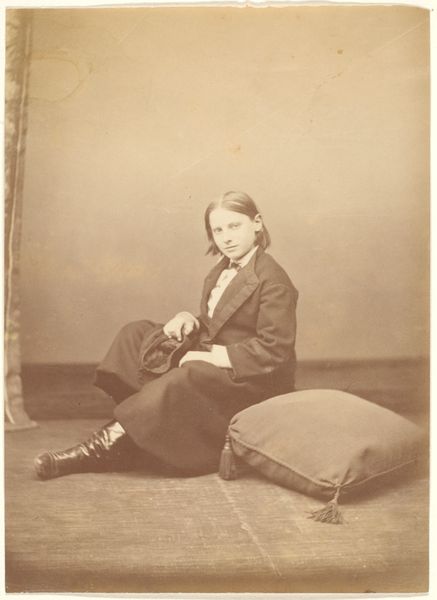
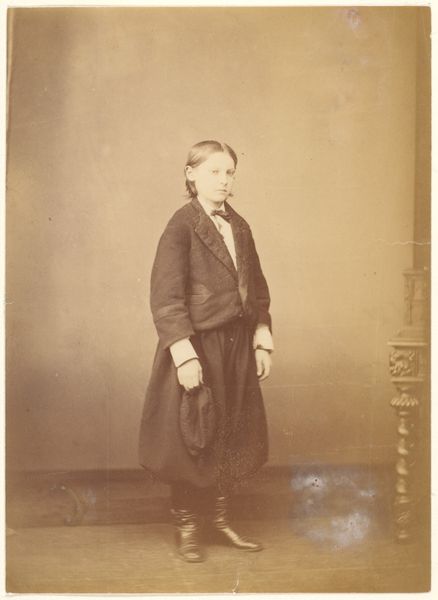
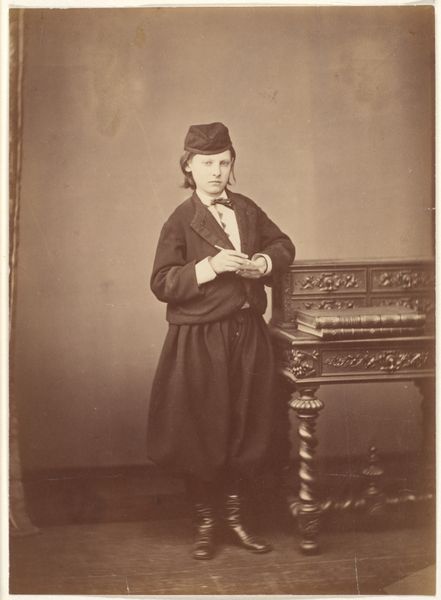
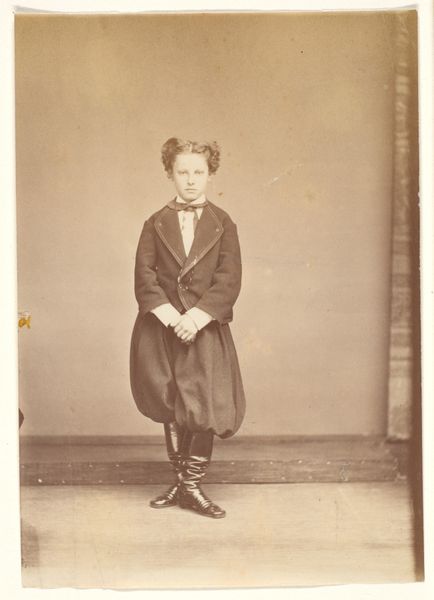
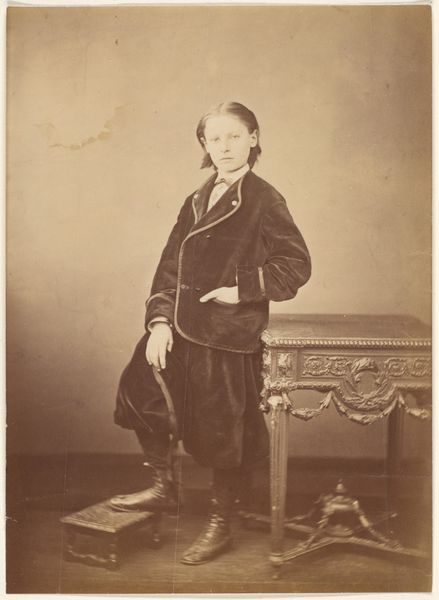
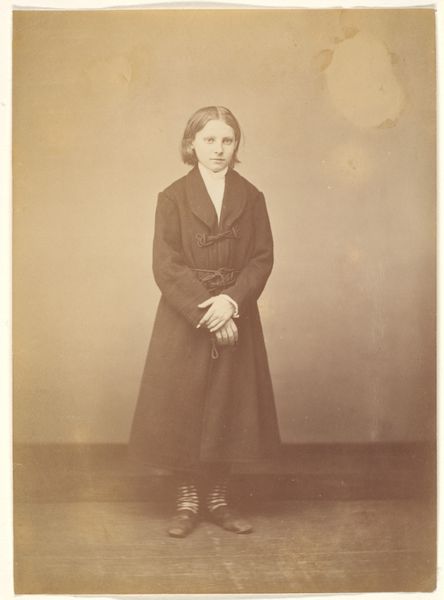
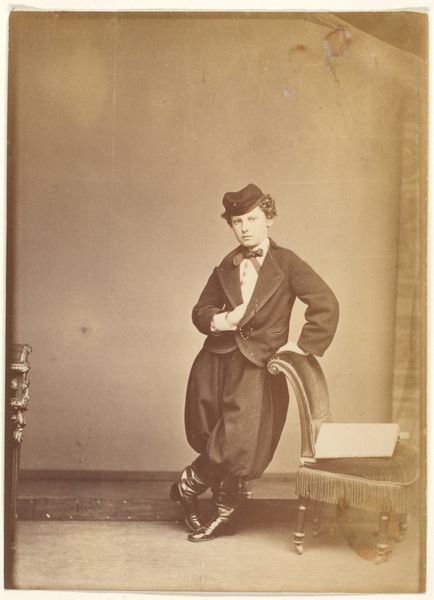
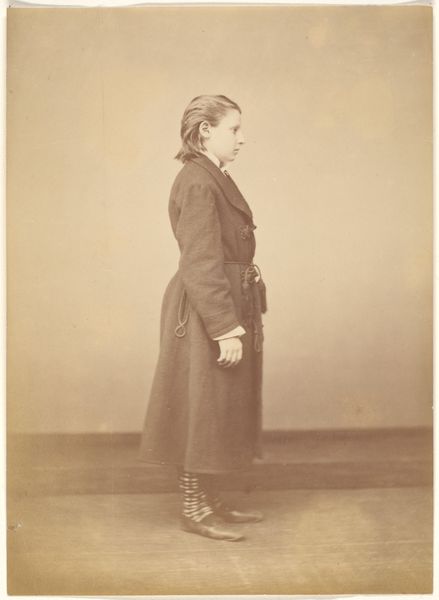
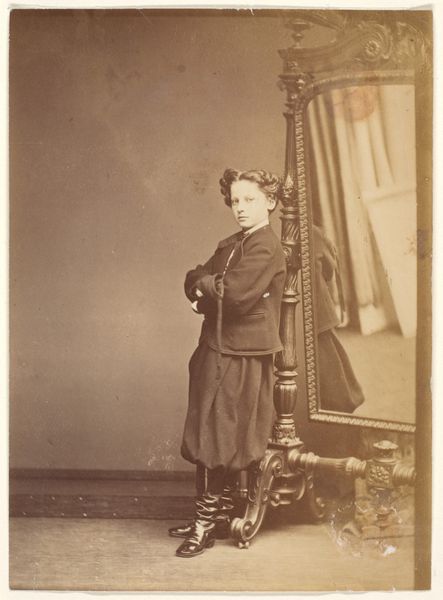
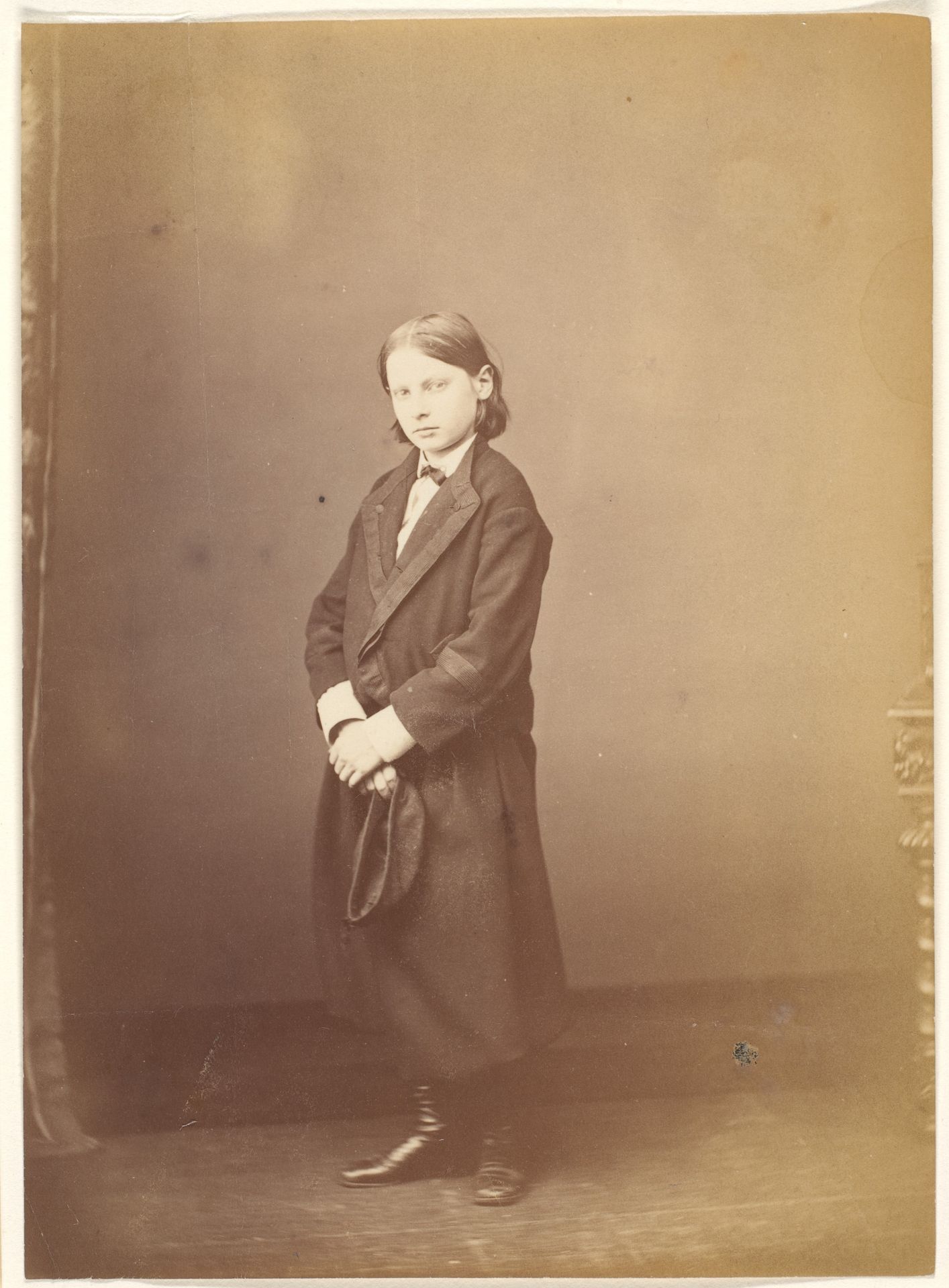
Curator: Here we have "Le Grand Russe," a captivating portrait, likely a gelatin silver print from the 1860s by Pierre-Louis Pierson, residing here at the Metropolitan Museum of Art. Editor: There's something quite arresting about this image. The tonal range is constrained but evocative, lending a rather melancholic, almost ethereal quality to the boy's presence. Curator: Indeed, the limited palette underscores the formal composition. Observe how the photographer skillfully uses light and shadow to sculpt the figure, drawing our attention to the subject's posture. How the sartorial elements speak volumes about social identity, the attire suggesting an affiliation to an aristocratic class. Editor: That somber attire certainly suggests a privileged, perhaps even restricted existence, although given its historical context, the implications of "aristocratic" extend far beyond simple financial wellbeing, implying inherited political clout and the weight of traditions in the Russian sphere. Look at his eyes, do you sense some melancholy? Curator: Undeniably, the photographic treatment captures a degree of wistfulness. But the carefully arranged pose and controlled expression speaks volumes of social expectations in those times, more so, what's amazing is how effectively photography becomes a vehicle to convey these conventions, even subconsciously to this date. Editor: It's precisely those embedded, often unarticulated power structures I find so absorbing in viewing a work like this. The visual language becomes a coded manifestation of socio-political ideals. But does focusing on the arrangement obscure what might be genuine emotion showing on this child's face? Curator: I would posit that the arrangement and the apparent emotion are inseparably linked. One informs the other, producing a complex tension that reflects broader dynamics in 19th-century Russia. But from a formal approach the stark presentation highlights and celebrates certain themes. Editor: The muted colors help to make the expression and the clothes prominent. You know, spending time thinking on it this way enriches my understanding of the picture overall! Curator: Agreed, bringing into balance form and the social aspects create interesting points of consideration.
Le Grand Russe
1860s

Pierre-Louis Pierson
1822 - 1913
The Metropolitan Museum of Art
Metropolitan Museum of Art, New York, NYArtwork details
- Medium
- daguerreotype, photography, gelatin-silver-print
- Dimensions
- 9.8 x 13.3 cm. (3 7/8 x 5 1/4 in.)
- Location
- Metropolitan Museum of Art, New York, NY
- Copyright
- Public Domain
Tags
Comments
Share your thoughts
About this artwork
Curator: Here we have "Le Grand Russe," a captivating portrait, likely a gelatin silver print from the 1860s by Pierre-Louis Pierson, residing here at the Metropolitan Museum of Art. Editor: There's something quite arresting about this image. The tonal range is constrained but evocative, lending a rather melancholic, almost ethereal quality to the boy's presence. Curator: Indeed, the limited palette underscores the formal composition. Observe how the photographer skillfully uses light and shadow to sculpt the figure, drawing our attention to the subject's posture. How the sartorial elements speak volumes about social identity, the attire suggesting an affiliation to an aristocratic class. Editor: That somber attire certainly suggests a privileged, perhaps even restricted existence, although given its historical context, the implications of "aristocratic" extend far beyond simple financial wellbeing, implying inherited political clout and the weight of traditions in the Russian sphere. Look at his eyes, do you sense some melancholy? Curator: Undeniably, the photographic treatment captures a degree of wistfulness. But the carefully arranged pose and controlled expression speaks volumes of social expectations in those times, more so, what's amazing is how effectively photography becomes a vehicle to convey these conventions, even subconsciously to this date. Editor: It's precisely those embedded, often unarticulated power structures I find so absorbing in viewing a work like this. The visual language becomes a coded manifestation of socio-political ideals. But does focusing on the arrangement obscure what might be genuine emotion showing on this child's face? Curator: I would posit that the arrangement and the apparent emotion are inseparably linked. One informs the other, producing a complex tension that reflects broader dynamics in 19th-century Russia. But from a formal approach the stark presentation highlights and celebrates certain themes. Editor: The muted colors help to make the expression and the clothes prominent. You know, spending time thinking on it this way enriches my understanding of the picture overall! Curator: Agreed, bringing into balance form and the social aspects create interesting points of consideration.
Comments
Share your thoughts