About this artwork
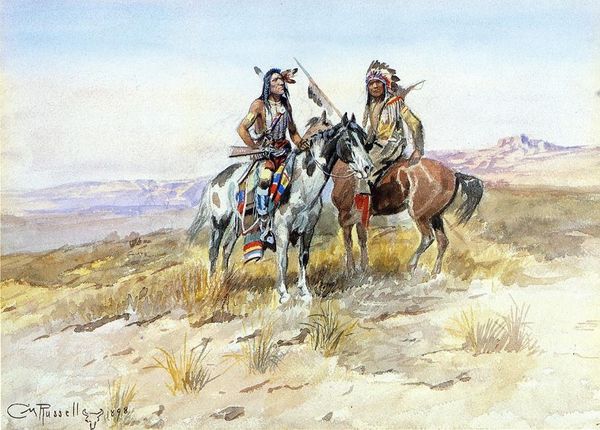
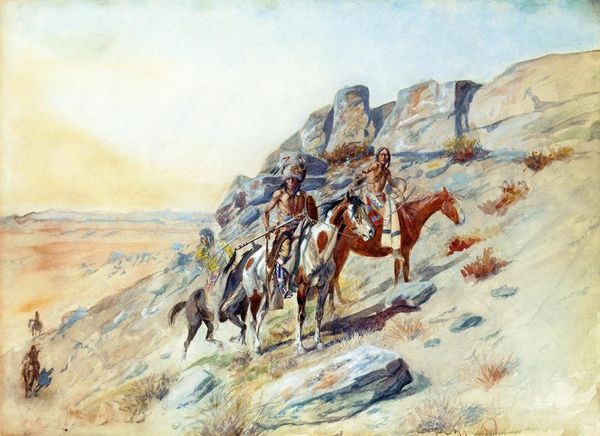
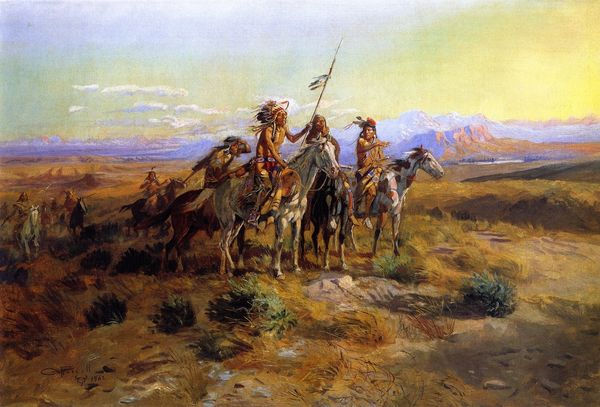
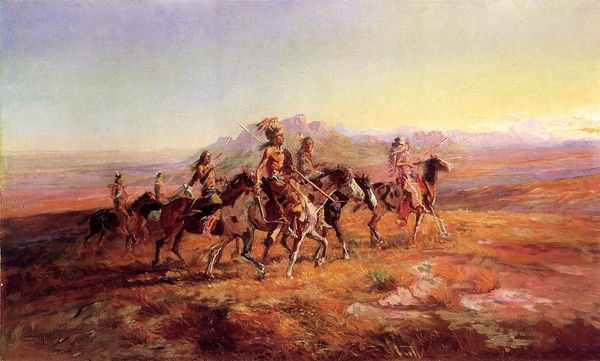
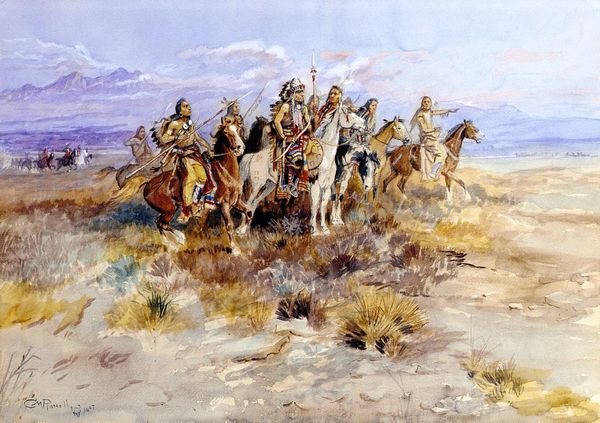
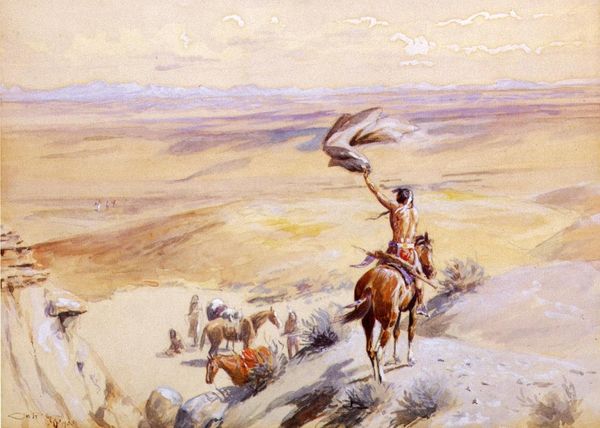
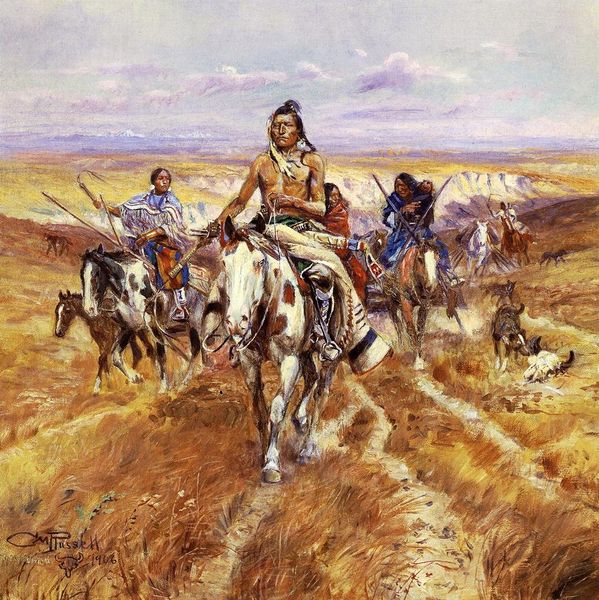
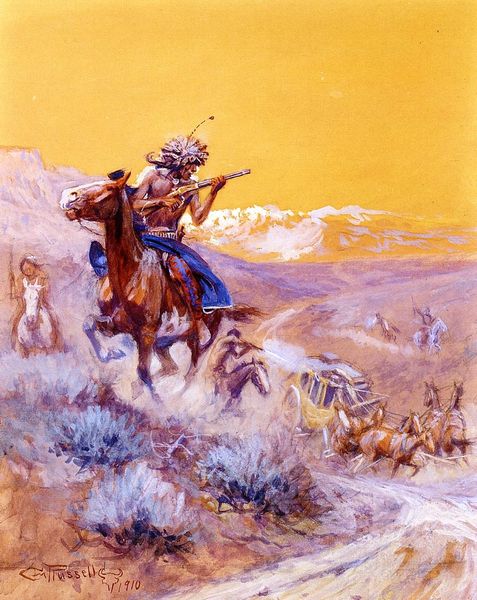
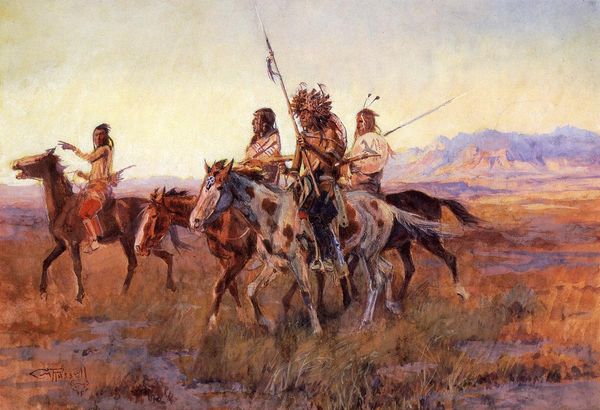
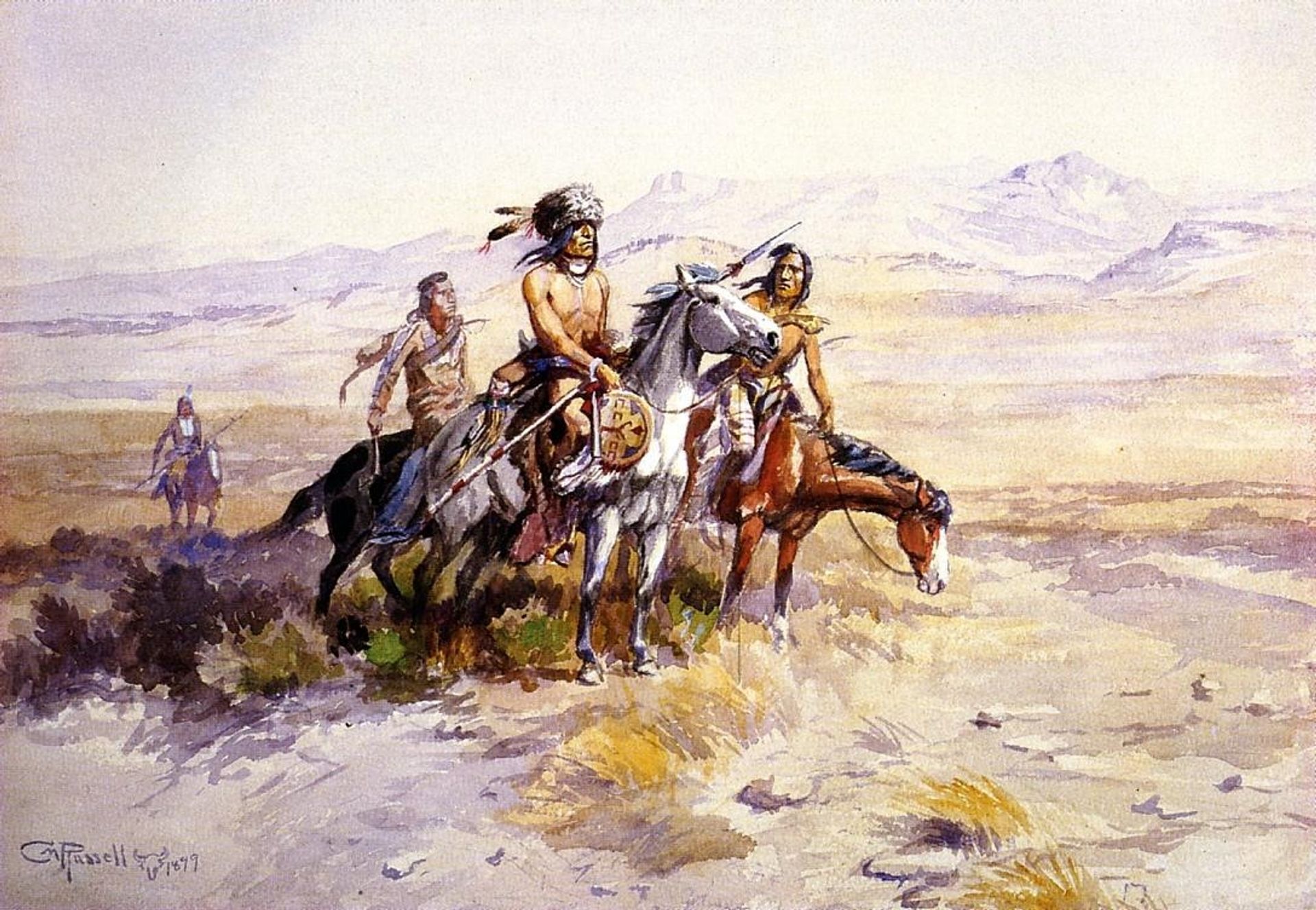
Editor: So, here we have Charles M. Russell’s “In Enemy Country,” painted around 1899. It's primarily watercolor, I believe. What strikes me immediately is the sense of vigilance; these figures are poised, alert amidst this vast, somewhat desolate landscape. What do you see in this piece? Curator: Desolate, yes, but it sings, doesn't it? Like a lonely coyote's howl. It feels vast, like a memory stretching to the horizon. Russell had this way of capturing not just the West, but its soul, its anxieties too. Notice the lead rider, how he holds that shield - it's both protection and declaration. Almost as if saying, "we belong here", but the tension... Do you feel it? Editor: I do. It’s in the way they’re scanning the distance, their bodies taut. Are they invaders themselves or are they defending their land, I wonder? Curator: Exactly the question Russell poses! The "enemy country" could be viewed from many angles, couldn’t it? Russell often explored these gray areas in his work, reflecting on a West rapidly changing. I feel he asks us, whose country is it, really? Is ownership merely perspective? Makes you think about Manifest Destiny in all its tragic beauty, doesn’t it? Editor: It does. And how a single title can shift the whole narrative. It gives the whole piece a haunting resonance. Curator: Beautifully said. It is that delicate wash of color and suggestion of movement… like life itself flickering there in the big, wide West, both yesterday and today. Editor: I see what you mean; it’s an illusion of a snapshot in time, but also it feels alive, like any second they might spring to life and disappear into that painted distance. Curator: It's history holding its breath, isn't it? Something Russell managed to do so well, to pause those moments in painted immortality. Thank you for seeing with fresh eyes. Editor: Thanks! That's a completely different view than my initial assumptions. The West is always more complex than John Ford makes it look.

Artwork details
- Medium
- painting, watercolor
- Copyright
- Public domain
Tags
Comments
Share your thoughts
About this artwork
Editor: So, here we have Charles M. Russell’s “In Enemy Country,” painted around 1899. It's primarily watercolor, I believe. What strikes me immediately is the sense of vigilance; these figures are poised, alert amidst this vast, somewhat desolate landscape. What do you see in this piece? Curator: Desolate, yes, but it sings, doesn't it? Like a lonely coyote's howl. It feels vast, like a memory stretching to the horizon. Russell had this way of capturing not just the West, but its soul, its anxieties too. Notice the lead rider, how he holds that shield - it's both protection and declaration. Almost as if saying, "we belong here", but the tension... Do you feel it? Editor: I do. It’s in the way they’re scanning the distance, their bodies taut. Are they invaders themselves or are they defending their land, I wonder? Curator: Exactly the question Russell poses! The "enemy country" could be viewed from many angles, couldn’t it? Russell often explored these gray areas in his work, reflecting on a West rapidly changing. I feel he asks us, whose country is it, really? Is ownership merely perspective? Makes you think about Manifest Destiny in all its tragic beauty, doesn’t it? Editor: It does. And how a single title can shift the whole narrative. It gives the whole piece a haunting resonance. Curator: Beautifully said. It is that delicate wash of color and suggestion of movement… like life itself flickering there in the big, wide West, both yesterday and today. Editor: I see what you mean; it’s an illusion of a snapshot in time, but also it feels alive, like any second they might spring to life and disappear into that painted distance. Curator: It's history holding its breath, isn't it? Something Russell managed to do so well, to pause those moments in painted immortality. Thank you for seeing with fresh eyes. Editor: Thanks! That's a completely different view than my initial assumptions. The West is always more complex than John Ford makes it look.
Comments
Share your thoughts