About this artwork
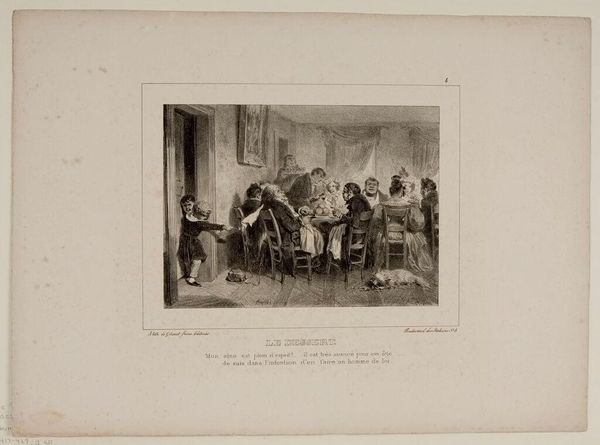
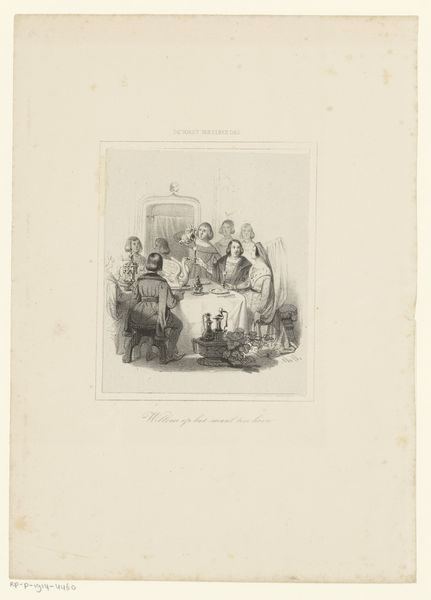
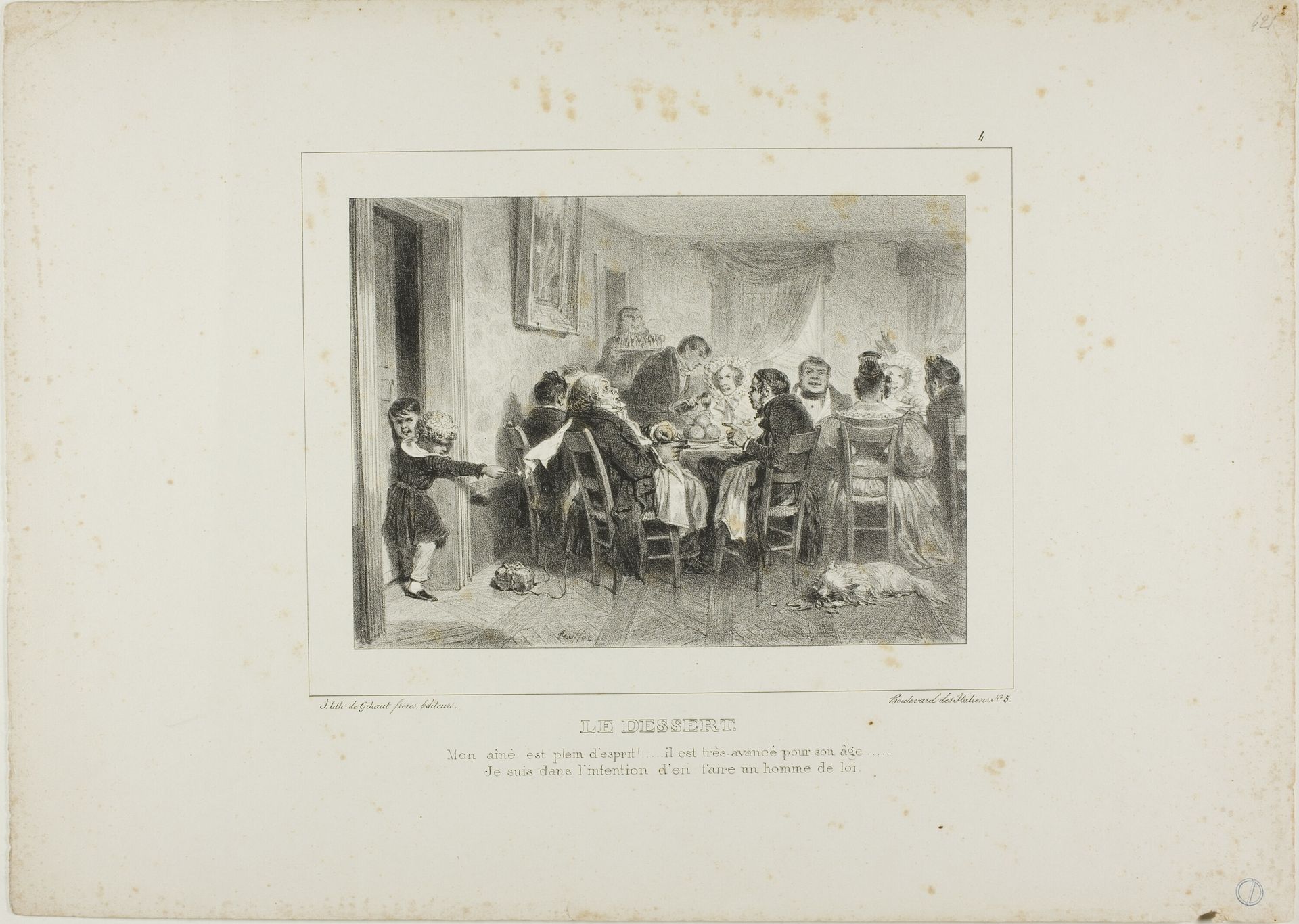
Auguste Raffet made this lithograph, "The Dessert", in the 19th century, using a method of printing dependent on the chemistry of oil and water. The imagery is drawn on a flat stone or metal plate using greasy ink, and then transferred to paper. Here, Raffet has exploited the graphic potential of lithography, achieving subtle tonalities and textures. Look closely, and you'll notice a range of values, from stark black lines to soft, shaded areas, each requiring nuanced handling of the greasy lithographic crayon. The linear precision gives the image a crisp feel, and this is vital to the print’s social critique. The scene is an intimate family meal, with all its tensions and class aspirations laid bare. A young boy, on the cusp of adulthood, is presented as a future lawyer – the family’s hope for upward mobility. It is through the inherent qualities of lithography, with its capacity for detail and tonal variation, that Raffet conveys not only a scene, but also a sense of the cultural aspirations and material conditions of 19th-century France. This is a reminder that the meaning of an image is always inseparable from its making.
The Dessert: My eldest is full of spirit!...he is very advanced for his age...I intend to make a lawyer of him. 1837


Artwork details
- Medium
- drawing, lithograph, print, paper
- Dimensions
- 139 × 189 mm (image); 283 × 397 mm (sheet)
- Location
- The Art Institute of Chicago
- Copyright
- Public Domain
Tags
photo of handprinted image
drawing
aged paper
toned paper
light pencil work
lithograph
ink paper printed
parchment
pencil sketch
light coloured
paper
france
watercolour illustration
watercolor
Comments
No comments
About this artwork
Auguste Raffet made this lithograph, "The Dessert", in the 19th century, using a method of printing dependent on the chemistry of oil and water. The imagery is drawn on a flat stone or metal plate using greasy ink, and then transferred to paper. Here, Raffet has exploited the graphic potential of lithography, achieving subtle tonalities and textures. Look closely, and you'll notice a range of values, from stark black lines to soft, shaded areas, each requiring nuanced handling of the greasy lithographic crayon. The linear precision gives the image a crisp feel, and this is vital to the print’s social critique. The scene is an intimate family meal, with all its tensions and class aspirations laid bare. A young boy, on the cusp of adulthood, is presented as a future lawyer – the family’s hope for upward mobility. It is through the inherent qualities of lithography, with its capacity for detail and tonal variation, that Raffet conveys not only a scene, but also a sense of the cultural aspirations and material conditions of 19th-century France. This is a reminder that the meaning of an image is always inseparable from its making.
Comments
No comments