About this artwork
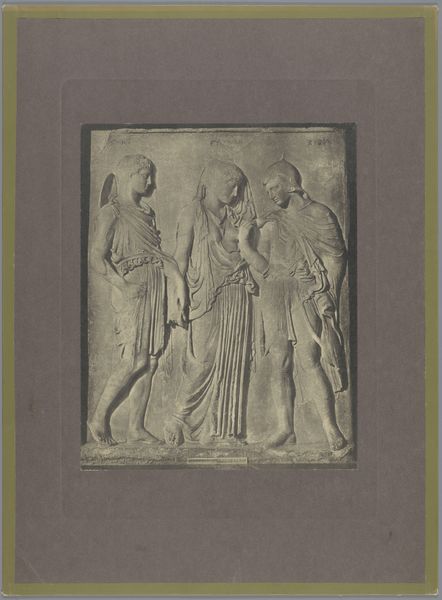
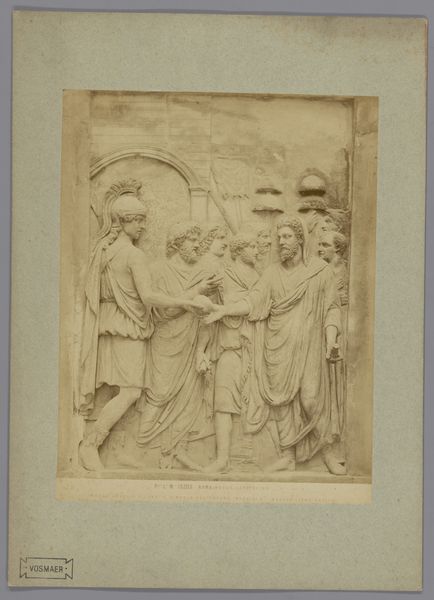
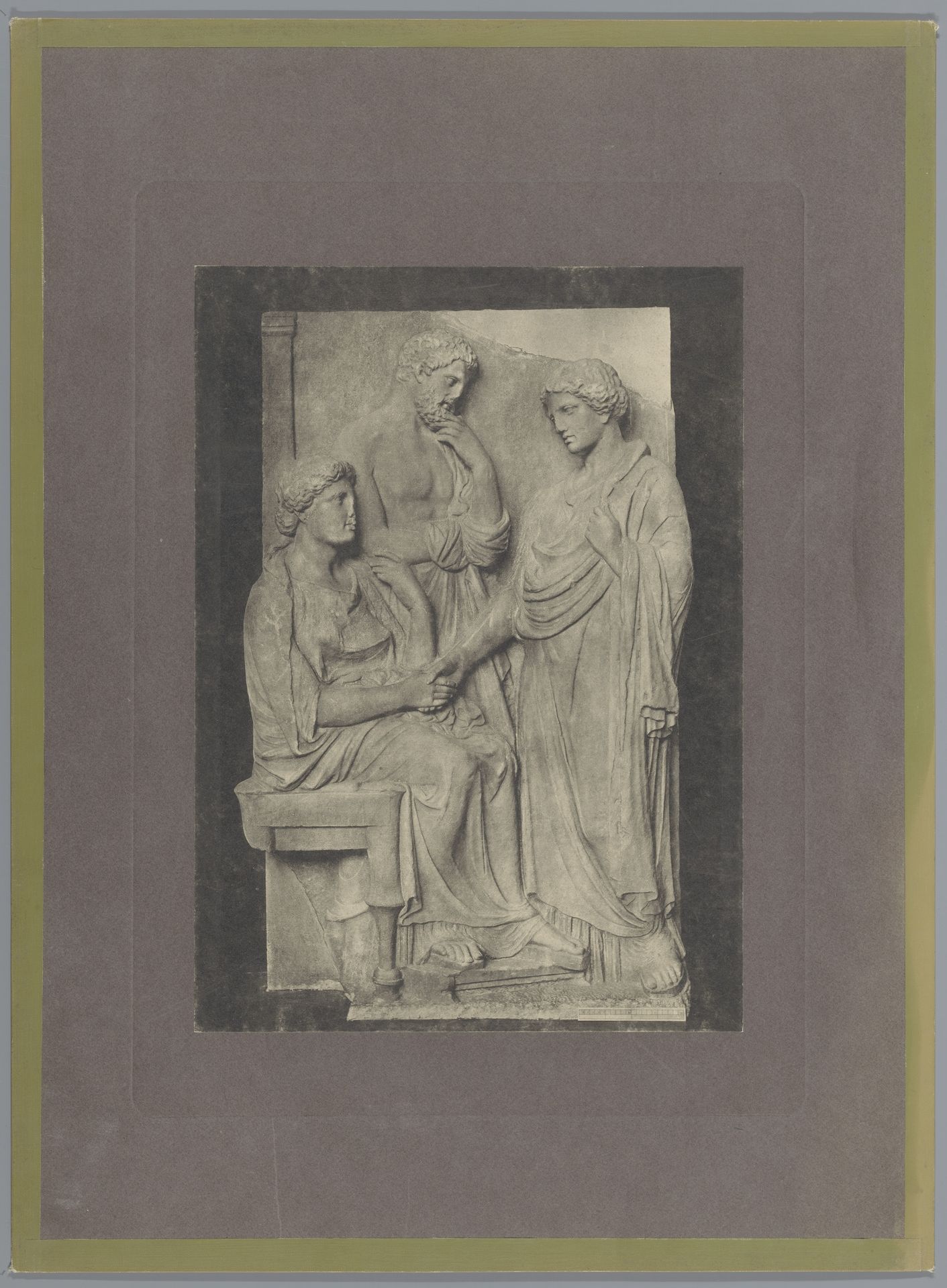
Editor: This photograph, taken in 1898, presents a plaster relief from Athens depicting three figures. The composition, with its stark monochromatic tones, reminds me of ancient funerary monuments, almost a frozen moment of departure or farewell. What catches your eye in this work? Curator: It's a fascinating glimpse into how the 19th century understood and re-presented classical antiquity. The handshake, the *dextra iunctio*, immediately leaps out. For the Romans, it symbolized concord, agreement, and often, marriage. In funerary art, though, as you observed, it signified the final parting. But look closer - is it truly final? Editor: I see what you mean. The seated woman is facing toward the other figures, she doesn't seem to be departing completely... Curator: Precisely! Consider the context. Ancient Greek art often served to negotiate complex societal transitions, and their images are rarely straightforward records. The gesture, charged with tradition, is subtly undermined. This image complicates a simple reading of death or leave-taking; what narrative layers are built from conflicting information? It may be that memory is itself the focus; who gets remembered and how? Editor: So, by examining a single handshake, we unlock a larger story about cultural memory and societal values! Curator: Exactly. And remember, photography itself was emerging, capturing and reinterpreting these ancient symbols for a modern audience. Consider the image as a whole -- a layering of memories and mediums. Editor: That adds so much depth; it really shifts my perspective! Thanks, it's incredibly useful.
Grafreliëf afkomstig uit Athene met een zittend en twee staande personen
1898

Anonymous
@anonymousLocation
RijksmuseumArtwork details
- Medium
- relief, photography, sculpture, gelatin-silver-print
- Dimensions
- height 377 mm, width 270 mm
- Location
- Rijksmuseum
- Copyright
- Rijks Museum: Open Domain
Tags
portrait
greek-and-roman-art
relief
figuration
photography
ancient-mediterranean
sculpture
gelatin-silver-print
Comments
Be the first to share your thoughts about this work.
About this artwork
Editor: This photograph, taken in 1898, presents a plaster relief from Athens depicting three figures. The composition, with its stark monochromatic tones, reminds me of ancient funerary monuments, almost a frozen moment of departure or farewell. What catches your eye in this work? Curator: It's a fascinating glimpse into how the 19th century understood and re-presented classical antiquity. The handshake, the *dextra iunctio*, immediately leaps out. For the Romans, it symbolized concord, agreement, and often, marriage. In funerary art, though, as you observed, it signified the final parting. But look closer - is it truly final? Editor: I see what you mean. The seated woman is facing toward the other figures, she doesn't seem to be departing completely... Curator: Precisely! Consider the context. Ancient Greek art often served to negotiate complex societal transitions, and their images are rarely straightforward records. The gesture, charged with tradition, is subtly undermined. This image complicates a simple reading of death or leave-taking; what narrative layers are built from conflicting information? It may be that memory is itself the focus; who gets remembered and how? Editor: So, by examining a single handshake, we unlock a larger story about cultural memory and societal values! Curator: Exactly. And remember, photography itself was emerging, capturing and reinterpreting these ancient symbols for a modern audience. Consider the image as a whole -- a layering of memories and mediums. Editor: That adds so much depth; it really shifts my perspective! Thanks, it's incredibly useful.
Comments
Be the first to share your thoughts about this work.