Dimensions: Sheet: 16 13/16 × 23 1/2 in. (42.7 × 59.7 cm) Plate: 16 1/4 in. × 19 in. (41.3 × 48.3 cm)
Copyright: Public Domain
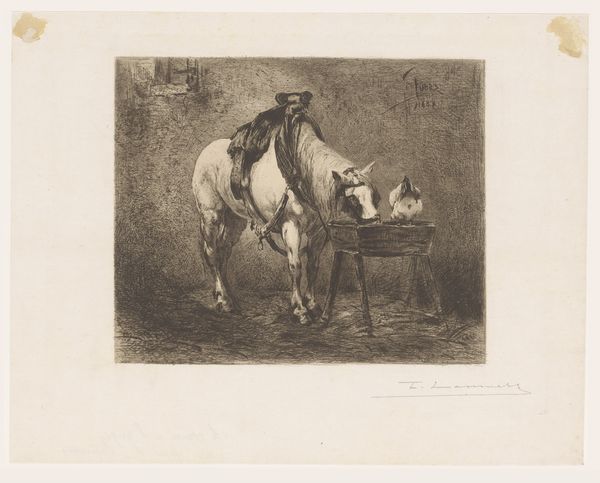
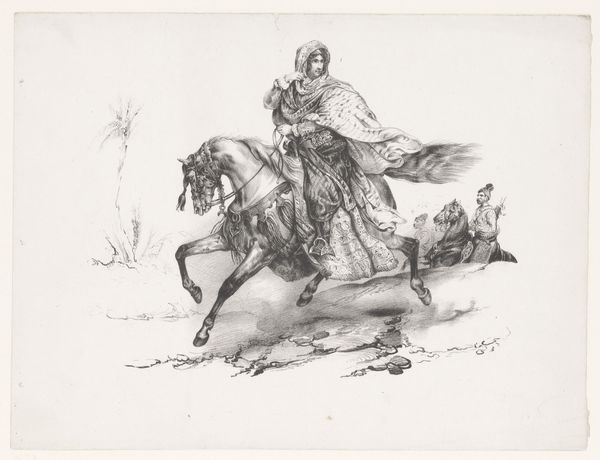
Curator: This etching is titled "Cheval arabe au piquet, d'après Delacroix," which translates to "Arab Horse at the Stake, after Delacroix." Félix Bracquemond created this print in 1857, and it’s currently housed here at the Met. It’s a dynamic piece; what’s your initial impression? Editor: Restless. The stark contrast of light and shadow, especially on the horse, gives it a nervous, almost volatile energy. You can almost hear it pawing at the ground. Curator: It's fascinating how Bracquemond captured that energy using etching techniques. Look at the cross-hatching—see how he layers those lines to create depth and shadow. It’s quite masterful for a print intended to reproduce another artist's work. What does this reproduction tell us about the printmaking process during that period? Editor: Reproduction in that era speaks volumes. Here, Delacroix's Romanticism becomes a commodity. This also embodies an Orientalist perspective, exoticizing Arab culture through its art while controlling the narrative by reinterpreting Delacroix through a French lens. This artwork becomes a cultural transaction rooted in unequal power dynamics. Curator: That’s insightful. It raises important questions about artistic labor. Bracquemond wasn't creating an entirely original work. So what does that make him, craftsman or artist? His skill and the print’s detailed textures surely elevates him beyond mere reproduction, but also acknowledges Delacroix’s celebrity. The division of labor here isn’t simple. Editor: Exactly, and let’s not ignore how easily it's displayed within a museum context now. Are we critiquing or simply perpetuating those colonial gazes? What about labor rights or artistic agency? How is his own cultural identity and artistic process mediated and complicated? Curator: These prints, produced serially, entered homes as decoration, were compiled into portfolios. This work becomes portable, marketable, its influence and reception unfolding far beyond the walls of any museum, a physical commodity carrying a much heavier set of implications with each turn of the printing press. Editor: It does force you to consider the intersectionality of art. Considering both production and context, we can confront some challenging colonial legacies imbedded within art and ourselves. Curator: Looking at Bracquemond's artistic decisions and the choices behind production brings the past into the present in an unexpectedly complicated, beautiful way. Editor: Precisely. It is how a seemingly quiet image sparks a crucial dialogue on artistic responsibility and challenges the politics of cultural representations.
Comments
No comments
Be the first to comment and join the conversation on the ultimate creative platform.
 Collect
 React
React Comment
More like this