About this artwork
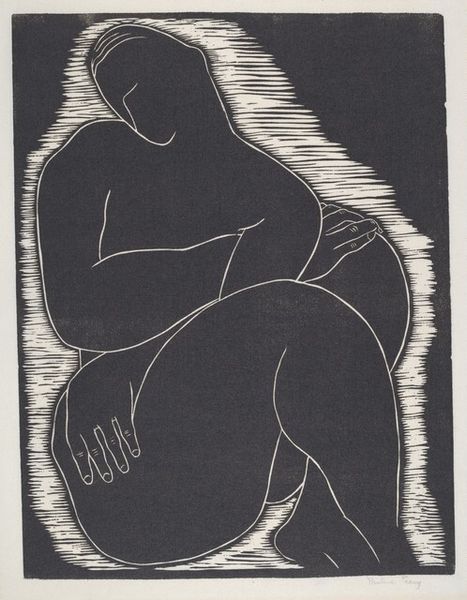
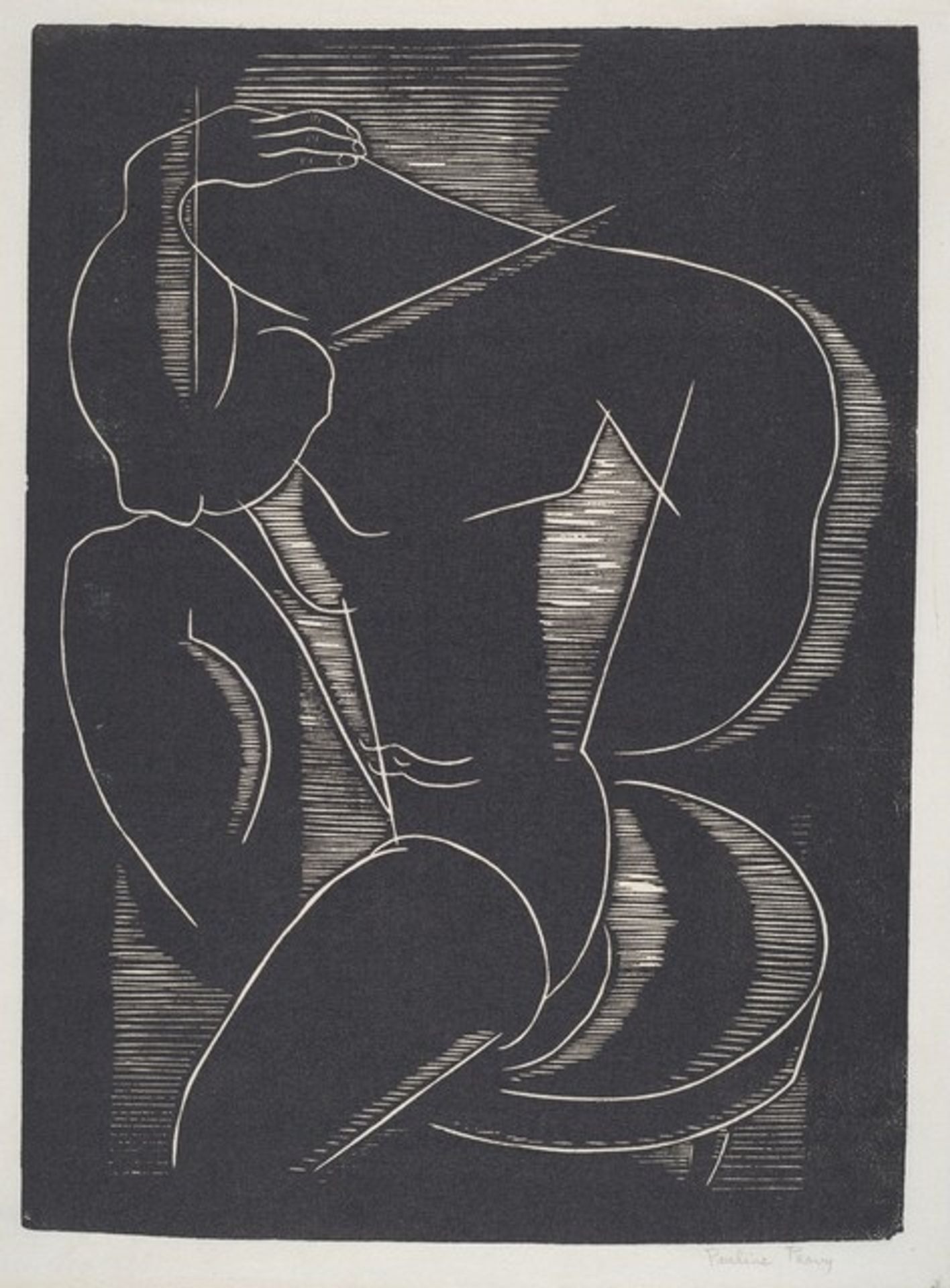
Pauline White Peavy made this woodcut print of a male nude sometime in the 20th century. The thing that grabs me is the use of line, it’s so simple and yet so descriptive. The contrast of black and white, of positive and negative space, creates a really dynamic tension. You can see how the artist uses these lines to define the form of the body, but also to create a sense of movement. There’s this really interesting rhythm happening where the lines curve, swell, and taper, almost like a dance. The lines create areas of shadow. The solid planes of darkness work to flatten the image and to give the nude figure a monumental quality. The surface, too, has a kind of handcrafted feel to it. You can almost feel the texture of the wood, the way the knife would have bitten into the surface. It reminds me a little bit of some of the German Expressionist woodcuts, like Kirchner or Heckel. But Peavy's work feels a bit more lyrical, a bit more playful, even. It's like she's inviting us to see the human form in a new and unexpected way.
Untitled (Male Nude) c. 1935


Artwork details
- Medium
- print, woodcut
- Dimensions
- Block: 402 x 294 mm Sheet: 495 x 372 mm
- Copyright
- National Gallery of Art: CC0 1.0
Tags
figuration
woodcut
line
nude
Comments
No comments
About this artwork
Pauline White Peavy made this woodcut print of a male nude sometime in the 20th century. The thing that grabs me is the use of line, it’s so simple and yet so descriptive. The contrast of black and white, of positive and negative space, creates a really dynamic tension. You can see how the artist uses these lines to define the form of the body, but also to create a sense of movement. There’s this really interesting rhythm happening where the lines curve, swell, and taper, almost like a dance. The lines create areas of shadow. The solid planes of darkness work to flatten the image and to give the nude figure a monumental quality. The surface, too, has a kind of handcrafted feel to it. You can almost feel the texture of the wood, the way the knife would have bitten into the surface. It reminds me a little bit of some of the German Expressionist woodcuts, like Kirchner or Heckel. But Peavy's work feels a bit more lyrical, a bit more playful, even. It's like she's inviting us to see the human form in a new and unexpected way.
Comments
No comments