About this artwork
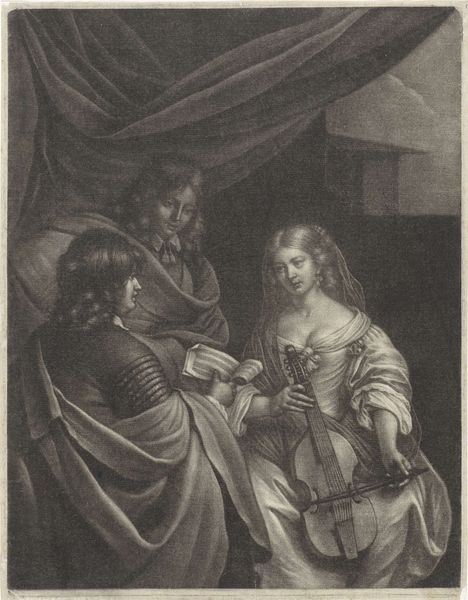
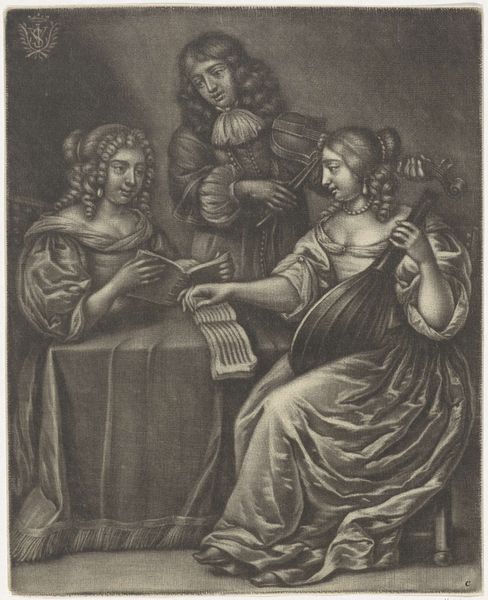
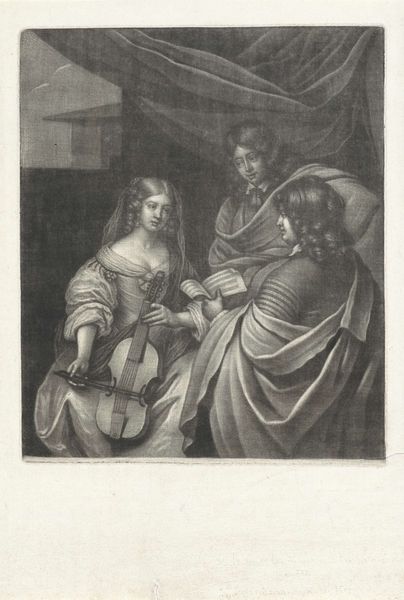
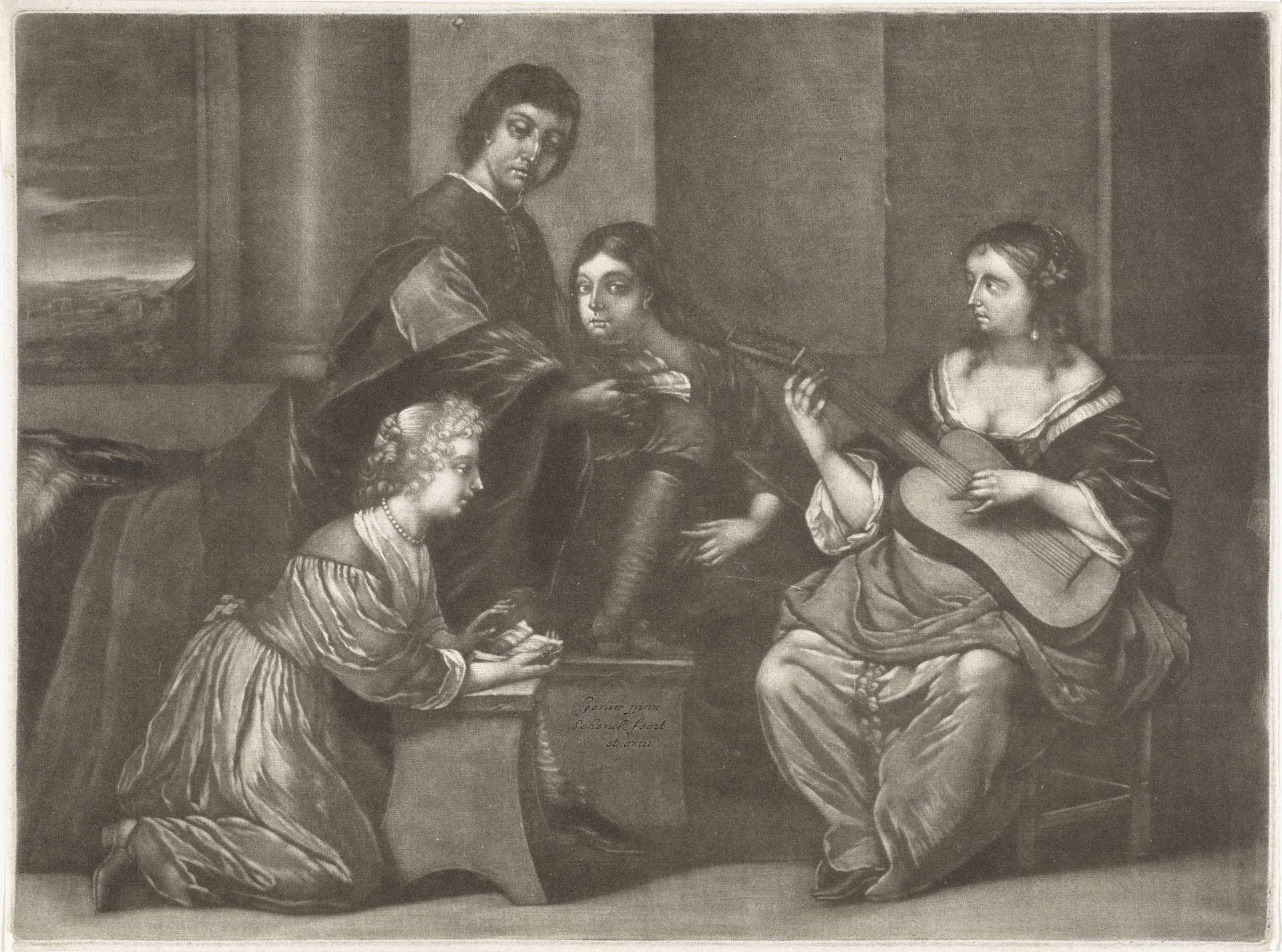
Editor: This engraving, "Musicerend gezelschap" or "Musical Company", created between 1670 and 1713 by Pieter Schenk, strikes me as very intimate, like a glimpse into a private moment. What do you see in this piece? Curator: This print gives us a window into the performance of social class during the late 17th and early 18th centuries. These figures are deliberately projecting an image of refinement and leisure, something accessible to the emerging bourgeois. How do the power dynamics within this "musical company" play out, visually? Editor: Well, the woman with the guitar seems to be at the center, literally playing, while the others seem to support or admire her. Is this purely a social tableau? Curator: Not exactly "purely" anything! Remember, gender roles were sharply defined. Music, particularly domestic music-making, was seen as a virtue for women, proof of their education and accomplishments, but simultaneously, it confined them to the domestic sphere. This image then, could also be critiquing such rigid definitions. The almost staged arrangement feels ripe for subversion. Do you see that here, or is this me projecting? Editor: I think I see it too. There is a performative quality that suggests there's more beneath the surface. Thanks for that perspective. Curator: And thank you! It is a reminder to interrogate what appear to be straightforward narratives, particularly about women's roles. It is up to us to amplify those voices, muted as they might seem.

Artwork details
- Medium
- engraving
- Dimensions
- height 248 mm, width 335 mm
- Location
- Rijksmuseum
- Copyright
- Rijks Museum: Open Domain
Tags
portrait
baroque
group-portraits
genre-painting
engraving
Comments
Be the first to share your thoughts about this work.
About this artwork
Editor: This engraving, "Musicerend gezelschap" or "Musical Company", created between 1670 and 1713 by Pieter Schenk, strikes me as very intimate, like a glimpse into a private moment. What do you see in this piece? Curator: This print gives us a window into the performance of social class during the late 17th and early 18th centuries. These figures are deliberately projecting an image of refinement and leisure, something accessible to the emerging bourgeois. How do the power dynamics within this "musical company" play out, visually? Editor: Well, the woman with the guitar seems to be at the center, literally playing, while the others seem to support or admire her. Is this purely a social tableau? Curator: Not exactly "purely" anything! Remember, gender roles were sharply defined. Music, particularly domestic music-making, was seen as a virtue for women, proof of their education and accomplishments, but simultaneously, it confined them to the domestic sphere. This image then, could also be critiquing such rigid definitions. The almost staged arrangement feels ripe for subversion. Do you see that here, or is this me projecting? Editor: I think I see it too. There is a performative quality that suggests there's more beneath the surface. Thanks for that perspective. Curator: And thank you! It is a reminder to interrogate what appear to be straightforward narratives, particularly about women's roles. It is up to us to amplify those voices, muted as they might seem.
Comments
Be the first to share your thoughts about this work.