About this artwork
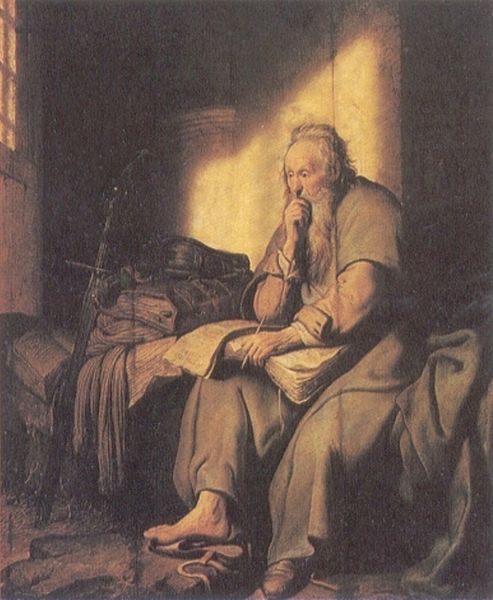
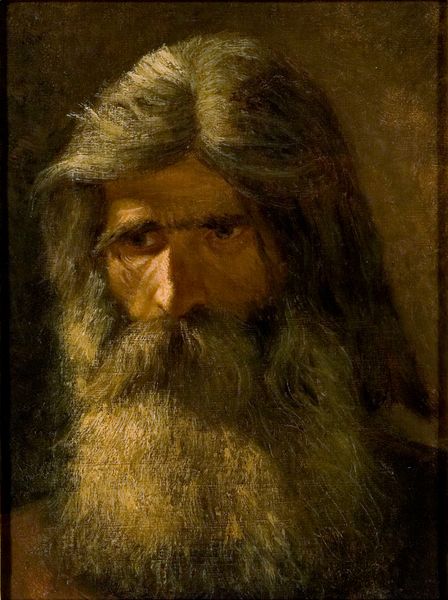
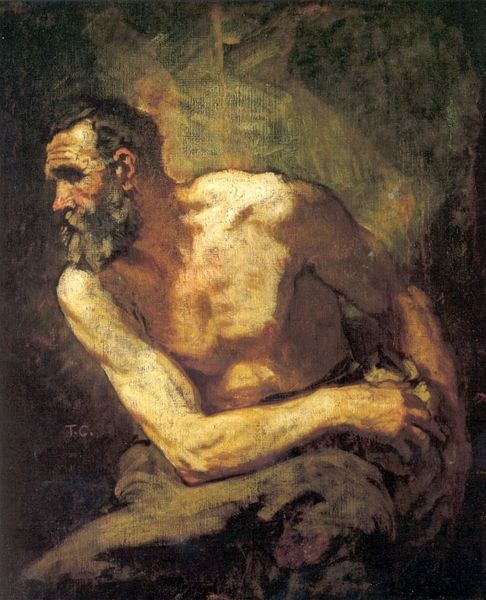
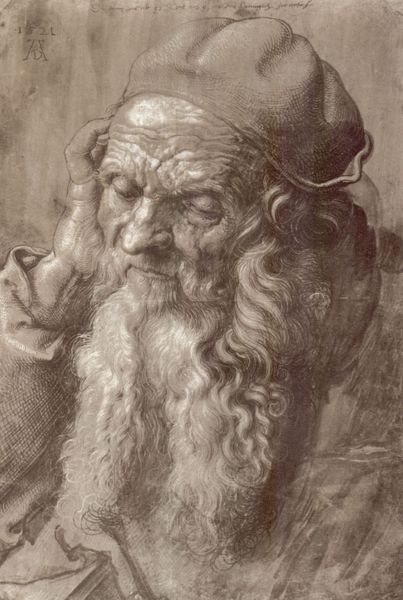
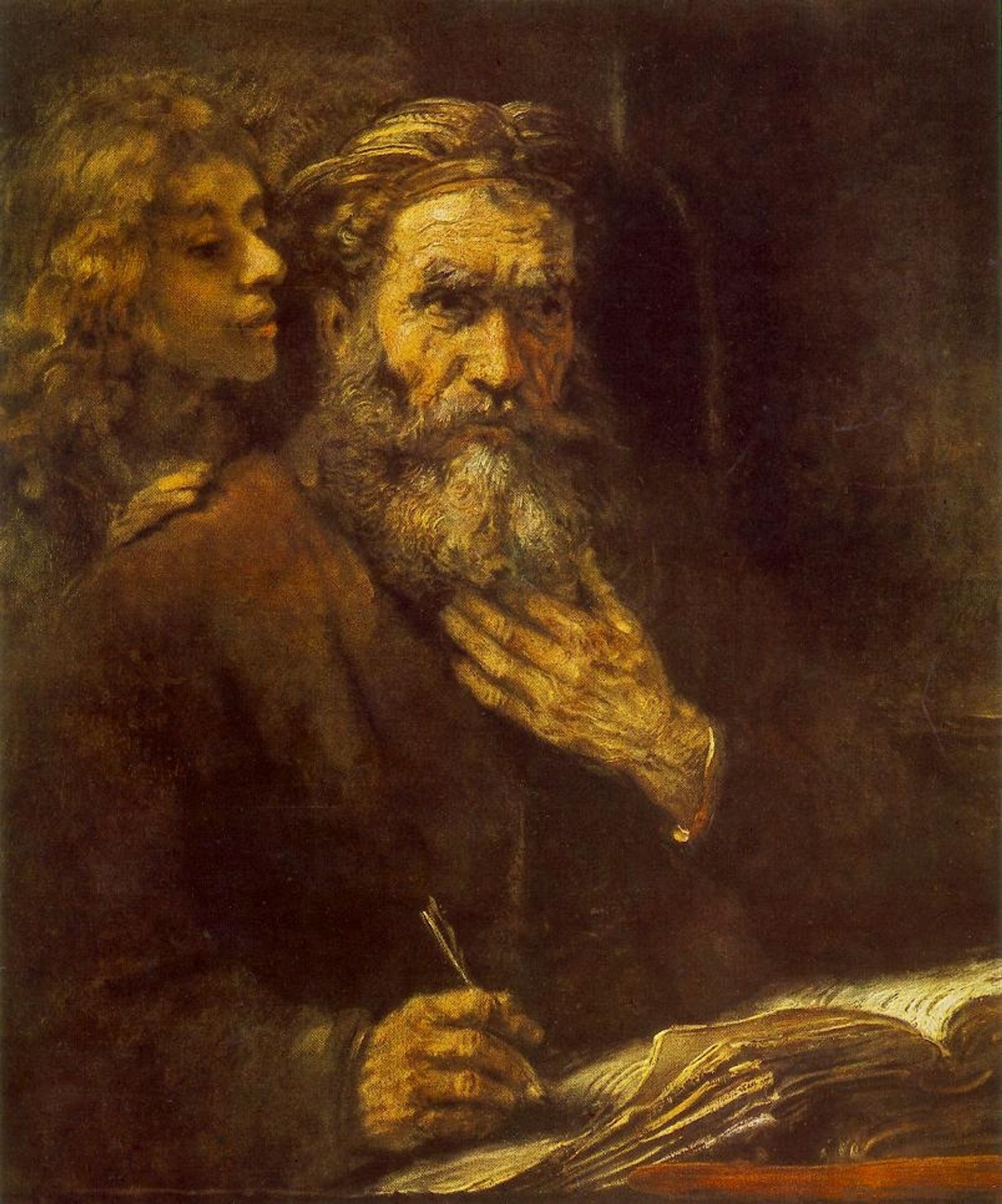
Rembrandt van Rijn created this oil on canvas painting, St. Matthew and The Angel, whose date is unknown, and which hangs today in the Louvre in Paris. The artwork's power lies in its contrasting use of light and shadow, a technique known as chiaroscuro. Notice how the face of St. Matthew emerges from the darkness, illuminated to highlight his furrowed brow and contemplative expression. The angel, subtly positioned behind him, offers a soft contrast. Rembrandt masterfully uses the materiality of paint to convey texture and depth. Thick impasto in the beard and hands of Matthew creates a tactile quality, drawing our attention to the human aspect of divine inspiration. The open book and quill serve as semiotic markers, indicating the act of writing and the transmission of knowledge. But, is Matthew writing or listening? The angel’s barely visible touch destabilizes our sense of perception. Is he a vision? Ultimately, the genius of this piece lies not only in its aesthetic qualities but in its invitation to question the nature of inspiration, of perception, and the very act of artistic creation.


Artwork details
- Medium
- painting, oil-paint
- Dimensions
- 52 x 66 cm
- Location
- Louvre, Paris, France
- Copyright
- Public domain
Tags
portrait
baroque
painting
oil-paint
oil painting
history-painting
angel
Comments
No comments
About this artwork
Rembrandt van Rijn created this oil on canvas painting, St. Matthew and The Angel, whose date is unknown, and which hangs today in the Louvre in Paris. The artwork's power lies in its contrasting use of light and shadow, a technique known as chiaroscuro. Notice how the face of St. Matthew emerges from the darkness, illuminated to highlight his furrowed brow and contemplative expression. The angel, subtly positioned behind him, offers a soft contrast. Rembrandt masterfully uses the materiality of paint to convey texture and depth. Thick impasto in the beard and hands of Matthew creates a tactile quality, drawing our attention to the human aspect of divine inspiration. The open book and quill serve as semiotic markers, indicating the act of writing and the transmission of knowledge. But, is Matthew writing or listening? The angel’s barely visible touch destabilizes our sense of perception. Is he a vision? Ultimately, the genius of this piece lies not only in its aesthetic qualities but in its invitation to question the nature of inspiration, of perception, and the very act of artistic creation.
Comments
No comments