About this artwork
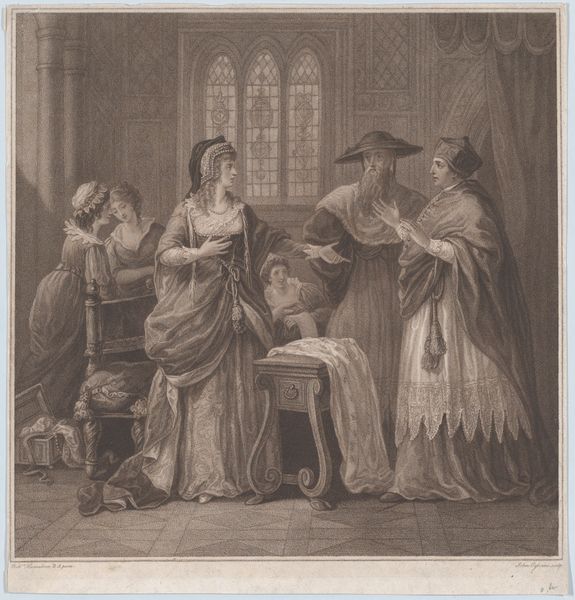
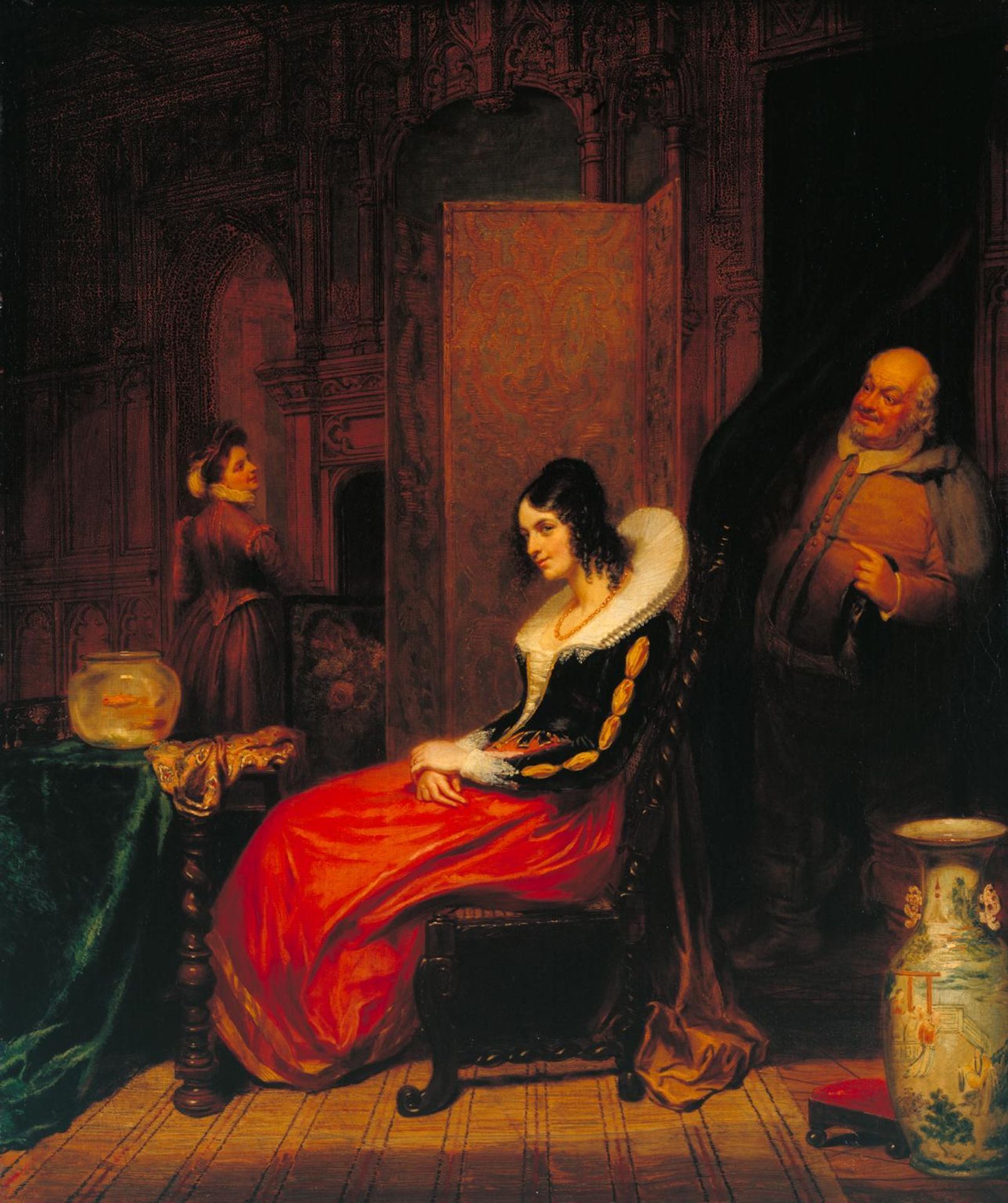
Curator: This is George Clint’s "Falstaff’s Assignation with Mrs Ford," currently residing at the Tate Collections. It captures a scene rife with tension and anticipation. Editor: My first impression is one of unease, a sense of something not quite right. Mrs. Ford seems burdened, not joyous, despite the suggestive title. Curator: The work draws upon Shakespeare's "The Merry Wives of Windsor", a comedy that, within its social context, played with anxieties around class and reputation. Clint’s illustration, in this light, feels almost subversive. Editor: Note the goldfish bowl, a symbol of entrapment and fleeting beauty. The gaze of Mrs Ford seems very much locked to the goldfish within. Curator: Absolutely, and we can also examine the placement of the screen, the concealed Falstaff, the power dynamics at play within the burgeoning middle class, eager to mimic aristocratic pastimes and manners. Editor: It's as if Clint captured a moment where societal expectations and personal desires collide, leaving a residue of discomfort. Curator: Indeed, it prompts consideration of how artistic renderings influence our understanding of literature and social decorum. Editor: A fascinating intersection of text and image, revealing hidden depths in a seemingly lighthearted tale.
Falstaff’s Assignation with Mrs Ford Possibly 1830 - 1831

Artwork details
- Dimensions
- support: 768 x 641 mm frame: 1000 x 877 x 147 mm
- Location
- Tate Collections
- Copyright
- CC-BY-NC-ND 4.0 DEED, Photo: Tate
Comments

http://www.tate.org.uk/art/artworks/clint-falstaffs-assignation-with-mrs-ford-n00377
This illustrates a scene from Shakespeare's comedy 'The Merry Wives of Windsor'. The fat knight Sir John Falstaff has fallen on hard times. So he sets out to woo Mistress Ford and Mistress Page, both of whom hold the purse strings in their households. He writes identical love letters to both women. Aware of Falstaff's intentions, the wives aim to tease him and then show him up as a fool. Clint shows Falstaff making his first approach to Mistress Ford whose co-conspirator, Mistress Page, exits to the left. Her announcement of Master Ford's imminent return is the signal for Falstaff to be hidden in a laundry basket and dumped in the Thames. Gallery label, March 1993
About this artwork
Curator: This is George Clint’s "Falstaff’s Assignation with Mrs Ford," currently residing at the Tate Collections. It captures a scene rife with tension and anticipation. Editor: My first impression is one of unease, a sense of something not quite right. Mrs. Ford seems burdened, not joyous, despite the suggestive title. Curator: The work draws upon Shakespeare's "The Merry Wives of Windsor", a comedy that, within its social context, played with anxieties around class and reputation. Clint’s illustration, in this light, feels almost subversive. Editor: Note the goldfish bowl, a symbol of entrapment and fleeting beauty. The gaze of Mrs Ford seems very much locked to the goldfish within. Curator: Absolutely, and we can also examine the placement of the screen, the concealed Falstaff, the power dynamics at play within the burgeoning middle class, eager to mimic aristocratic pastimes and manners. Editor: It's as if Clint captured a moment where societal expectations and personal desires collide, leaving a residue of discomfort. Curator: Indeed, it prompts consideration of how artistic renderings influence our understanding of literature and social decorum. Editor: A fascinating intersection of text and image, revealing hidden depths in a seemingly lighthearted tale.
Comments
http://www.tate.org.uk/art/artworks/clint-falstaffs-assignation-with-mrs-ford-n00377
This illustrates a scene from Shakespeare's comedy 'The Merry Wives of Windsor'. The fat knight Sir John Falstaff has fallen on hard times. So he sets out to woo Mistress Ford and Mistress Page, both of whom hold the purse strings in their households. He writes identical love letters to both women. Aware of Falstaff's intentions, the wives aim to tease him and then show him up as a fool. Clint shows Falstaff making his first approach to Mistress Ford whose co-conspirator, Mistress Page, exits to the left. Her announcement of Master Ford's imminent return is the signal for Falstaff to be hidden in a laundry basket and dumped in the Thames. Gallery label, March 1993