drawing, paper, pencil
#
drawing
#
paper
#
form
#
pencil
#
line
#
watercolor
Copyright: Public Domain: Artvee
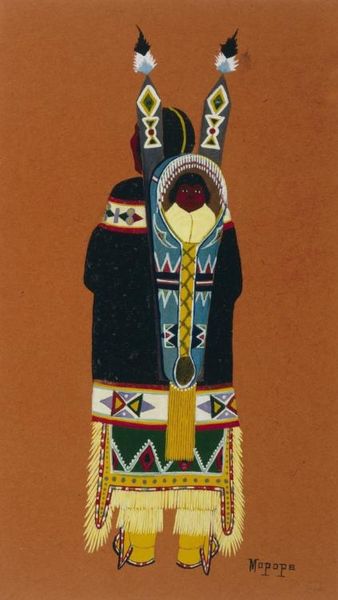
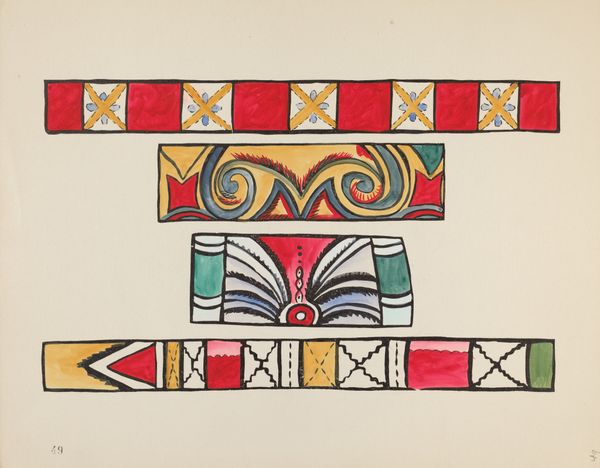
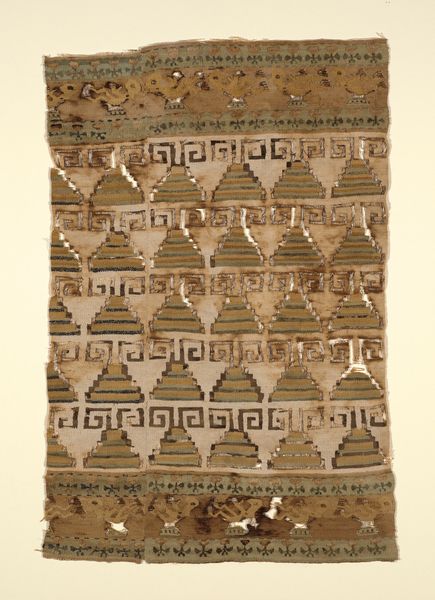
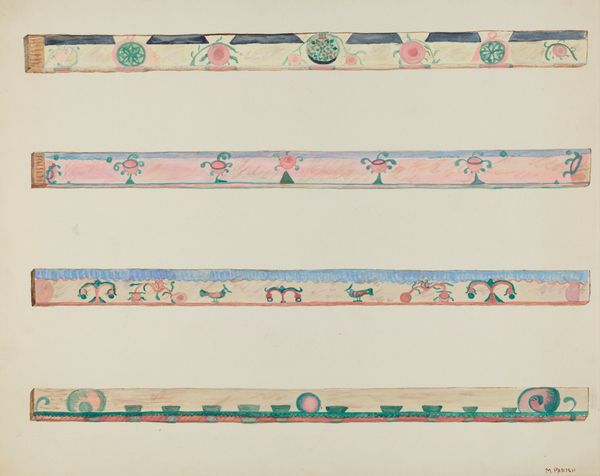
Curator: Looking at this, the watercolor medium immediately catches my eye. It suggests delicacy, a study rather than the monumentality usually associated with totem poles. Editor: I see an elegance of line and stark contrasts that immediately bring to mind a vibrant culture grappling with modern representation, as though it’s an archive of lost techniques. Curator: Indeed. This is Winold Reiss’s "Design for totem pole," created around 1910. It is watercolor and drawing on paper, indicative of Reiss's fascination with North American indigenous art and design, here captured in this preparatory medium. Editor: Watercolor. So, a choice reflecting the artist’s context as a cultural observer; I wonder if they considered the implications of removing totem pole design from wood to paper and watercolour, given totem poles represent social status. Curator: Consider the graphic boldness Reiss retains, though! Look at how he employs simple washes to define the forms, abstracting and stylizing the totemic figures. It's more than simple depiction; there is a semiotic approach at play to convey the essence of monumentality. Editor: It is an interpretation using water-based methods to reflect, not replicate, an entire symbolic and production context—labor involved in wood procurement to final pole raising. It’s Reiss filtering Indigenous art through a distinctly modern, European artistic lens. It feels both a nod and a stark departure. Curator: Agreed. Yet, Reiss masterfully captures essential principles in his approach; formal strategies and arrangements are evident as his unique engagement. Editor: Yes, it acknowledges both the labor of production of monumental objects and the symbolism that would imbue indigenous communities of the early twentieth century. We see Reiss highlighting production’s crucial importance. Curator: This, as we see it, demonstrates the cross-cultural interplay occurring at the turn of the century—the negotiation of traditional form and representation with modern sensibility and stylistic reinterpretation. Editor: The intersection lies within seeing how each tool of construction - in Indigenous society through hand tools applied by trained hands to harvesting resources and its modern depiction - is not mutually exclusive. A new means can elevate rather than denigrate old practices by observing context for production and its result.
Comments
No comments
Be the first to comment and join the conversation on the ultimate creative platform.
 Collect
 React
React Comment
More like this