About this artwork
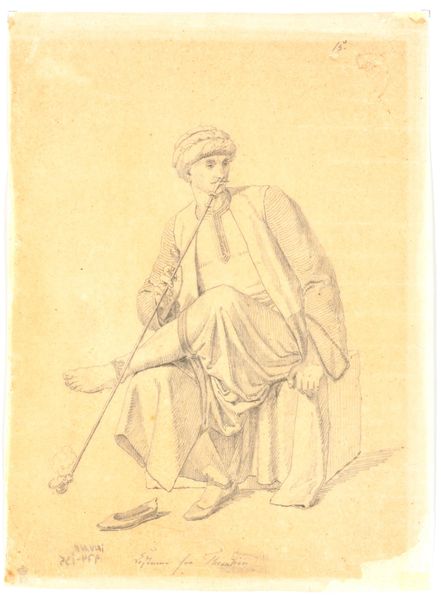
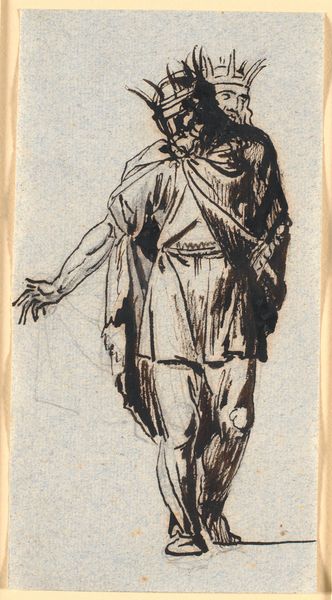
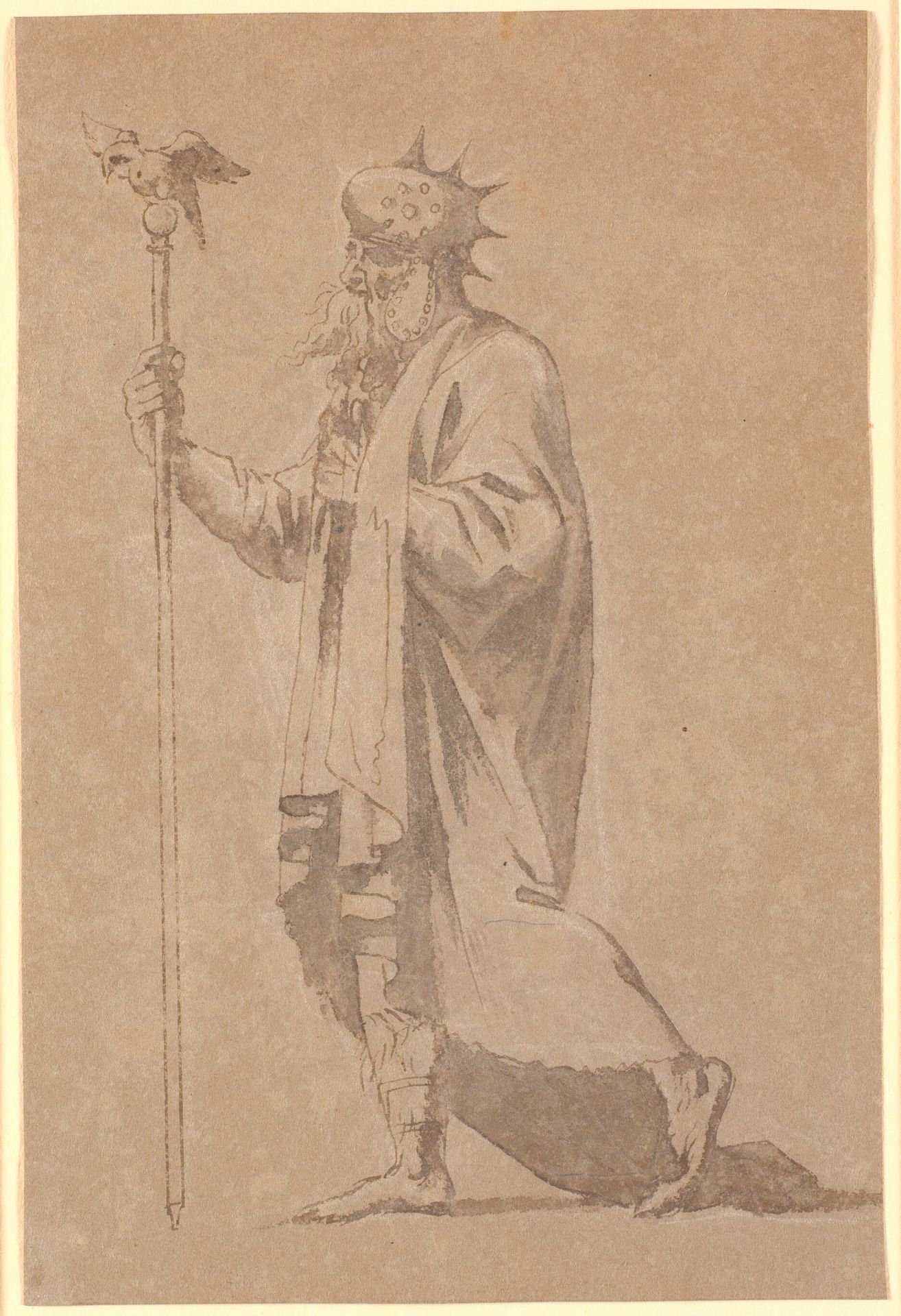
Nicolai Abildgaard made this drawing, ‘Draft for a man's costume. He carries a long staff with a bird on top,’ using pencil on paper. Made in Denmark, at the end of the 18th century, the sketch depicts a man in profile, his costume evoking a distant and somewhat fantastical past. The figure's clothing and staff topped with a bird are visual codes that reference Norse mythology and Viking culture. This interest in Nordic heritage emerged during the period of Romantic Nationalism. Artists like Abildgaard contributed to a growing sense of national identity, using imagery that resonated with ideas of cultural and ethnic origins. To understand Abildgaard’s choice of subject, scholars might study the artist’s personal letters, the exhibition records of the Royal Danish Academy of Fine Arts, and the literature that was popular in Denmark at the time. This helps us interpret the artwork, recognizing that its meaning is contingent on cultural and institutional contexts.
Udkast til en mandsdragt. Han bærer en lang stav med en fugl på toppen
1743 - 1809


Artwork details
- Dimensions
- 248 mm (height) x 164 mm (width) (bladmaal)
- Location
- SMK - Statens Museum for Kunst
Comments
Share your thoughts
About this artwork
Nicolai Abildgaard made this drawing, ‘Draft for a man's costume. He carries a long staff with a bird on top,’ using pencil on paper. Made in Denmark, at the end of the 18th century, the sketch depicts a man in profile, his costume evoking a distant and somewhat fantastical past. The figure's clothing and staff topped with a bird are visual codes that reference Norse mythology and Viking culture. This interest in Nordic heritage emerged during the period of Romantic Nationalism. Artists like Abildgaard contributed to a growing sense of national identity, using imagery that resonated with ideas of cultural and ethnic origins. To understand Abildgaard’s choice of subject, scholars might study the artist’s personal letters, the exhibition records of the Royal Danish Academy of Fine Arts, and the literature that was popular in Denmark at the time. This helps us interpret the artwork, recognizing that its meaning is contingent on cultural and institutional contexts.
Comments
Share your thoughts